Nonprofit warns hundreds of Alaska schools face aging, hazardous conditions; urges base facilities allocation
March 09, 2026 | 2026 Legislature Alaska, Alaska
This article was created by AI summarizing key points discussed. AI makes mistakes, so for full details and context, please refer to the video of the full meeting. Please report any errors so we can fix them. Report an error »
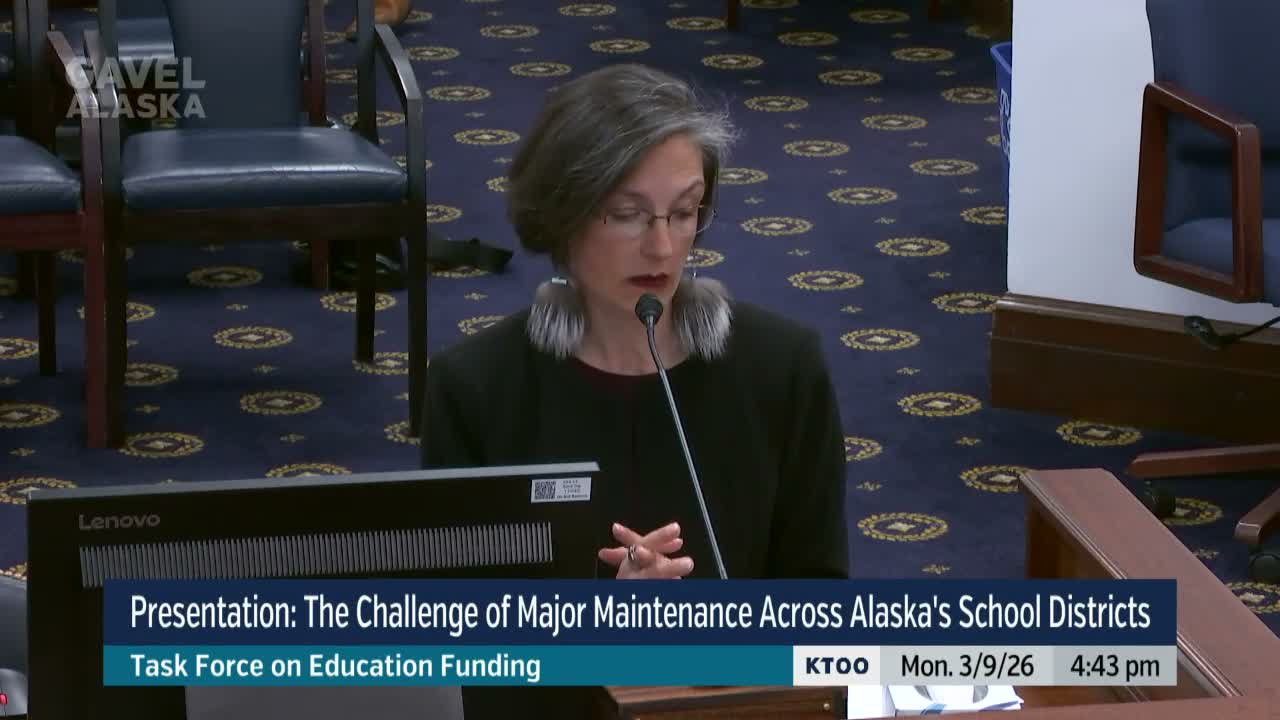
Caroline Storm, executive director of the Coalition for Education Equity, told the joint legislative task force on March 9 that Alaska’s school facilities are aging and under-resourced, with particular difficulties in remote districts where construction costs and logistical challenges inflate project budgets.
Storm said the state has about 493 schools with an average age of 45 years and argued that systems such as HVAC and boilers have useful lives closer to 20–25 years; she added that ‘‘we now have well over a 100 schools that are in the same condition as Mount Edgecumbe,’’ a comparison she said reflects widespread deferred maintenance and code noncompliance. Storm warned that poor indoor environmental quality aggravates asthma and increases absenteeism, undermining student learning.
Storm described condition surveys and comprehensive assessments as costly for districts — citing typical consultant estimates of $200,000–$300,000 — and said DEED staffing gaps (vacant preventive-maintenance and project-support positions) leave districts with limited help in preparing applications. She recommended creating a dedicated base facilities allocation to separate facilities funding from general education funds, contracting one firm under a cost-plus model to perform condition assessments for all districts to reduce duplication, and incentivizing shared-service maintenance hubs in rural regions.
On construction costs, Storm noted a model-school estimate of about $600 per square foot that can rise 40–60% in remote locations and cited a personal example of a project that cost roughly $1,000 per square foot. She also recommended standardizing some equipment across districts to reduce spare-parts complexity and maintenance burdens.
Committee members asked technical follow-ups on life span (Storm: building shell ~100 years; major systems 20–25 years) and whether equipment standardization would reduce costs; Storm supported district standards with DEED oversight and regional shared-service approaches. The task force requested follow-up and indicated it will continue discussions at the next scheduled meeting.
Storm said the state has about 493 schools with an average age of 45 years and argued that systems such as HVAC and boilers have useful lives closer to 20–25 years; she added that ‘‘we now have well over a 100 schools that are in the same condition as Mount Edgecumbe,’’ a comparison she said reflects widespread deferred maintenance and code noncompliance. Storm warned that poor indoor environmental quality aggravates asthma and increases absenteeism, undermining student learning.
Storm described condition surveys and comprehensive assessments as costly for districts — citing typical consultant estimates of $200,000–$300,000 — and said DEED staffing gaps (vacant preventive-maintenance and project-support positions) leave districts with limited help in preparing applications. She recommended creating a dedicated base facilities allocation to separate facilities funding from general education funds, contracting one firm under a cost-plus model to perform condition assessments for all districts to reduce duplication, and incentivizing shared-service maintenance hubs in rural regions.
On construction costs, Storm noted a model-school estimate of about $600 per square foot that can rise 40–60% in remote locations and cited a personal example of a project that cost roughly $1,000 per square foot. She also recommended standardizing some equipment across districts to reduce spare-parts complexity and maintenance burdens.
Committee members asked technical follow-ups on life span (Storm: building shell ~100 years; major systems 20–25 years) and whether equipment standardization would reduce costs; Storm supported district standards with DEED oversight and regional shared-service approaches. The task force requested follow-up and indicated it will continue discussions at the next scheduled meeting.
Don't Miss a Word: See the Full Meeting!
Go beyond summaries. Unlock every video, transcript, and key insight with a Founder Membership.
✓
Get instant access to full meeting videos
✓
Search and clip any phrase from complete transcripts
✓
Receive AI-powered summaries & custom alerts
✓
Enjoy lifetime, unrestricted access to government data
30-day money-back guarantee
