Anacortes planners review Shoreline Master Program and prepare to restart 2019 periodic update
March 11, 2026 | Anacortes, Skagit County, Washington
This article was created by AI summarizing key points discussed. AI makes mistakes, so for full details and context, please refer to the video of the full meeting. Please report any errors so we can fix them. Report an error »
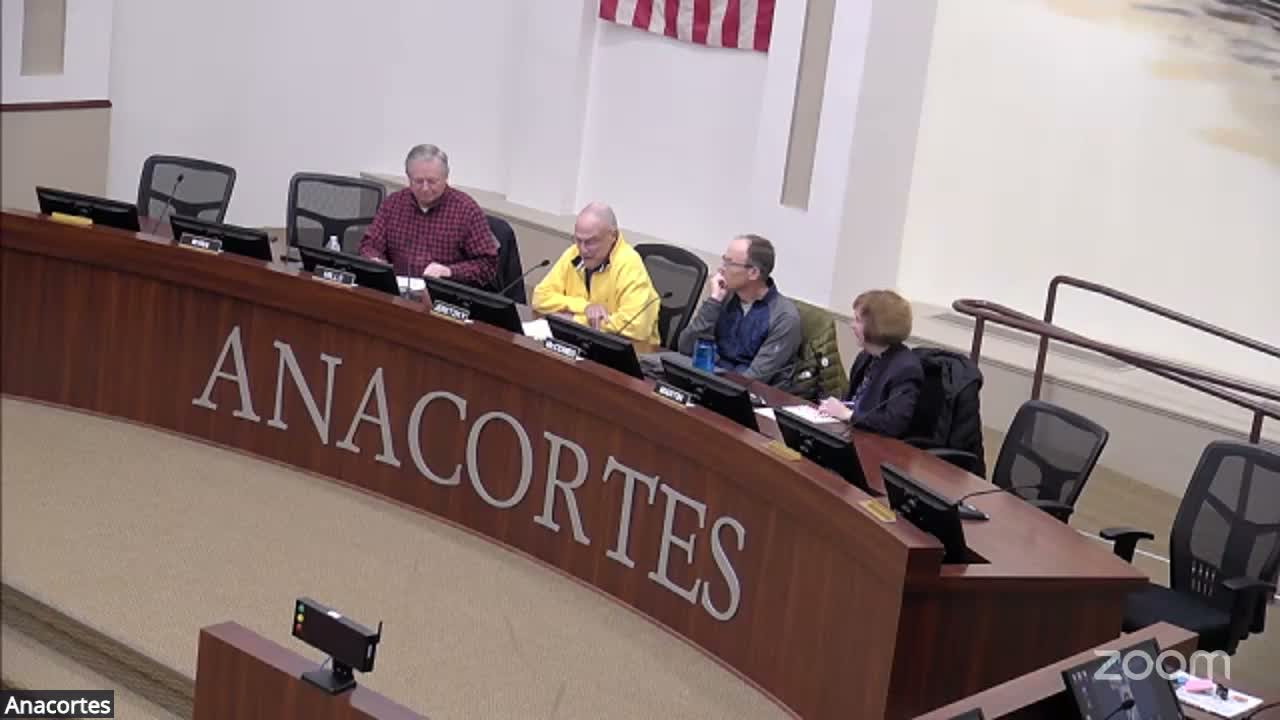
City planning staff presented a detailed refresher on the Anacortes Shoreline Master Program (SMP) and told the Planning Commission on March 10 that the city plans to reinitiate a periodic update that began in 2019.
The presentation, led by a planning staff member, traced the SMP's legal basis to the state Shoreline Management Act and to Department of Ecology guidance, reviewed the SMP's chapters and environment designations, and walked commissioners through how shoreline permits and administrative exemptions are processed.
The planner said, "The SMP is both a planning and a regulatory document," and explained shoreline jurisdiction covers marine waters, lakes larger than 20 acres and upland areas extending roughly 200 feet from the ordinary high-water mark. The presentation outlined three shoreline review paths under the SMP: shoreline substantial development permits, conditional-use permits and variances; it also described letters of exemption that are used for some projects, including most single-family residences.
Commissioners pressed staff for practical details. One commissioner asked whether a single-family residence in shoreline jurisdiction needs a shoreline permit; staff replied that such projects typically require a letter of exemption plus the usual building permit and that the exemption is requested through the city's administrative application process. "It's just an application form that gets submitted to the city," the planner said.
The staff presentation reviewed environment designations used in Anacortes (conservancy, natural, shoreline residential, urban maritime), and explained how those designations feed into permitted-use tables, required setbacks and standards. Using a Skyline neighborhood example, staff noted the shoreline residential setback in that area is 25 feet and described impervious-surface limits (about 20%–30% depending on slope) and vegetation-retention or planting requirements.
The planner summarized the 2019 periodic-update work: inventories, characterization studies, public open houses and a draft sent to Ecology for a consistency determination. The commission had previously recommended approval, and the city council asked that planning-commission recommendations be integrated and the draft go back out for public review in 2022. Staff said appeals to the city's critical-areas regulations delayed adoption; those appeals were resolved in 2023 and staff now want to reinitiate the periodic SMP update and evaluate the best path forward.
John Coleman, the city's director of planning, community and economic development, told commissioners staff aims to complete the SMP update this year after the comprehensive plan periodic-review work is finished. Coleman said staff will evaluate whether to use the 2010 adopted SMP or the 2019 draft as the baseline and will ensure consistency with updated state guidance and the comprehensive plan.
Commissioners also discussed document organization: staff said one option under consideration is to migrate shoreline regulations into the city's development regulations and to carry shoreline policies into the comprehensive plan rather than maintaining a standalone SMP document.
Next steps: staff will return with details about scope, schedule and the preferred baseline document, and may call additional meetings to advance the periodic update. No public testimony was offered at this meeting.
The presentation, led by a planning staff member, traced the SMP's legal basis to the state Shoreline Management Act and to Department of Ecology guidance, reviewed the SMP's chapters and environment designations, and walked commissioners through how shoreline permits and administrative exemptions are processed.
The planner said, "The SMP is both a planning and a regulatory document," and explained shoreline jurisdiction covers marine waters, lakes larger than 20 acres and upland areas extending roughly 200 feet from the ordinary high-water mark. The presentation outlined three shoreline review paths under the SMP: shoreline substantial development permits, conditional-use permits and variances; it also described letters of exemption that are used for some projects, including most single-family residences.
Commissioners pressed staff for practical details. One commissioner asked whether a single-family residence in shoreline jurisdiction needs a shoreline permit; staff replied that such projects typically require a letter of exemption plus the usual building permit and that the exemption is requested through the city's administrative application process. "It's just an application form that gets submitted to the city," the planner said.
The staff presentation reviewed environment designations used in Anacortes (conservancy, natural, shoreline residential, urban maritime), and explained how those designations feed into permitted-use tables, required setbacks and standards. Using a Skyline neighborhood example, staff noted the shoreline residential setback in that area is 25 feet and described impervious-surface limits (about 20%–30% depending on slope) and vegetation-retention or planting requirements.
The planner summarized the 2019 periodic-update work: inventories, characterization studies, public open houses and a draft sent to Ecology for a consistency determination. The commission had previously recommended approval, and the city council asked that planning-commission recommendations be integrated and the draft go back out for public review in 2022. Staff said appeals to the city's critical-areas regulations delayed adoption; those appeals were resolved in 2023 and staff now want to reinitiate the periodic SMP update and evaluate the best path forward.
John Coleman, the city's director of planning, community and economic development, told commissioners staff aims to complete the SMP update this year after the comprehensive plan periodic-review work is finished. Coleman said staff will evaluate whether to use the 2010 adopted SMP or the 2019 draft as the baseline and will ensure consistency with updated state guidance and the comprehensive plan.
Commissioners also discussed document organization: staff said one option under consideration is to migrate shoreline regulations into the city's development regulations and to carry shoreline policies into the comprehensive plan rather than maintaining a standalone SMP document.
Next steps: staff will return with details about scope, schedule and the preferred baseline document, and may call additional meetings to advance the periodic update. No public testimony was offered at this meeting.
View the Full Meeting & All Its Details
This article offers just a summary. Unlock complete video, transcripts, and insights as a Founder Member.
✓
Watch full, unedited meeting videos
✓
Search every word spoken in unlimited transcripts
✓
AI summaries & real-time alerts (all government levels)
✓
Permanent access to expanding government content
30-day money-back guarantee
