Senators hear plan to return shared-services work and decentralize payroll to state agencies
March 09, 2026 | 2026 Legislature Alaska, Alaska
This article was created by AI summarizing key points discussed. AI makes mistakes, so for full details and context, please refer to the video of the full meeting. Please report any errors so we can fix them. Report an error »
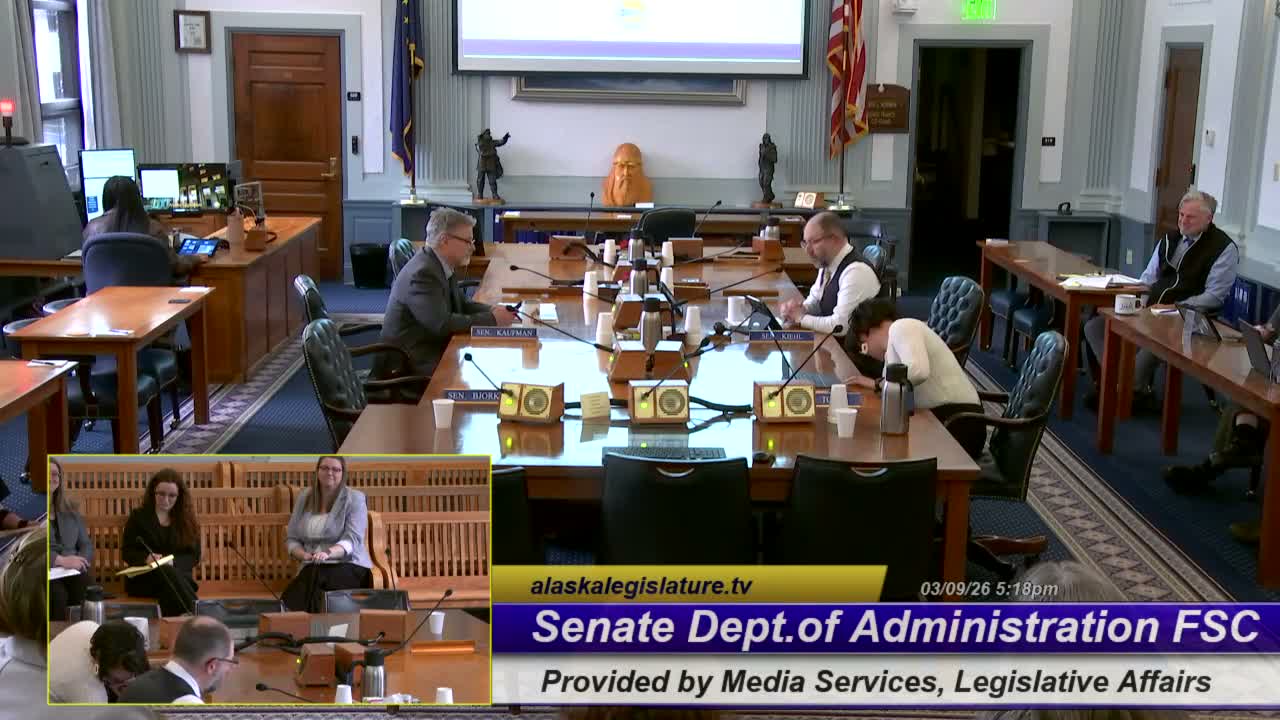
The Senate Finance subcommittee on March 9 heard Department of Administration officials outline a plan to return Shared Services of Alaska (SSOA) accounts-payable and travel processing to state agencies and to decentralize payroll functions to selected departments.
"Since 2023 our payroll teams have resolved 2,349 notices of payroll problems," Commissioner Paula Verana told the panel, citing automation gains and a lower vacancy rate. She said the vacancy rate has fallen "to 38%" from a previous 50% and credited automation that produced "more than 7,500 automated time sheets." Verana framed the change as allowing the Department of Administration to focus on statewide consistency, oversight, training and policy support while agencies perform transaction entry.
Director of Administrative Services Stephanie Bingham said the change aims to shorten the largest, indeterminate portion of invoice processing time that occurs inside agencies before items are submitted to the SSOA portal. "The department processing times, before submitting to that SSOA payroll is the indeterminate portion of time," she said, emphasizing decentralization should put transaction entry closer to staff who maintain supporting documentation.
Bingham detailed counts and job classes: a total of 87 SSOA positions will transfer back (81 permanent full-time and 6 non-permanent), with the Division of Finance receiving 30, the Department of Transportation 15 and Fish and Game 7; 76 of the 87 are filled and 11 are vacant. On payroll, she said 40 permanent full-time payroll positions will return, with DOT receiving 17, Corrections 8 and Fish and Game 6; 27 are filled and 13 vacant. The FY2027 governor's budget reflects those job classifications, Bingham said.
Elizabeth Janoski, Acting Director of the Division of Finance, addressed quality-control questions about invoices returned to agencies. "Some of those return to departments that you're seeing on there are actually due to budgeting errors, like, they don't have enough money in their appropriations and their allocations," Janoski said, noting that those errors require departments to fix budgets or find alternative coding before payments proceed.
Senators repeatedly pressed officials on implementation risks: training, supervisory capacity, and whether staffing and skills at departments will be sufficient to handle complex notices of pay problems. Janoski said training will be significant and that an HR technician 2 takes about a year to reach full competency. "We're gonna be looking at trying to abbreviate this as much as possible and handing off as much as we possibly can through, providing them with training materials and manuals," she said, but declined to project how high pay-problem counts might spike during the transition.
Officials said agencies will conduct recruitments for returned positions rather than pooled hiring and that the Division of Finance will develop universal payroll training, documented procedures and materials to support knowledge transfer. Bingham identified July 1, 2026, as the effective date for payroll transfers in postings tied to the FY2027 budget.
Committee members asked for additional follow-up: historical comparisons to pre-centralization processing times, explicit hour/day targets for department-side processing, a vacancy and job-class alignment list to avoid creating intense local recruitment competition, and a plan for training supervisors and ensuring backup coverage across decentralized teams. DOA officials agreed to supply more detailed information.
The subcommittee did not take votes on the plan; members left the hearing with follow-up requests and the expectation of written materials. The committee adjourned at about 6:17 p.m. and scheduled its next meeting for March 16 at 5:15 p.m.
"Since 2023 our payroll teams have resolved 2,349 notices of payroll problems," Commissioner Paula Verana told the panel, citing automation gains and a lower vacancy rate. She said the vacancy rate has fallen "to 38%" from a previous 50% and credited automation that produced "more than 7,500 automated time sheets." Verana framed the change as allowing the Department of Administration to focus on statewide consistency, oversight, training and policy support while agencies perform transaction entry.
Director of Administrative Services Stephanie Bingham said the change aims to shorten the largest, indeterminate portion of invoice processing time that occurs inside agencies before items are submitted to the SSOA portal. "The department processing times, before submitting to that SSOA payroll is the indeterminate portion of time," she said, emphasizing decentralization should put transaction entry closer to staff who maintain supporting documentation.
Bingham detailed counts and job classes: a total of 87 SSOA positions will transfer back (81 permanent full-time and 6 non-permanent), with the Division of Finance receiving 30, the Department of Transportation 15 and Fish and Game 7; 76 of the 87 are filled and 11 are vacant. On payroll, she said 40 permanent full-time payroll positions will return, with DOT receiving 17, Corrections 8 and Fish and Game 6; 27 are filled and 13 vacant. The FY2027 governor's budget reflects those job classifications, Bingham said.
Elizabeth Janoski, Acting Director of the Division of Finance, addressed quality-control questions about invoices returned to agencies. "Some of those return to departments that you're seeing on there are actually due to budgeting errors, like, they don't have enough money in their appropriations and their allocations," Janoski said, noting that those errors require departments to fix budgets or find alternative coding before payments proceed.
Senators repeatedly pressed officials on implementation risks: training, supervisory capacity, and whether staffing and skills at departments will be sufficient to handle complex notices of pay problems. Janoski said training will be significant and that an HR technician 2 takes about a year to reach full competency. "We're gonna be looking at trying to abbreviate this as much as possible and handing off as much as we possibly can through, providing them with training materials and manuals," she said, but declined to project how high pay-problem counts might spike during the transition.
Officials said agencies will conduct recruitments for returned positions rather than pooled hiring and that the Division of Finance will develop universal payroll training, documented procedures and materials to support knowledge transfer. Bingham identified July 1, 2026, as the effective date for payroll transfers in postings tied to the FY2027 budget.
Committee members asked for additional follow-up: historical comparisons to pre-centralization processing times, explicit hour/day targets for department-side processing, a vacancy and job-class alignment list to avoid creating intense local recruitment competition, and a plan for training supervisors and ensuring backup coverage across decentralized teams. DOA officials agreed to supply more detailed information.
The subcommittee did not take votes on the plan; members left the hearing with follow-up requests and the expectation of written materials. The committee adjourned at about 6:17 p.m. and scheduled its next meeting for March 16 at 5:15 p.m.
View the Full Meeting & All Its Details
This article offers just a summary. Unlock complete video, transcripts, and insights as a Founder Member.
✓
Watch full, unedited meeting videos
✓
Search every word spoken in unlimited transcripts
✓
AI summaries & real-time alerts (all government levels)
✓
Permanent access to expanding government content
30-day money-back guarantee
