Committee hears data and powerful testimony on bill to raise Alaska’s base student allocation
March 09, 2026 | 2026 Legislature Alaska, Alaska
This article was created by AI summarizing key points discussed. AI makes mistakes, so for full details and context, please refer to the video of the full meeting. Please report any errors so we can fix them. Report an error »
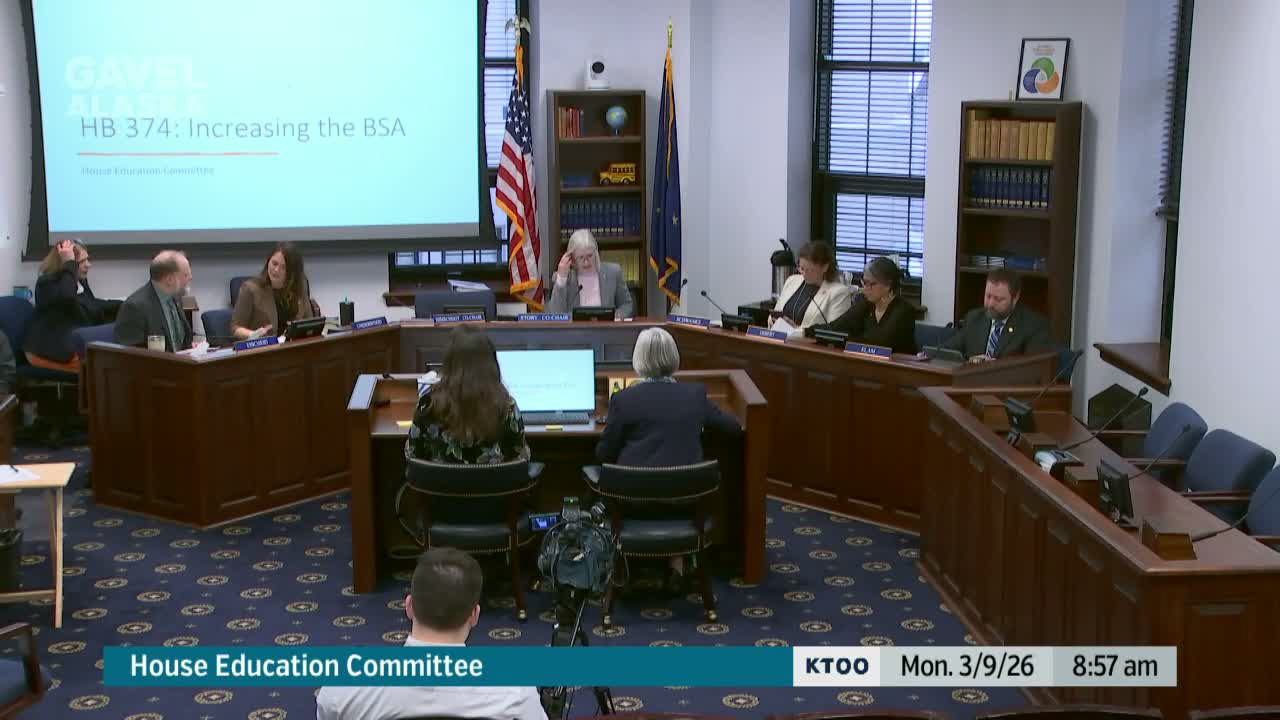
Co‑chair Rebecca Himshute presented House Bill 374 to the House Education Committee on March 9, describing a bill to raise the Base Student Allocation (BSA) to help districts meet rising fixed and operational costs.
Himshute reminded the committee that changing the BSA requires a statutory change and budget funding and summarized recent history: last year’s legislation included a $700 BSA increase but districts still face large gaps. She cited rising insurance and health‑benefit costs, energy spikes in places like Sitka and aging facilities, and preliminary district survey work sampling 10 districts to quantify inflationary impacts.
Himshute tied the BSA proposal to teacher recruitment and retention: Alaska’s teacher turnover (she cited roughly 28%) far exceeds national averages and contributes to staffing instability and replacement costs she said are approaching $30,000 per teacher. She argued that predictable, sustained increases to the BSA are one tool to stabilize staffing and programming.
Invited testimony underscored the fiscal strain. David Dodd, principal of Golden View Middle School in Anchorage and president of the Alaska Association of Secondary School Principals, presented results from an ACSA survey of districts: among 43 respondents, 32 reported projected FY27 deficits with total reported deficits in the range of roughly $142M–$147M; he cited Anchorage’s projected shortfall at about $90M. Dodd described program and staffing impacts: planned staff reductions, increased class sizes, loss of electives and collaboration time, and curtailed student opportunities.
Elizabeth Kwame, principal of Sterling Elementary (≈110 students) in the Kenai Peninsula Borough, described the risk of school closure without additional funding. Her school has lost 3.5 certificated staff in two years and she warned consolidation would enlarge receiving schools dramatically and reduce individualized supports for vulnerable students.
Committee members asked for more district‑level data, and Himshute said she and staff are collecting additional inflation and program‑cost information and will share it. Story set the next hearing for HB374 on Wednesday, March 11 at 5 p.m. to take public testimony and adjourned the session.
Himshute reminded the committee that changing the BSA requires a statutory change and budget funding and summarized recent history: last year’s legislation included a $700 BSA increase but districts still face large gaps. She cited rising insurance and health‑benefit costs, energy spikes in places like Sitka and aging facilities, and preliminary district survey work sampling 10 districts to quantify inflationary impacts.
Himshute tied the BSA proposal to teacher recruitment and retention: Alaska’s teacher turnover (she cited roughly 28%) far exceeds national averages and contributes to staffing instability and replacement costs she said are approaching $30,000 per teacher. She argued that predictable, sustained increases to the BSA are one tool to stabilize staffing and programming.
Invited testimony underscored the fiscal strain. David Dodd, principal of Golden View Middle School in Anchorage and president of the Alaska Association of Secondary School Principals, presented results from an ACSA survey of districts: among 43 respondents, 32 reported projected FY27 deficits with total reported deficits in the range of roughly $142M–$147M; he cited Anchorage’s projected shortfall at about $90M. Dodd described program and staffing impacts: planned staff reductions, increased class sizes, loss of electives and collaboration time, and curtailed student opportunities.
Elizabeth Kwame, principal of Sterling Elementary (≈110 students) in the Kenai Peninsula Borough, described the risk of school closure without additional funding. Her school has lost 3.5 certificated staff in two years and she warned consolidation would enlarge receiving schools dramatically and reduce individualized supports for vulnerable students.
Committee members asked for more district‑level data, and Himshute said she and staff are collecting additional inflation and program‑cost information and will share it. Story set the next hearing for HB374 on Wednesday, March 11 at 5 p.m. to take public testimony and adjourned the session.
View the Full Meeting & All Its Details
This article offers just a summary. Unlock complete video, transcripts, and insights as a Founder Member.
✓
Watch full, unedited meeting videos
✓
Search every word spoken in unlimited transcripts
✓
AI summaries & real-time alerts (all government levels)
✓
Permanent access to expanding government content
30-day money-back guarantee
