Committee advances bill to license respiratory care practitioners in Alaska
March 09, 2026 | 2026 Legislature Alaska, Alaska
This article was created by AI summarizing key points discussed. AI makes mistakes, so for full details and context, please refer to the video of the full meeting. Please report any errors so we can fix them. Report an error »
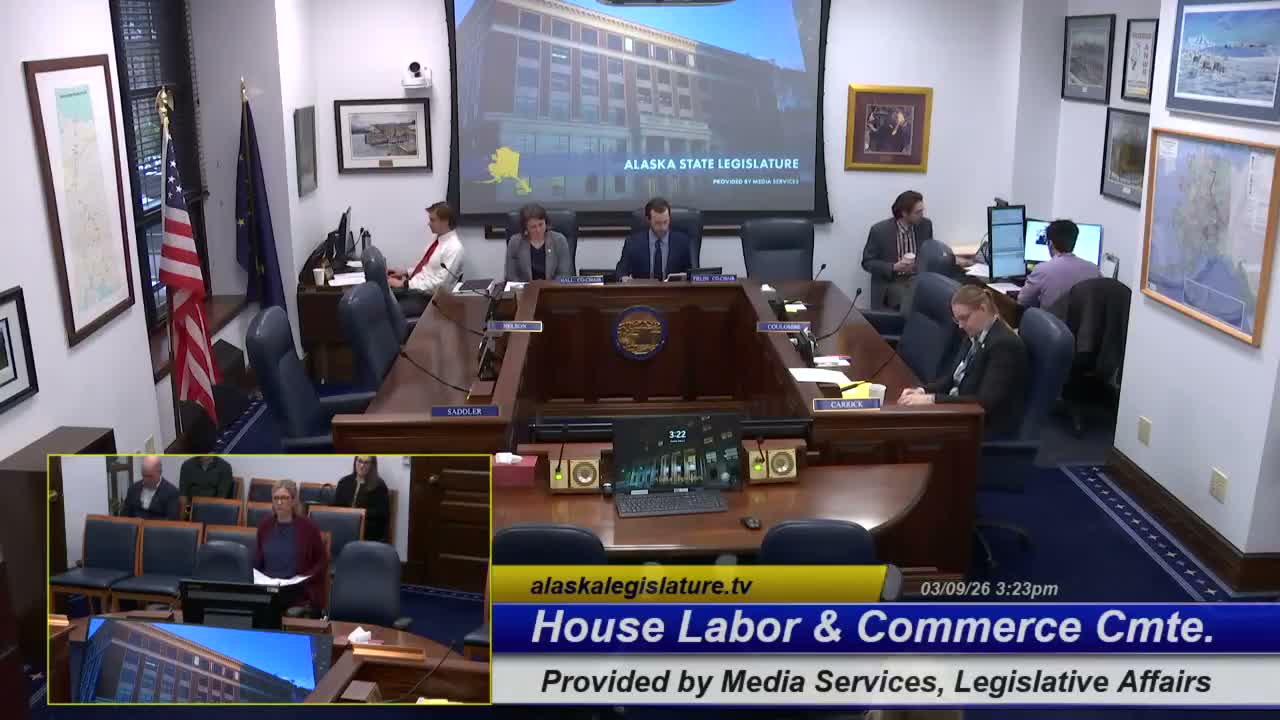
The House Labor and Commerce Committee on March 11 reported HB362, a bill to establish state licensure for respiratory care practitioners, after hearing testimony from respiratory therapists and professional associations who said licensure would improve patient safety and professional accountability.
Joan Wilkerson, committee aide for Co‑Chair Hall, summarized the measure as creating a licensure framework that would align Alaska with national standards, require biannual renewal and continuing education, and grandfather currently certified respiratory therapists. "Licensure for respiratory care practitioners in Alaska would be a crucial step towards protecting patients and ensuring professional accountability," Wilkerson said.
Several practicing respiratory therapists and association representatives urged passage. "Licensure is an important safeguard. It protects both the professionals providing complex cardiopulmonary care and, most importantly, the patients who rely on that care," said Lindsay Gilday, state delegate for the Alaska Society for Respiratory Care and a registered respiratory therapist at Central Peninsula Hospital. Holly Pulaski, the Society's treasurer and a practicing therapist, described bedside autonomy in emergency and intensive care settings and said "with that level of autonomy should also come clear accountability." Carl Hinkson, past president of the American Association for Respiratory Care, told the committee licensure prevents practitioners with problems elsewhere from migrating between states and facilities.
Committee members asked for details about the bill's fiscal impact. Sylvan Raab, director of the Division of Corporations, Business and Professional Licensing, said the fiscal note shows higher first‑year costs primarily because the division must complete a regulations project and pay for outreach and legal review; those up‑front costs (about $4,046,000 in the fiscal note) fall to receipt‑supported services and would be offset in later years by licensing fees, which the division projects will drop to roughly $41,000 annually once implementation costs end.
After discussion and no recorded objections, a committee member moved to report HB362 out of committee "with individual recommendations and accompanying fiscal notes," and the motion carried. The committee recessed briefly to sign paperwork; the bill will move forward with the committee's recommendations and fiscal documentation attached.
The committee did not take additional votes on HB362 text at this meeting; staff said existing certified respiratory therapists would be grandfathered and that the division would set fee levels consistent with similar, non‑boarded licensing programs. The bill's next procedural step will be scheduling for floor consideration, subject to committee scheduling and any further amendment requests.
Joan Wilkerson, committee aide for Co‑Chair Hall, summarized the measure as creating a licensure framework that would align Alaska with national standards, require biannual renewal and continuing education, and grandfather currently certified respiratory therapists. "Licensure for respiratory care practitioners in Alaska would be a crucial step towards protecting patients and ensuring professional accountability," Wilkerson said.
Several practicing respiratory therapists and association representatives urged passage. "Licensure is an important safeguard. It protects both the professionals providing complex cardiopulmonary care and, most importantly, the patients who rely on that care," said Lindsay Gilday, state delegate for the Alaska Society for Respiratory Care and a registered respiratory therapist at Central Peninsula Hospital. Holly Pulaski, the Society's treasurer and a practicing therapist, described bedside autonomy in emergency and intensive care settings and said "with that level of autonomy should also come clear accountability." Carl Hinkson, past president of the American Association for Respiratory Care, told the committee licensure prevents practitioners with problems elsewhere from migrating between states and facilities.
Committee members asked for details about the bill's fiscal impact. Sylvan Raab, director of the Division of Corporations, Business and Professional Licensing, said the fiscal note shows higher first‑year costs primarily because the division must complete a regulations project and pay for outreach and legal review; those up‑front costs (about $4,046,000 in the fiscal note) fall to receipt‑supported services and would be offset in later years by licensing fees, which the division projects will drop to roughly $41,000 annually once implementation costs end.
After discussion and no recorded objections, a committee member moved to report HB362 out of committee "with individual recommendations and accompanying fiscal notes," and the motion carried. The committee recessed briefly to sign paperwork; the bill will move forward with the committee's recommendations and fiscal documentation attached.
The committee did not take additional votes on HB362 text at this meeting; staff said existing certified respiratory therapists would be grandfathered and that the division would set fee levels consistent with similar, non‑boarded licensing programs. The bill's next procedural step will be scheduling for floor consideration, subject to committee scheduling and any further amendment requests.
Don't Miss a Word: See the Full Meeting!
Go beyond summaries. Unlock every video, transcript, and key insight with a Founder Membership.
✓
Get instant access to full meeting videos
✓
Search and clip any phrase from complete transcripts
✓
Receive AI-powered summaries & custom alerts
✓
Enjoy lifetime, unrestricted access to government data
30-day money-back guarantee
