Committee holds first hearing on tax for large pass‑through entities with $25M threshold
March 09, 2026 | 2026 Legislature Alaska, Alaska
This article was created by AI summarizing key points discussed. AI makes mistakes, so for full details and context, please refer to the video of the full meeting. Please report any errors so we can fix them. Report an error »
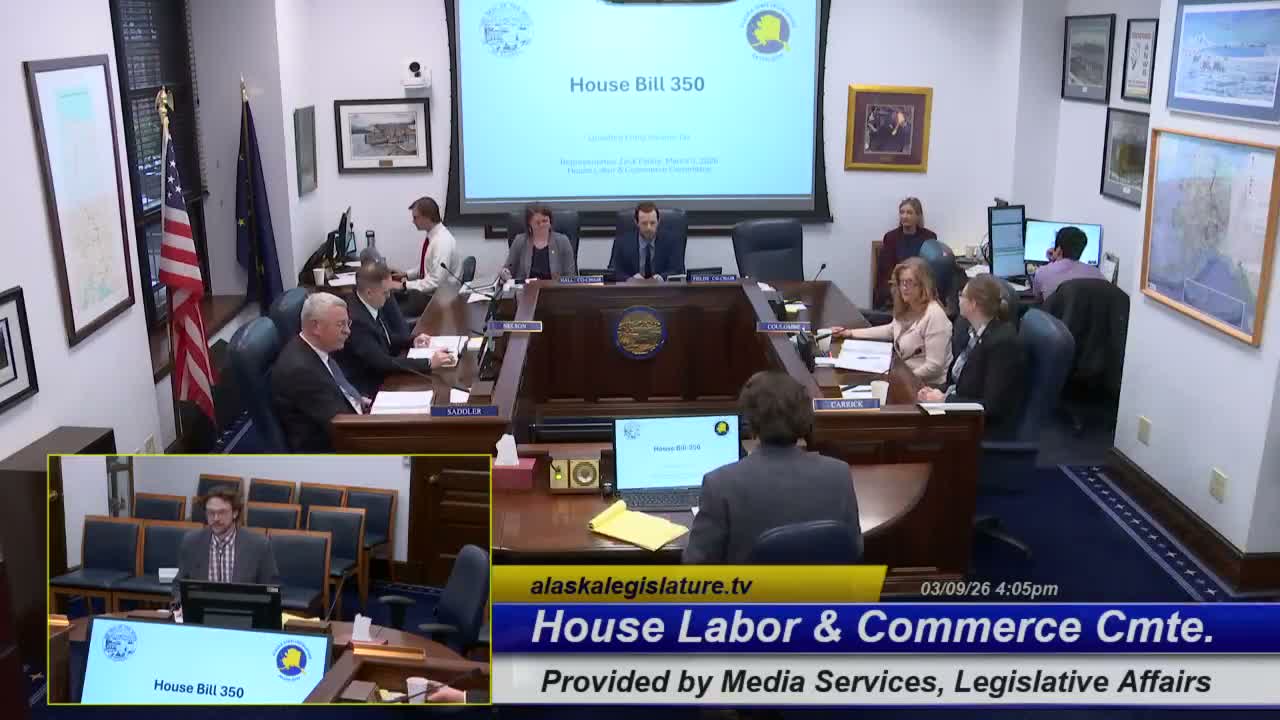
The House Labor and Commerce Committee on March 11 held the first hearing for HB350, a proposal to impose an income tax on certain pass‑through businesses ("qualified entities") that exceed $25,000,000 in taxable income, applying a 9.4% rate for income above that threshold and directing the Department of Revenue to aggregate unitary or related‑entity income for threshold calculations.
Evan Anderson, staff to Representative Fields, said the bill targets pass‑through entities such as S corporations, partnerships, LLCs and sole proprietorships that effectively pay no state income tax in Alaska because the state lacks a personal income tax. "This is a targeted reform that could improve the fairness and sustainability of Alaska's revenue structure without requiring a broad‑based tax increase on households or small businesses," Anderson said in his presentation.
Committee members questioned the $25 million threshold and single flat rate. Representative Sadler asked why the threshold was set at $25 million rather than a higher or lower amount; the sponsor said the figure aims to capture very large businesses while avoiding ensnaring small practices. Members suggested a graduated rate structure might be an acceptable amendment; the sponsor said he would consider graduated options.
The committee also asked how the bill interacts with existing tax credits. Anderson said the drafting intent is that existing Alaska tax credits (for example, education or mineral exploration incentives noted in statute) remain applicable; some credit language in the bill references federal tax treatment and will need clarification.
On fiscal impact, Anderson said a fiscal‑note projection anticipates up to $110 million in annual revenue if the measure is enacted. Members expressed concern about sudden changes to the tax treatment of businesses that invested in Alaska under different expectations: one member observed that a large local corporation (referred to in discussion as "Hillcorp") invested under earlier tax assumptions and said a retroactive or sudden tax could be politically and economically sensitive.
No committee vote was taken on HB350; members asked staff to seek Department of Revenue modeling and to consider refinements such as graduated rates or thresholds before the bill is scheduled for further action.
Evan Anderson, staff to Representative Fields, said the bill targets pass‑through entities such as S corporations, partnerships, LLCs and sole proprietorships that effectively pay no state income tax in Alaska because the state lacks a personal income tax. "This is a targeted reform that could improve the fairness and sustainability of Alaska's revenue structure without requiring a broad‑based tax increase on households or small businesses," Anderson said in his presentation.
Committee members questioned the $25 million threshold and single flat rate. Representative Sadler asked why the threshold was set at $25 million rather than a higher or lower amount; the sponsor said the figure aims to capture very large businesses while avoiding ensnaring small practices. Members suggested a graduated rate structure might be an acceptable amendment; the sponsor said he would consider graduated options.
The committee also asked how the bill interacts with existing tax credits. Anderson said the drafting intent is that existing Alaska tax credits (for example, education or mineral exploration incentives noted in statute) remain applicable; some credit language in the bill references federal tax treatment and will need clarification.
On fiscal impact, Anderson said a fiscal‑note projection anticipates up to $110 million in annual revenue if the measure is enacted. Members expressed concern about sudden changes to the tax treatment of businesses that invested in Alaska under different expectations: one member observed that a large local corporation (referred to in discussion as "Hillcorp") invested under earlier tax assumptions and said a retroactive or sudden tax could be politically and economically sensitive.
No committee vote was taken on HB350; members asked staff to seek Department of Revenue modeling and to consider refinements such as graduated rates or thresholds before the bill is scheduled for further action.
Don't Miss a Word: See the Full Meeting!
Go beyond summaries. Unlock every video, transcript, and key insight with a Founder Membership.
✓
Get instant access to full meeting videos
✓
Search and clip any phrase from complete transcripts
✓
Receive AI-powered summaries & custom alerts
✓
Enjoy lifetime, unrestricted access to government data
30-day money-back guarantee
