Paley and Maddox describe House 2 investments for business growth, housing and shelter changes
March 09, 2026 | 2026 Legislature MA, Massachusetts
This article was created by AI summarizing key points discussed. AI makes mistakes, so for full details and context, please refer to the video of the full meeting. Please report any errors so we can fix them. Report an error »
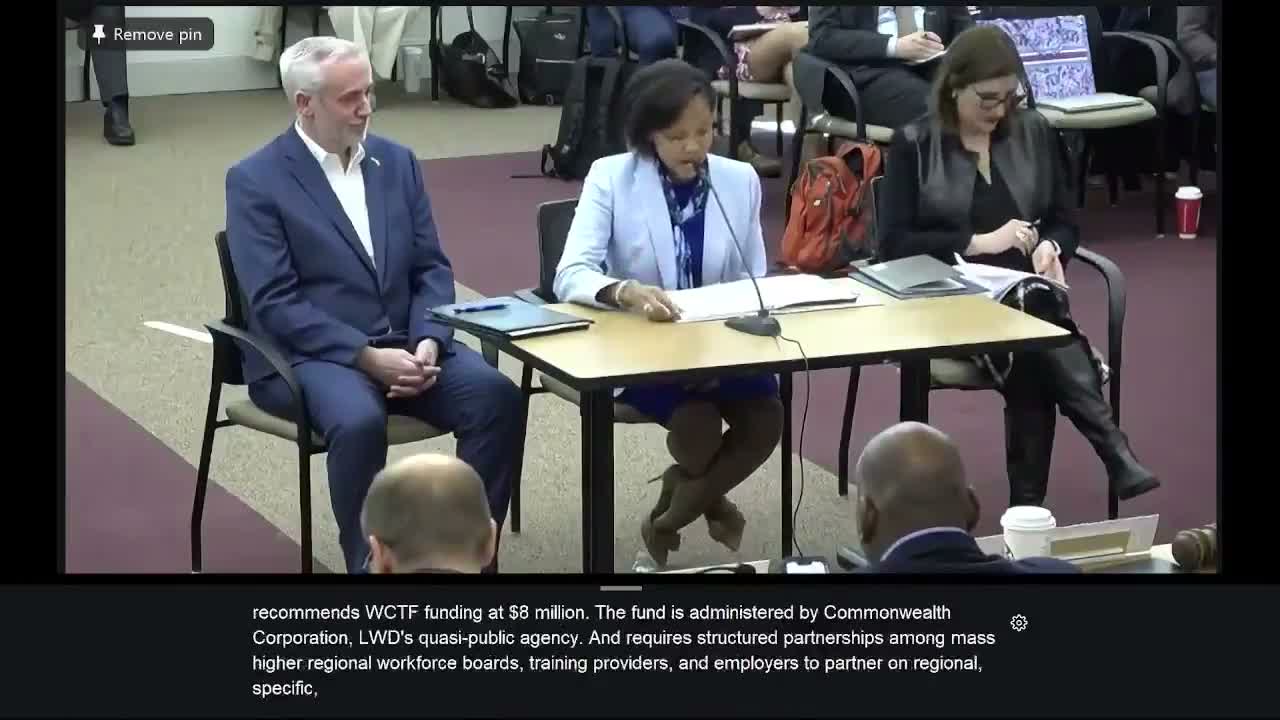
Department and secretariat leaders told the Joint Ways and Means committee that House 2 adopts a conservative fiscal approach while targeting capital and operating investments intended to support economic competitiveness and housing production.
Eric Paley, secretary of Economic Development, said House 2 would fund EOED at about $131.8 million and continue programs that pair capital and tax incentives with workforce alignment. "House 2 recommends $131,800,000 for the executive office of economic development in FY27," Paley said, describing the Community One-Stop for Growth, Mass Life Sciences tax incentives and the new community workforce partnerships proposal ($10 million) intended to train and place residents into in-demand jobs.
Paley highlighted efforts to use the Workforce Investment Trust Fund to support regional workforce programs and to leverage the AI Hub and MassHigh Performance Computing investments to sustain life-sciences and advanced-tech leadership.
Interim Secretary Jennifer Maddox presented HLC's approach to addressing housing shortages and shelter reform, laying out a roughly $1.2 billion package that includes a new $12 million line for winter shelter capacity, increased funding for rental voucher programs (including MRVP at approximately $278.3 million to support more than 11,500 vouchers), and $25 million in capital to expand first-time homebuyer assistance. Maddox said the administration is reprocuring family shelter contracts and seeks to right-size emergency assistance with more diversion and prevention tools.
On regional equity, Paley and Maddox acknowledged continuing gaps across regions and described active efforts to work with MassHire regional boards, rural economic development organizations and MassHousing to target resources where local plans are executable. Legislators from Western Massachusetts and Cape Cod pressed for assurances that trust-fund and grant allocations will be equitable and that infrastructure constraints (water, sewer, energy) will not block development.
Officials said components of the housing plan require additional legislative action, including capital authorizations in chapter 90 and statutory changes associated with the Affordable Homes Act. Committee members signaled interest in follow-up briefings on distribution formulas and on monitoring early outcomes of pilot programs for seasonal communities.
No formal committee votes were taken during the hearing; the secretariats offered to provide additional written analyses and local-level allocations on request.
Eric Paley, secretary of Economic Development, said House 2 would fund EOED at about $131.8 million and continue programs that pair capital and tax incentives with workforce alignment. "House 2 recommends $131,800,000 for the executive office of economic development in FY27," Paley said, describing the Community One-Stop for Growth, Mass Life Sciences tax incentives and the new community workforce partnerships proposal ($10 million) intended to train and place residents into in-demand jobs.
Paley highlighted efforts to use the Workforce Investment Trust Fund to support regional workforce programs and to leverage the AI Hub and MassHigh Performance Computing investments to sustain life-sciences and advanced-tech leadership.
Interim Secretary Jennifer Maddox presented HLC's approach to addressing housing shortages and shelter reform, laying out a roughly $1.2 billion package that includes a new $12 million line for winter shelter capacity, increased funding for rental voucher programs (including MRVP at approximately $278.3 million to support more than 11,500 vouchers), and $25 million in capital to expand first-time homebuyer assistance. Maddox said the administration is reprocuring family shelter contracts and seeks to right-size emergency assistance with more diversion and prevention tools.
On regional equity, Paley and Maddox acknowledged continuing gaps across regions and described active efforts to work with MassHire regional boards, rural economic development organizations and MassHousing to target resources where local plans are executable. Legislators from Western Massachusetts and Cape Cod pressed for assurances that trust-fund and grant allocations will be equitable and that infrastructure constraints (water, sewer, energy) will not block development.
Officials said components of the housing plan require additional legislative action, including capital authorizations in chapter 90 and statutory changes associated with the Affordable Homes Act. Committee members signaled interest in follow-up briefings on distribution formulas and on monitoring early outcomes of pilot programs for seasonal communities.
No formal committee votes were taken during the hearing; the secretariats offered to provide additional written analyses and local-level allocations on request.
Don't Miss a Word: See the Full Meeting!
Go beyond summaries. Unlock every video, transcript, and key insight with a Founder Membership.
✓
Get instant access to full meeting videos
✓
Search and clip any phrase from complete transcripts
✓
Receive AI-powered summaries & custom alerts
✓
Enjoy lifetime, unrestricted access to government data
30-day money-back guarantee
