House committee hears heated debate over bill to opt Minnesota into federal scholarship tax credit
March 10, 2026 | 2026 Legislature MN, Minnesota
This article was created by AI summarizing key points discussed. AI makes mistakes, so for full details and context, please refer to the video of the full meeting. Please report any errors so we can fix them. Report an error »
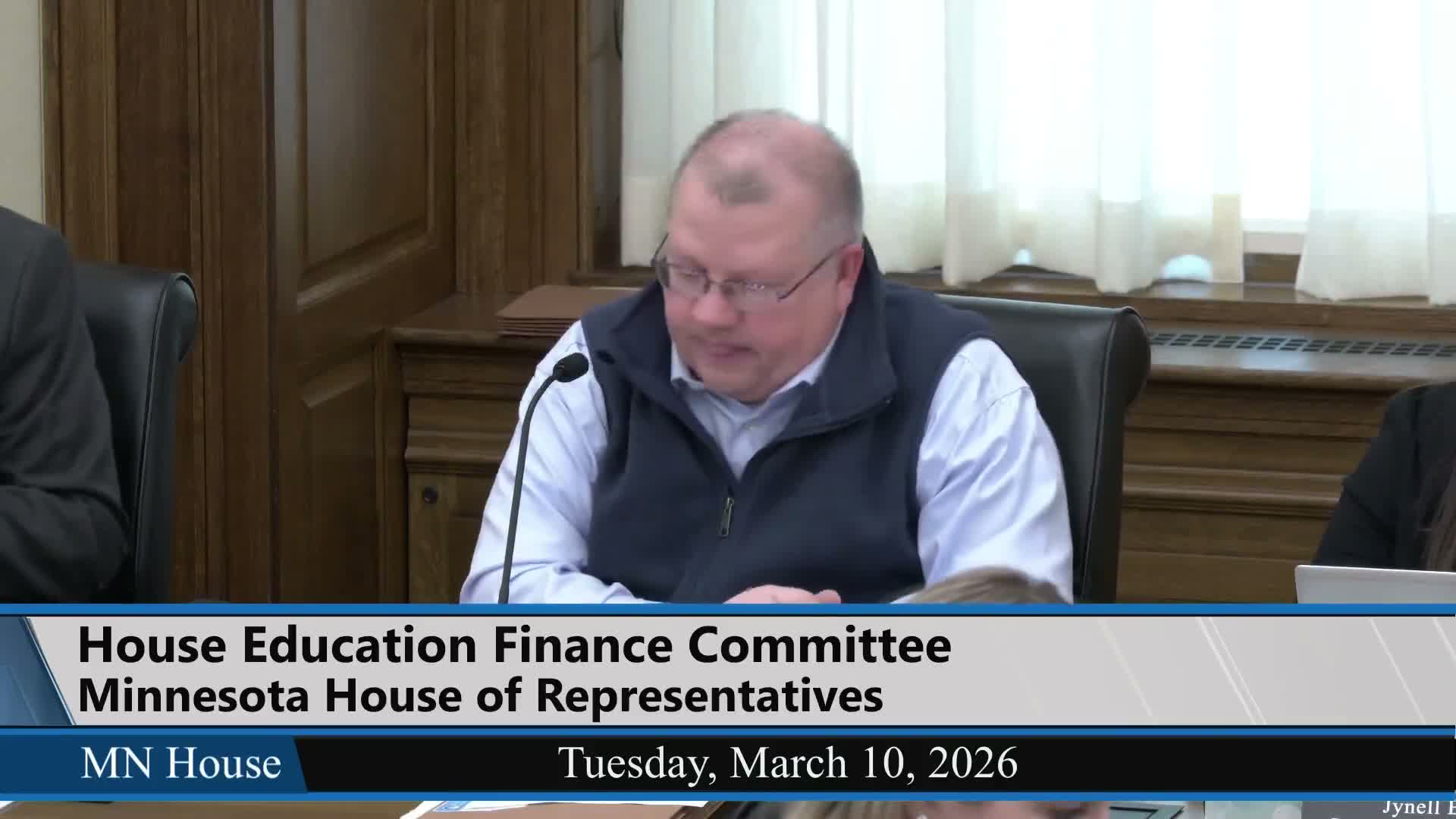
The House Education Finance Committee on March 10 heard sharply divided testimony and extended member debate on House File 3490, a bill that would allow Minnesota to opt into a federal scholarship tax credit program that enables taxpayers to claim a federal credit (up to $1,700) for donations to scholarship-granting organizations, or SGOs.
Anne Lesser, president and CEO of Invest in Education Foundation, told the committee the program ‘‘provides a new pathway to educational access’’ and would generate private funding for K–12 services such as tutoring, special-needs services, extended-day programs and transportation. ‘‘This law, which goes into effect on 01/01/2027, will enable individual taxpayers to claim a 100% federal tax credit up to $1,700 annually for donations made to nonprofit scholarship granting organizations,’’ Lesser said, urging Minnesota to opt in so those dollars stay in-state.
That view drew support from several nonprofit and private-school advocates. Ricky Austin, president of the AIM Higher Foundation, said his organization serves about 2,900 K–8 students and that a federal credit would increase philanthropic scholarship dollars for families who need them. ‘‘We receive 7,000 applications for the current school year and we can only fund about 40%,’’ Austin said, arguing the program would let organizations meet more need without drawing from the state general fund.
But several teachers, school-union leaders and the Minnesota Department of Education expressed strong opposition. Kelly Gibbons, executive director of SEIU Local 284, warned that ‘‘vouchers would starve our public schools,’’ citing staff shortages and unmet special-education needs in public districts. Jennifer Lipsky, president of the Minnetonka Teachers Union, said the proposal ‘‘functions much like a voucher system’’ and ‘‘would weaken the foundation’’ of public education by redirecting tax incentives toward private tuition rather than the majority of students who attend public schools.
Nikoschini, director of government relations for the Minnesota Department of Education, told the committee the state constitution requires a ‘‘general and uniform’’ public-school system and cautioned that the federal program ‘‘incentivizes enrollment in non public schools’’ and could erode funding that supports services for all students. The administration’s position, he said, is not to opt in.
Members asked detailed questions about how the program would work and what it would cover. Nonpartisan tax staff explained the bill has two pieces: an opt-in authority that permits Minnesota-based SGOs to qualify for the federal credit (which itself does not directly alter state revenue), and a state ‘‘tax conformity’’ provision that would adopt federal treatment to disallow a charitable deduction for the same donated amount while making scholarships nontaxable to recipients. Department of Revenue estimates described to the committee projected a small net revenue increase from those state-level conformity changes, though members noted federal cost estimates vary widely depending on take-up and how many states participate.
Lawmakers also focused on eligibility and oversight. Nonpartisan staff explained the federal guidance requires SGOs to be 501(c)(3) organizations, to award scholarships to at least 10 students who do not all attend the same school, to spend at least 90% of qualified funds on scholarships, and to verify household income (the federal threshold referenced in testimony was 300% of area median gross income). The bill assigns initial regulatory duties to the Minnesota Department of Education and leaves other enforcement tools, including attorney-general authority.
Opponents raised equity and civil‑rights concerns: multiple members and witnesses asked whether scholarship funds could flow to nonpublic schools that do not provide services required of public districts for students with disabilities, or that could otherwise exclude students. Supporters said school districts and public-school foundations could form SGOs and that most Minnesota students attend public schools, arguing public schools could benefit if local donors direct funds to SGOs that support extracurriculars and supplemental services in public districts.
The committee also discussed fraud and data questions. Members asked what reporting and auditing would be required and how misuse would be detected. Nonpartisan staff said certain SGO requirements and reporting would exist under federal guidance and that Minnesota oversight would be coordinated through the Department of Education and other state enforcement channels, but staff cautioned federal rules were not yet finalized in every detail.
After several hours of testimony and back‑and‑forth among committee members, Representative Myers, the bill’s author, and committee leadership said they intended further work on implementation and oversight. The committee adopted two author's amendments (A1 and A4) by voice vote to clarify the bill's language and the Department of Education’s role. Chair Kresha then laid House File 3490 over as amended; no final committee vote on passage occurred at this hearing.
The next steps are procedural: the bill is laid over for further consideration and a vote is expected before the third deadline in the House calendar. If Minnesota’s policymakers decline to opt in, witnesses and members noted taxpayers could still take the federal credit by directing donations to SGOs registered in other states.
The committee adjourned after Chair Kresha and members exchanged closing remarks.
Anne Lesser, president and CEO of Invest in Education Foundation, told the committee the program ‘‘provides a new pathway to educational access’’ and would generate private funding for K–12 services such as tutoring, special-needs services, extended-day programs and transportation. ‘‘This law, which goes into effect on 01/01/2027, will enable individual taxpayers to claim a 100% federal tax credit up to $1,700 annually for donations made to nonprofit scholarship granting organizations,’’ Lesser said, urging Minnesota to opt in so those dollars stay in-state.
That view drew support from several nonprofit and private-school advocates. Ricky Austin, president of the AIM Higher Foundation, said his organization serves about 2,900 K–8 students and that a federal credit would increase philanthropic scholarship dollars for families who need them. ‘‘We receive 7,000 applications for the current school year and we can only fund about 40%,’’ Austin said, arguing the program would let organizations meet more need without drawing from the state general fund.
But several teachers, school-union leaders and the Minnesota Department of Education expressed strong opposition. Kelly Gibbons, executive director of SEIU Local 284, warned that ‘‘vouchers would starve our public schools,’’ citing staff shortages and unmet special-education needs in public districts. Jennifer Lipsky, president of the Minnetonka Teachers Union, said the proposal ‘‘functions much like a voucher system’’ and ‘‘would weaken the foundation’’ of public education by redirecting tax incentives toward private tuition rather than the majority of students who attend public schools.
Nikoschini, director of government relations for the Minnesota Department of Education, told the committee the state constitution requires a ‘‘general and uniform’’ public-school system and cautioned that the federal program ‘‘incentivizes enrollment in non public schools’’ and could erode funding that supports services for all students. The administration’s position, he said, is not to opt in.
Members asked detailed questions about how the program would work and what it would cover. Nonpartisan tax staff explained the bill has two pieces: an opt-in authority that permits Minnesota-based SGOs to qualify for the federal credit (which itself does not directly alter state revenue), and a state ‘‘tax conformity’’ provision that would adopt federal treatment to disallow a charitable deduction for the same donated amount while making scholarships nontaxable to recipients. Department of Revenue estimates described to the committee projected a small net revenue increase from those state-level conformity changes, though members noted federal cost estimates vary widely depending on take-up and how many states participate.
Lawmakers also focused on eligibility and oversight. Nonpartisan staff explained the federal guidance requires SGOs to be 501(c)(3) organizations, to award scholarships to at least 10 students who do not all attend the same school, to spend at least 90% of qualified funds on scholarships, and to verify household income (the federal threshold referenced in testimony was 300% of area median gross income). The bill assigns initial regulatory duties to the Minnesota Department of Education and leaves other enforcement tools, including attorney-general authority.
Opponents raised equity and civil‑rights concerns: multiple members and witnesses asked whether scholarship funds could flow to nonpublic schools that do not provide services required of public districts for students with disabilities, or that could otherwise exclude students. Supporters said school districts and public-school foundations could form SGOs and that most Minnesota students attend public schools, arguing public schools could benefit if local donors direct funds to SGOs that support extracurriculars and supplemental services in public districts.
The committee also discussed fraud and data questions. Members asked what reporting and auditing would be required and how misuse would be detected. Nonpartisan staff said certain SGO requirements and reporting would exist under federal guidance and that Minnesota oversight would be coordinated through the Department of Education and other state enforcement channels, but staff cautioned federal rules were not yet finalized in every detail.
After several hours of testimony and back‑and‑forth among committee members, Representative Myers, the bill’s author, and committee leadership said they intended further work on implementation and oversight. The committee adopted two author's amendments (A1 and A4) by voice vote to clarify the bill's language and the Department of Education’s role. Chair Kresha then laid House File 3490 over as amended; no final committee vote on passage occurred at this hearing.
The next steps are procedural: the bill is laid over for further consideration and a vote is expected before the third deadline in the House calendar. If Minnesota’s policymakers decline to opt in, witnesses and members noted taxpayers could still take the federal credit by directing donations to SGOs registered in other states.
The committee adjourned after Chair Kresha and members exchanged closing remarks.
View the Full Meeting & All Its Details
This article offers just a summary. Unlock complete video, transcripts, and insights as a Founder Member.
✓
Watch full, unedited meeting videos
✓
Search every word spoken in unlimited transcripts
✓
AI summaries & real-time alerts (all government levels)
✓
Permanent access to expanding government content
30-day money-back guarantee
