Committee tables interstate massage-therapy compact amid disputes over training, grandfathering and trafficking risks
March 10, 2026 | Regulated Industries and Utilities, SENATE, Committees, Legislative, Georgia
This article was created by AI summarizing key points discussed. AI makes mistakes, so for full details and context, please refer to the video of the full meeting. Please report any errors so we can fix them. Report an error »
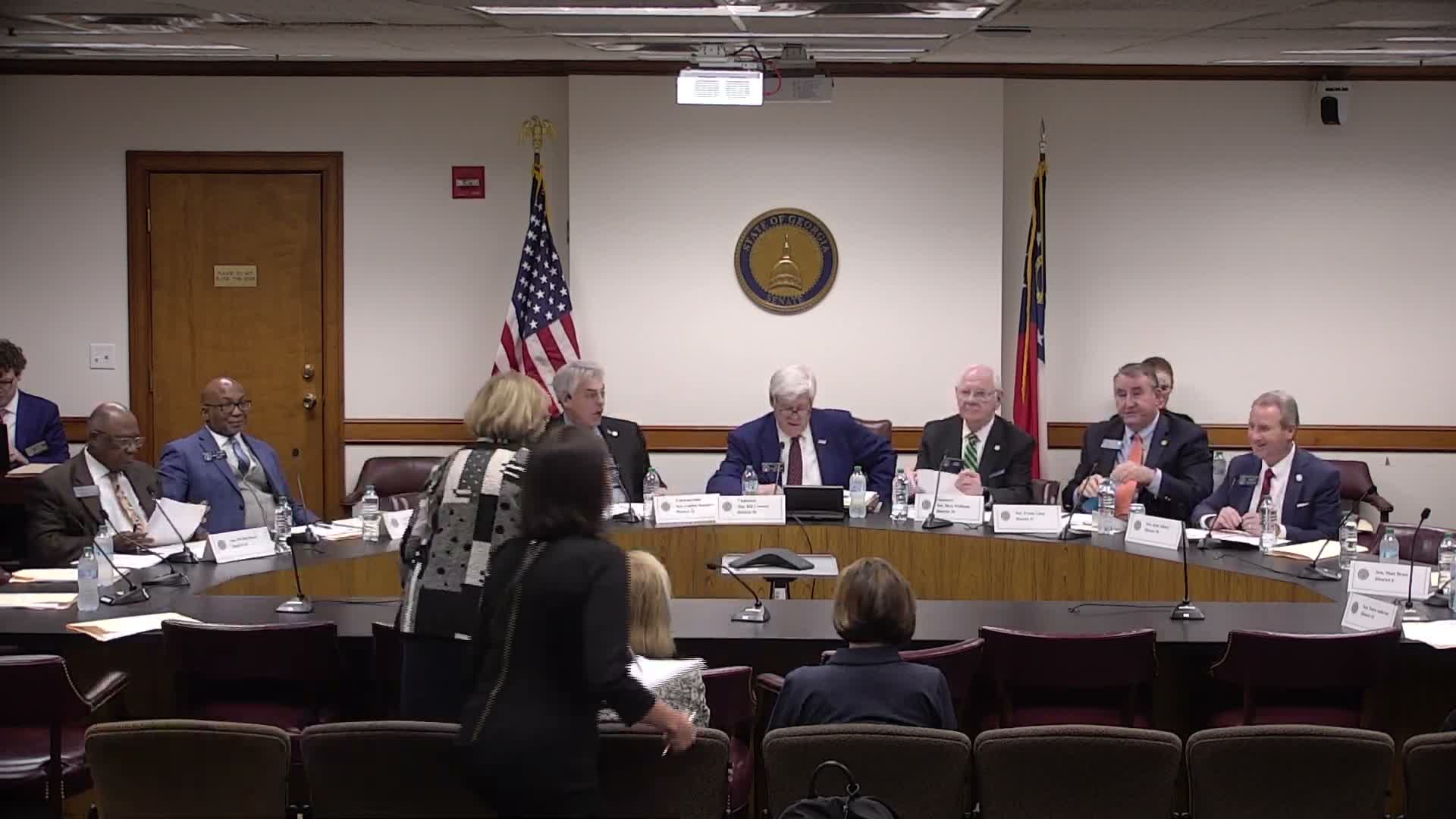
Representative Silcox introduced House Bill 232 as an interstate compact for massage therapists intended to expand public access to services, align Georgia with other states, support military families, and increase the statutory minimum training to 625 hours. He said the compact would be the 23rd of its kind and would bring Georgia closer to full activation of the multistate licensing framework.
Mylene Petrine, identified to the committee as the director of legal and regulatory affairs for the Federation of State Massage Therapy Boards, said the federation helped draft the original compact language with a Department of Defense grant and that the original version was designed to preserve higher standards and allow regulators to make "substantial equivalence" determinations by rule so legacy or grandparented practitioners would not be excluded. She said revised, lower-standard language circulating elsewhere has been rejected in other states and warned that lowering standards could facilitate trafficking.
George Ray, representing the American Massage Therapy Association, said AMTA supports multistate licensure in principle but opposes the bill’s current language because it raises the minimum to 625 hours and could force currently licensed Georgia practitioners to return to school to qualify for a multistate license. He urged stakeholder negotiation and offered to bring parties together to resolve differences.
Committee members asked technical questions about "legacy" therapists, Pell Grant eligibility (noting the 600-hour federal threshold), national exams, and how grandparenting or commission-level rulemaking could preserve access for existing practitioners. Witnesses said the compact’s drafters intended rulemaking flexibility to address legacy practitioners and that the revised language proposed elsewhere would change those mechanisms.
Given unresolved disagreements about training hours, veteran access, and trafficking risks, Senator Summers moved to table the bill so stakeholders could meet (including a planned meeting involving the Department of Defense and the Council of State Governments). The motion to table was seconded and carried unanimously. The chair signaled the bill would be placed back on the committee schedule for further consideration.
Outcome: House Bill 232 was tabled for stakeholder negotiation; no final vote on adoption was taken.
Mylene Petrine, identified to the committee as the director of legal and regulatory affairs for the Federation of State Massage Therapy Boards, said the federation helped draft the original compact language with a Department of Defense grant and that the original version was designed to preserve higher standards and allow regulators to make "substantial equivalence" determinations by rule so legacy or grandparented practitioners would not be excluded. She said revised, lower-standard language circulating elsewhere has been rejected in other states and warned that lowering standards could facilitate trafficking.
George Ray, representing the American Massage Therapy Association, said AMTA supports multistate licensure in principle but opposes the bill’s current language because it raises the minimum to 625 hours and could force currently licensed Georgia practitioners to return to school to qualify for a multistate license. He urged stakeholder negotiation and offered to bring parties together to resolve differences.
Committee members asked technical questions about "legacy" therapists, Pell Grant eligibility (noting the 600-hour federal threshold), national exams, and how grandparenting or commission-level rulemaking could preserve access for existing practitioners. Witnesses said the compact’s drafters intended rulemaking flexibility to address legacy practitioners and that the revised language proposed elsewhere would change those mechanisms.
Given unresolved disagreements about training hours, veteran access, and trafficking risks, Senator Summers moved to table the bill so stakeholders could meet (including a planned meeting involving the Department of Defense and the Council of State Governments). The motion to table was seconded and carried unanimously. The chair signaled the bill would be placed back on the committee schedule for further consideration.
Outcome: House Bill 232 was tabled for stakeholder negotiation; no final vote on adoption was taken.
Don't Miss a Word: See the Full Meeting!
Go beyond summaries. Unlock every video, transcript, and key insight with a Founder Membership.
✓
Get instant access to full meeting videos
✓
Search and clip any phrase from complete transcripts
✓
Receive AI-powered summaries & custom alerts
✓
Enjoy lifetime, unrestricted access to government data
30-day money-back guarantee
