Planning commission recommends Assembly approval for area-wide rezoning to update decades-old Title 21 districts
March 10, 2026 | Anchorage Municipality, Alaska
This article was created by AI summarizing key points discussed. AI makes mistakes, so for full details and context, please refer to the video of the full meeting. Please report any errors so we can fix them. Report an error »
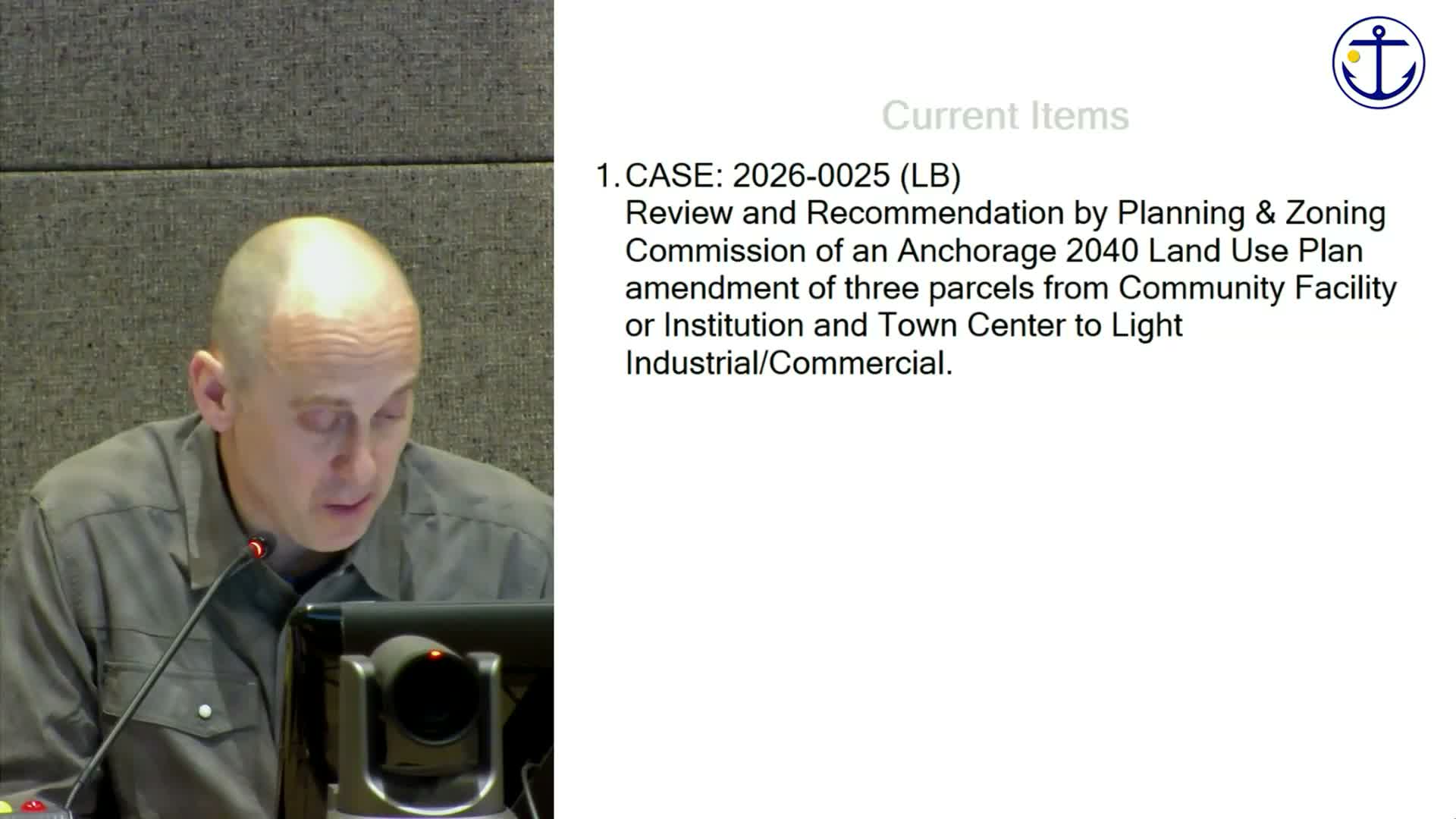
The Anchorage Planning and Zoning Commission on March 9 voted to recommend that the Anchorage Assembly approve a package of land-use and zoning changes intended to remove obsolete Title 21 districts and align parcels with the Anchorage 2040 comprehensive plan.
Planning staff presented two linked items: PCC 2026-0025, an amendment to the Anchorage 2040 land-use map for three parcels near Huffman Road and the Seward Highway, and PCC 2026-0024, an area-wide rezoning affecting about 90.8 acres and 23 parcels across the Anchorage Bowl. "The main purpose of this land-use map amendment and rezone is to address it — finally get those off the map after more than a decade at this point," said Luke Bertram, senior planner in the long-range planning division. Staff recommended approval and cited code provisions that the proposals meet.
Staff described multiple subareas in the package: industrial/commercial designations and an I-1 zoning recommendation for parcels adjacent to Huffman Road and Seward Highway; conversions of TR/T zoning in the Sand Lake area to R1 (single-family implementation zoning) to reflect existing residential character; B4-to-B3 changes around Muldoon Road (including the former Children’s Theatre site and a McDonald’s) to match a separate land-use proposal for commercial corridor; and parcel clean-ups on Debar Road and in Airport Heights to resolve split zoning.
Commissioners pressed staff on the history and practical effects of the changes. Commissioner Radhika Krishna asked why the municipality was initiating rezones now; Bertram said the authority to initiate area-wide rezonings was adopted recently and staff is using it to resolve inconsistencies left from the 2012 rewrite of Title 21. Commissioner Mieth McKee asked whether the Anchorage School District objected to an industrial designation next to a school; staff said ASD had no long-term plans to expand into the parcels and did not express opposition.
A nearby property owner, Fred Kring, told the commission he had discussed the proposal with staff and neighbors and did not generally oppose it, but said he was concerned about losing flexibility he believed the parcel previously allowed (for example subdividing or different development options) and about potential tax effects if the parcel’s classification changed. Planning staff replied that code includes a "least intensive adjacent" provision: where TR parcels are contiguous to residential zoning, the applicable standards (setbacks, heights, intensity) are limited to those of the least intensive adjacent district — in many cases R1. Staff also noted that nonconforming conditions would be grandfathered and that specific subdivision or utility constraints can affect future development.
Commissioner Jeff Ron moved to recommend Assembly approval of the land-use map amendment in PCC 2026-0025; Commissioner Ama Abaza seconded the motion, and the commission passed it. Commissioner Krishna moved to recommend rezoning per PCC 2026-0024 (updating roughly 91 acres that still used old Title 21 districts to modern implementation districts such as R1, R2M, R3, B3, and I-1); the motion was seconded by Commissioner Abaza and passed.
What it means: The actions are map and code clean-ups rather than approvals of new development. Staff emphasized the package formalizes existing patterns in many places, reduces mismatches between old and current Title 21 districts, and is intended to simplify permitting and provide more consistent standards for property owners. The recommendations now go to the Anchorage Assembly for final action; the commission record did not include specific vote tallies for the recommendations.
Timeline/next steps: The commission forwarded both items to the Assembly with recommendations for approval. The Assembly will consider the measures in its regular legislative process; staff and proponents presented findings of consistency with Anchorage Municipal Code approval criteria before the commission’s votes.
Planning staff presented two linked items: PCC 2026-0025, an amendment to the Anchorage 2040 land-use map for three parcels near Huffman Road and the Seward Highway, and PCC 2026-0024, an area-wide rezoning affecting about 90.8 acres and 23 parcels across the Anchorage Bowl. "The main purpose of this land-use map amendment and rezone is to address it — finally get those off the map after more than a decade at this point," said Luke Bertram, senior planner in the long-range planning division. Staff recommended approval and cited code provisions that the proposals meet.
Staff described multiple subareas in the package: industrial/commercial designations and an I-1 zoning recommendation for parcels adjacent to Huffman Road and Seward Highway; conversions of TR/T zoning in the Sand Lake area to R1 (single-family implementation zoning) to reflect existing residential character; B4-to-B3 changes around Muldoon Road (including the former Children’s Theatre site and a McDonald’s) to match a separate land-use proposal for commercial corridor; and parcel clean-ups on Debar Road and in Airport Heights to resolve split zoning.
Commissioners pressed staff on the history and practical effects of the changes. Commissioner Radhika Krishna asked why the municipality was initiating rezones now; Bertram said the authority to initiate area-wide rezonings was adopted recently and staff is using it to resolve inconsistencies left from the 2012 rewrite of Title 21. Commissioner Mieth McKee asked whether the Anchorage School District objected to an industrial designation next to a school; staff said ASD had no long-term plans to expand into the parcels and did not express opposition.
A nearby property owner, Fred Kring, told the commission he had discussed the proposal with staff and neighbors and did not generally oppose it, but said he was concerned about losing flexibility he believed the parcel previously allowed (for example subdividing or different development options) and about potential tax effects if the parcel’s classification changed. Planning staff replied that code includes a "least intensive adjacent" provision: where TR parcels are contiguous to residential zoning, the applicable standards (setbacks, heights, intensity) are limited to those of the least intensive adjacent district — in many cases R1. Staff also noted that nonconforming conditions would be grandfathered and that specific subdivision or utility constraints can affect future development.
Commissioner Jeff Ron moved to recommend Assembly approval of the land-use map amendment in PCC 2026-0025; Commissioner Ama Abaza seconded the motion, and the commission passed it. Commissioner Krishna moved to recommend rezoning per PCC 2026-0024 (updating roughly 91 acres that still used old Title 21 districts to modern implementation districts such as R1, R2M, R3, B3, and I-1); the motion was seconded by Commissioner Abaza and passed.
What it means: The actions are map and code clean-ups rather than approvals of new development. Staff emphasized the package formalizes existing patterns in many places, reduces mismatches between old and current Title 21 districts, and is intended to simplify permitting and provide more consistent standards for property owners. The recommendations now go to the Anchorage Assembly for final action; the commission record did not include specific vote tallies for the recommendations.
Timeline/next steps: The commission forwarded both items to the Assembly with recommendations for approval. The Assembly will consider the measures in its regular legislative process; staff and proponents presented findings of consistency with Anchorage Municipal Code approval criteria before the commission’s votes.
View the Full Meeting & All Its Details
This article offers just a summary. Unlock complete video, transcripts, and insights as a Founder Member.
✓
Watch full, unedited meeting videos
✓
Search every word spoken in unlimited transcripts
✓
AI summaries & real-time alerts (all government levels)
✓
Permanent access to expanding government content
30-day money-back guarantee
