Committee advances limited‑liability measure for certified salt applicators after mixed testimony
March 10, 2026 | 2026 Legislature MN, Minnesota
This article was created by AI summarizing key points discussed. AI makes mistakes, so for full details and context, please refer to the video of the full meeting. Please report any errors so we can fix them. Report an error »
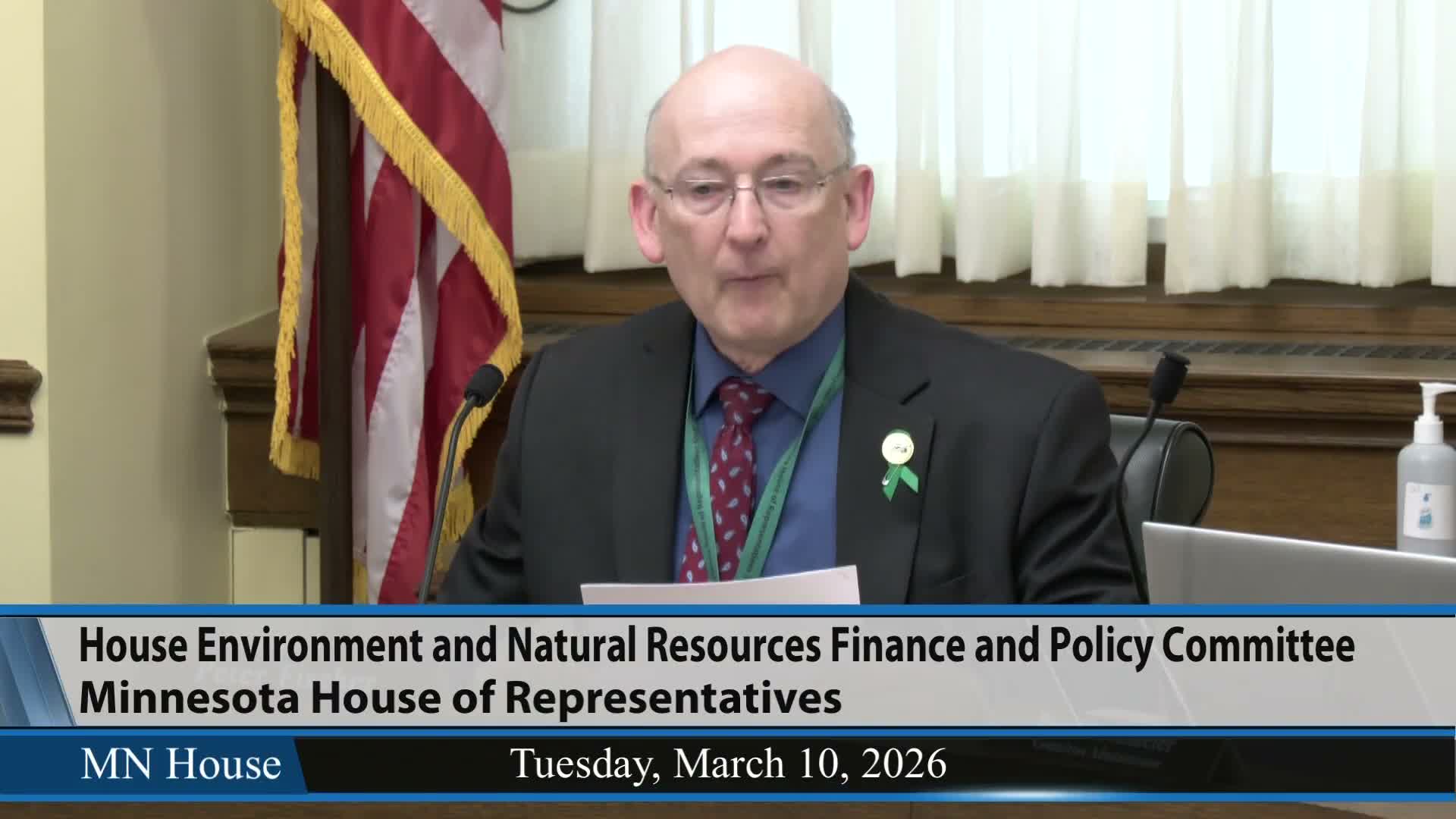
The House Environment and Natural Resources Policy and Finance Committee on March 10 amended and re‑referred House File 793, a bill that would grant limited liability protection to salt applicators who complete an approved certification and can show they followed best management practices.
Rep. Hollins, a co‑author, told the committee the measure is intended to reduce chloride pollution by encouraging use of the Minnesota Pollution Control Agency’s smart‑salting program. “This bill addresses that problem by providing limited liability protection to trained and certified salt applicators that can prove that they have still been using the best management practices during snow and ice management,” Rep. Hollins said.
Supporters from the industry said certification and liability safeguards would curb unnecessary salt use. Paulita LaPlante, owner of Prescription Landscape, said her company’s certified workforce and reporting show that training reduces salt use: “These are proven practices that decrease slip and falls and salt use in client properties.”
Opponents urged caution on the liability language and recertification schedule. Joel Carlson, who describes himself as a legal researcher, said the bill in its current form risks sweeping immunity for applicators and building owners and questioned the ten‑year recertification period. “This bill provides absolute immunity for the salt applicator and every building owner in the state who uses one of these applicators from any liability,” Carlson said, arguing the standard goes too far and that the recertification interval had been relaxed from prior drafts.
Alexis Donath, assistant director of government relations for the MPCA, said the agency supports the goal of reducing chloride and certifies roughly 1,500 applicators a year, but warned against statutory fixes that lock in fees or procedures that may become outdated and offered to work with the author on technical edits.
Committee members pressed authors on whether training should be limited to a single provider and on how frequently credentials should be renewed; several members suggested a three‑year recertification rather than the ten years in the current text. After discussion, the committee adopted a technical A1 amendment to update dates and moved the bill as amended to the Judiciary Finance and Civil Law Committee.
The committee record shows the authors and MPCA will continue stakeholder discussions to clarify training standards, renewal cycles and the scope of liability protection.
Rep. Hollins, a co‑author, told the committee the measure is intended to reduce chloride pollution by encouraging use of the Minnesota Pollution Control Agency’s smart‑salting program. “This bill addresses that problem by providing limited liability protection to trained and certified salt applicators that can prove that they have still been using the best management practices during snow and ice management,” Rep. Hollins said.
Supporters from the industry said certification and liability safeguards would curb unnecessary salt use. Paulita LaPlante, owner of Prescription Landscape, said her company’s certified workforce and reporting show that training reduces salt use: “These are proven practices that decrease slip and falls and salt use in client properties.”
Opponents urged caution on the liability language and recertification schedule. Joel Carlson, who describes himself as a legal researcher, said the bill in its current form risks sweeping immunity for applicators and building owners and questioned the ten‑year recertification period. “This bill provides absolute immunity for the salt applicator and every building owner in the state who uses one of these applicators from any liability,” Carlson said, arguing the standard goes too far and that the recertification interval had been relaxed from prior drafts.
Alexis Donath, assistant director of government relations for the MPCA, said the agency supports the goal of reducing chloride and certifies roughly 1,500 applicators a year, but warned against statutory fixes that lock in fees or procedures that may become outdated and offered to work with the author on technical edits.
Committee members pressed authors on whether training should be limited to a single provider and on how frequently credentials should be renewed; several members suggested a three‑year recertification rather than the ten years in the current text. After discussion, the committee adopted a technical A1 amendment to update dates and moved the bill as amended to the Judiciary Finance and Civil Law Committee.
The committee record shows the authors and MPCA will continue stakeholder discussions to clarify training standards, renewal cycles and the scope of liability protection.
View the Full Meeting & All Its Details
This article offers just a summary. Unlock complete video, transcripts, and insights as a Founder Member.
✓
Watch full, unedited meeting videos
✓
Search every word spoken in unlimited transcripts
✓
AI summaries & real-time alerts (all government levels)
✓
Permanent access to expanding government content
30-day money-back guarantee
