Bill to require separate permits and monthly reporting for very large water users draws broad testimony
March 10, 2026 | 2026 Legislature MN, Minnesota
This article was created by AI summarizing key points discussed. AI makes mistakes, so for full details and context, please refer to the video of the full meeting. Please report any errors so we can fix them. Report an error »
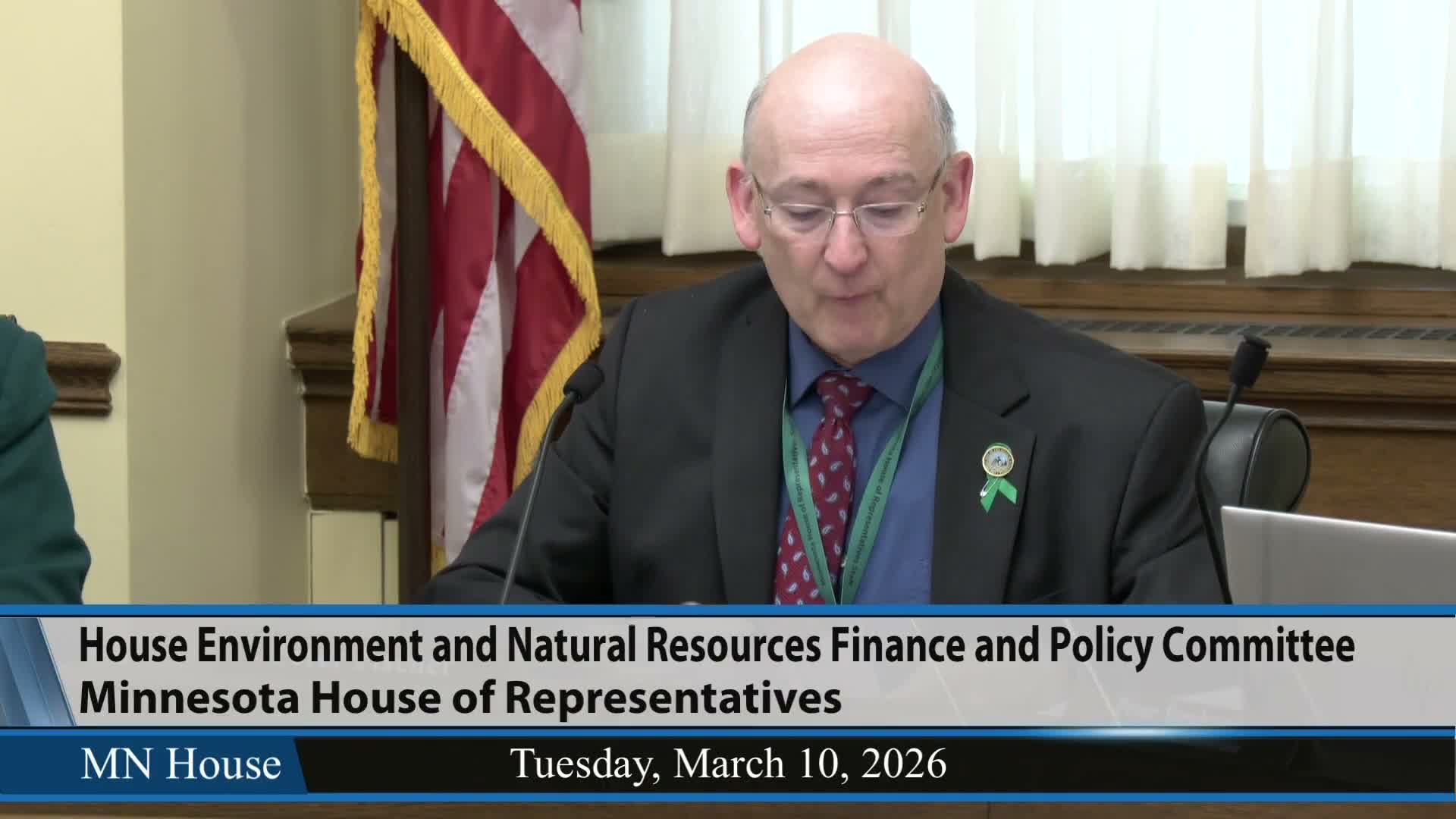
Vice Chair Rep. Purcell told the Environment and Natural Resources Committee that House File 3793 is intended to close a ‘‘loophole’’ allowing hyperscale data centers and other very large industrial users to operate under municipal water appropriation permits instead of obtaining separate authorizations and allowing clearer enforcement of Minnesota’s water‑priority statutes.
"House file 3 7 9 3 defines large volume commercial and industrial water users to include all commercial and industrial uses of water that exceed 100,000,000 gallons of water per year," Rep. Purcell said, adding the bill would create a public comment period and require monthly reporting to the Department of Natural Resources.
Multiple private‑well owners and hydrogeologists testified that municipal permitting has, in some cases, concealed harms. Janelle Kuzna, whose community experienced apparent well impacts during a 2022 pump test, said residents filed dozens of complaints and urged the committee to “close the loophole.” "We are no longer a lot we can no longer allowed allow large industrial users to hide behind municipal permits," she said.
Jim Berg, a retired DNR hydrogeologist, said the bill is necessary to protect aquifers from high volumes of groundwater use and to ensure DNR can apply the state's water‑use priority system.
Environmental groups supported the bill’s stricter scrutiny and reporting. Sarah Moradian of CURE cited documents showing proposals with potential water use in the hundreds of millions to billions of gallons annually and urged enforceable reporting requirements.
The Department of Natural Resources offered technical cautions. Jason Mecckel, assistant division director for ecological and water resources at DNR, said the bill effectively creates a ‘‘sub‑permitee’’ class underneath municipal permits and warned that administering separate industrial permits would likely require changes to permitting structure, new IT systems, and that the proposed 30‑day public comment timeline could add 60–90 days to complex permit reviews.
"We do not have a system for managing that kind of a public comment period or volume of information," Mecckel said.
Industry groups, including the Minnesota Chamber of Commerce, opposed elements of the bill as duplicative or impractical, arguing recent legislation already gives DNR pre‑application authority and that required notice obligations could span many jurisdictions.
Committee members asked whether large agricultural users should be included and whether the bill covers surface as well as groundwater; the author and DNR said they would work on clarifying statutory references and thresholds. The bill was laid over for additional drafting.
"House file 3 7 9 3 defines large volume commercial and industrial water users to include all commercial and industrial uses of water that exceed 100,000,000 gallons of water per year," Rep. Purcell said, adding the bill would create a public comment period and require monthly reporting to the Department of Natural Resources.
Multiple private‑well owners and hydrogeologists testified that municipal permitting has, in some cases, concealed harms. Janelle Kuzna, whose community experienced apparent well impacts during a 2022 pump test, said residents filed dozens of complaints and urged the committee to “close the loophole.” "We are no longer a lot we can no longer allowed allow large industrial users to hide behind municipal permits," she said.
Jim Berg, a retired DNR hydrogeologist, said the bill is necessary to protect aquifers from high volumes of groundwater use and to ensure DNR can apply the state's water‑use priority system.
Environmental groups supported the bill’s stricter scrutiny and reporting. Sarah Moradian of CURE cited documents showing proposals with potential water use in the hundreds of millions to billions of gallons annually and urged enforceable reporting requirements.
The Department of Natural Resources offered technical cautions. Jason Mecckel, assistant division director for ecological and water resources at DNR, said the bill effectively creates a ‘‘sub‑permitee’’ class underneath municipal permits and warned that administering separate industrial permits would likely require changes to permitting structure, new IT systems, and that the proposed 30‑day public comment timeline could add 60–90 days to complex permit reviews.
"We do not have a system for managing that kind of a public comment period or volume of information," Mecckel said.
Industry groups, including the Minnesota Chamber of Commerce, opposed elements of the bill as duplicative or impractical, arguing recent legislation already gives DNR pre‑application authority and that required notice obligations could span many jurisdictions.
Committee members asked whether large agricultural users should be included and whether the bill covers surface as well as groundwater; the author and DNR said they would work on clarifying statutory references and thresholds. The bill was laid over for additional drafting.
View the Full Meeting & All Its Details
This article offers just a summary. Unlock complete video, transcripts, and insights as a Founder Member.
✓
Watch full, unedited meeting videos
✓
Search every word spoken in unlimited transcripts
✓
AI summaries & real-time alerts (all government levels)
✓
Permanent access to expanding government content
30-day money-back guarantee
