Minn. committee holds emotional hearing on "Harvey's Law," debating cameras in state‑funded childcare
March 10, 2026 | 2026 Legislature MN, Minnesota
This article was created by AI summarizing key points discussed. AI makes mistakes, so for full details and context, please refer to the video of the full meeting. Please report any errors so we can fix them. Report an error »
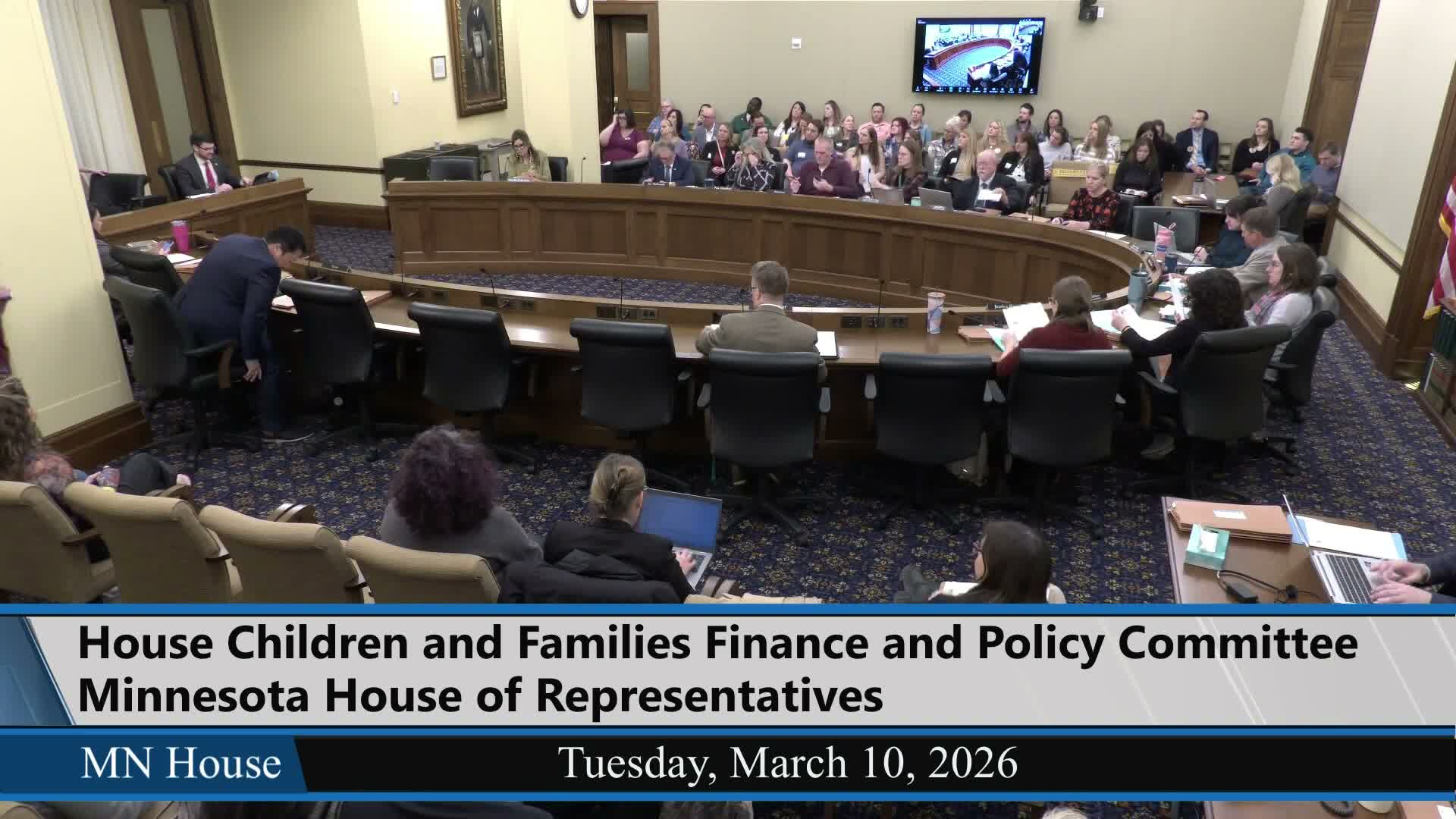
An informational hearing on proposed "Harvey's Law" opened with emotional testimony from the parents and grandparents of a boy who died while in daycare and ended with committee members agreeing to advance discussion and consider amendments.
Chair West introduced the bill as a targeted measure to require cameras in infant and toddler rooms of childcare centers that receive state funds and to retain footage for 28 days. "We need Harvey's law," he said, arguing the requirement would create accountability and speed investigations into suspected maltreatment.
Harvey's parents, Catherine and Hunter Muckelbast, told the committee their son was found unresponsive at his daycare and said the absence of cameras left investigators piecing together events for months. "If cameras had been present that day, the truth of what happened would have been known," Catherine Muckelbast said. Her testimony and other family statements framed the bill as a tool to produce evidence, protect children and deliver accountability.
Multiple parents and grandparents recounted incidents they said only video resolved. Janice Deganda described finding bruises on her toddler and said investigators could add charges for only some families because other footage had been deleted after a week. "We then found out that the daycare only kept video footage for a week at a time before it was deleted," she said, urging longer retention.
Law enforcement testimony underscored that point. Detective Ben Johnson of the Blaine Police Department reviewed surveillance that identified repeated mishandling of infants in one investigation, documenting "17 incidents of abuse involving 7 victims" over five days and saying footage was critical to holding people responsible.
Several provider groups and smaller programs voiced support for the safety goal but cautioned the committee about the bill's scope and costs. Darielle Damnan, a lobbyist for the Minnesota Childcare Association, said many members already use cameras but warned that an unfunded mandate could push some providers — particularly those serving low‑income families or operating in nonstandard facilities — to opt out of public funding or close. "This bill deserves thoughtful attention," she said, citing workforce and privacy concerns.
Jenna Borkoski of Learning Care, which operates centers nationwide, urged stronger privacy and security safeguards and said a seven‑day retention period had been sufficient in her experience, while small nonprofit providers such as Sunshine Montessori said even modest installation or storage expenses would be crippling without funding.
Medical and child‑safety advocates, including Dr. Lisa Hollensteiner of Safe Passage for Children of Minnesota, urged action and pointed to state data on maltreatment and injuries in licensed care. Several speakers asked the committee to fund implementation, establish data‑security best practices and consider narrowing covered spaces to infant and toddler rooms, as the bill proposes.
Committee members asked for reconciled data from state agencies, discussed whether a task force might help design guardrails or simply delay action, and raised concerns about potential misuse of footage if hacked or publicly released. Chair West said he was open to amendments adding explicit privacy protections and cybersecurity best practices, noting the 28‑day retention had been reduced from a prior proposal of 90 days.
There was no final vote on the bill at the hearing; the only recorded committee action was a procedural voice vote to approve the minutes at the meeting start. Chair West said the bill will be introduced with bipartisan support and urged members to continue developing amendments and funding plans before the next committee action.
Next steps: the author said the bill will be formally introduced and likely returned to committee for a vote; members requested written data from the Department of Human Services and other agencies to reconcile differing counts of maltreatment findings cited during testimony.
Chair West introduced the bill as a targeted measure to require cameras in infant and toddler rooms of childcare centers that receive state funds and to retain footage for 28 days. "We need Harvey's law," he said, arguing the requirement would create accountability and speed investigations into suspected maltreatment.
Harvey's parents, Catherine and Hunter Muckelbast, told the committee their son was found unresponsive at his daycare and said the absence of cameras left investigators piecing together events for months. "If cameras had been present that day, the truth of what happened would have been known," Catherine Muckelbast said. Her testimony and other family statements framed the bill as a tool to produce evidence, protect children and deliver accountability.
Multiple parents and grandparents recounted incidents they said only video resolved. Janice Deganda described finding bruises on her toddler and said investigators could add charges for only some families because other footage had been deleted after a week. "We then found out that the daycare only kept video footage for a week at a time before it was deleted," she said, urging longer retention.
Law enforcement testimony underscored that point. Detective Ben Johnson of the Blaine Police Department reviewed surveillance that identified repeated mishandling of infants in one investigation, documenting "17 incidents of abuse involving 7 victims" over five days and saying footage was critical to holding people responsible.
Several provider groups and smaller programs voiced support for the safety goal but cautioned the committee about the bill's scope and costs. Darielle Damnan, a lobbyist for the Minnesota Childcare Association, said many members already use cameras but warned that an unfunded mandate could push some providers — particularly those serving low‑income families or operating in nonstandard facilities — to opt out of public funding or close. "This bill deserves thoughtful attention," she said, citing workforce and privacy concerns.
Jenna Borkoski of Learning Care, which operates centers nationwide, urged stronger privacy and security safeguards and said a seven‑day retention period had been sufficient in her experience, while small nonprofit providers such as Sunshine Montessori said even modest installation or storage expenses would be crippling without funding.
Medical and child‑safety advocates, including Dr. Lisa Hollensteiner of Safe Passage for Children of Minnesota, urged action and pointed to state data on maltreatment and injuries in licensed care. Several speakers asked the committee to fund implementation, establish data‑security best practices and consider narrowing covered spaces to infant and toddler rooms, as the bill proposes.
Committee members asked for reconciled data from state agencies, discussed whether a task force might help design guardrails or simply delay action, and raised concerns about potential misuse of footage if hacked or publicly released. Chair West said he was open to amendments adding explicit privacy protections and cybersecurity best practices, noting the 28‑day retention had been reduced from a prior proposal of 90 days.
There was no final vote on the bill at the hearing; the only recorded committee action was a procedural voice vote to approve the minutes at the meeting start. Chair West said the bill will be introduced with bipartisan support and urged members to continue developing amendments and funding plans before the next committee action.
Next steps: the author said the bill will be formally introduced and likely returned to committee for a vote; members requested written data from the Department of Human Services and other agencies to reconcile differing counts of maltreatment findings cited during testimony.
Don't Miss a Word: See the Full Meeting!
Go beyond summaries. Unlock every video, transcript, and key insight with a Founder Membership.
✓
Get instant access to full meeting videos
✓
Search and clip any phrase from complete transcripts
✓
Receive AI-powered summaries & custom alerts
✓
Enjoy lifetime, unrestricted access to government data
30-day money-back guarantee
