House Republicans urge passage of HF 3490 to keep federal education tax-credit dollars in Minnesota
March 10, 2026 | 2026 Legislature MN, Minnesota
This article was created by AI summarizing key points discussed. AI makes mistakes, so for full details and context, please refer to the video of the full meeting. Please report any errors so we can fix them. Report an error »
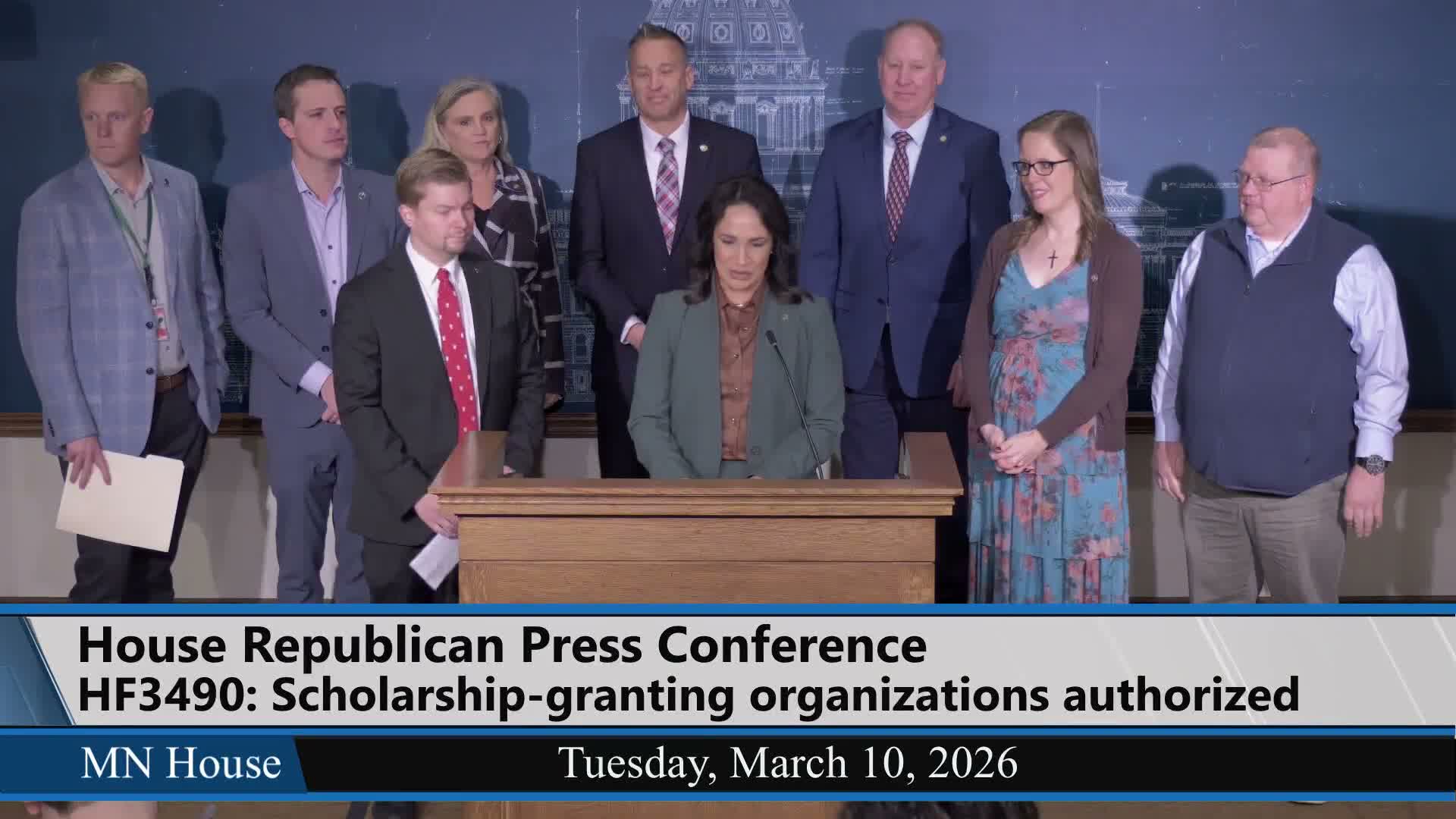
House Republican lawmakers on the House GOP side held a press event to press for passage of House File 3490, a bill that would opt Minnesota into an existing federal tax-credit program so donations that qualify for the federal credit can be directed to in-state scholarship-granting organizations (SGOs).
"We are here to talk about the easiest votes that could be taken here in the legislature this year," Speaker Lisa Damoth said, introducing the bill and saying it would "opt Minnesota into a federal tax credit program" and have "0 cost to the state." Damoth asked reporters to ask the governor whether he would support the bipartisan proposal and, if not, to ask why not.
House GOP Leader Harry Niska said the bill does not create the federal tax-credit program — "that program has already been created by federal law" — but would ensure Minnesota donations and the federal tax credit can be used to benefit Minnesota students and schools. "Do we want those Minnesota donations to benefit Minnesota kids?" he asked, arguing that SGOs could fund tutoring, after-school programs, summer academies and other supports that also serve public school students.
The bill's chief author, Rep. Andrew Myers, described personal ties to public schools in his district and urged colleagues to "put the politics aside." Myers said the proposal could bring significant federally enabled resources to Minnesota classrooms and cited a figure he attributed to AMSD that districts are facing roughly $220 million in shortfalls.
Rep. Ben Baker, a middle school principal, walked through an illustrative example multiplying the federal credit amount by a hypothetical number of taxpayers to suggest the program could yield a multi-billion-dollar pool under a high-uptake scenario, and said local education foundations could serve as SGOs if they meet the bill's requirements. "We need to have Minnesota money for Minnesota kids," Baker said.
During a question-and-answer segment, lawmakers explained that SGOs can be created by a range of entities but must meet procedural requirements; they said SGOs would distribute scholarships for tuition, extracurricular fees, transportation and other supports and that district-run education foundations could be one vehicle for administering funds to "students in need." Proponents framed the bill as benefiting both public and private students and urged Democrats and the governor to support it as a nonpartisan boost to schools.
No formal vote was recorded at the event. Rep. Myers said he expected a hearing in education finance later in the day.
Next steps: proponents indicated they will seek committee consideration in the House education finance committee; opponents or undecided lawmakers were not quoted at the event.
"We are here to talk about the easiest votes that could be taken here in the legislature this year," Speaker Lisa Damoth said, introducing the bill and saying it would "opt Minnesota into a federal tax credit program" and have "0 cost to the state." Damoth asked reporters to ask the governor whether he would support the bipartisan proposal and, if not, to ask why not.
House GOP Leader Harry Niska said the bill does not create the federal tax-credit program — "that program has already been created by federal law" — but would ensure Minnesota donations and the federal tax credit can be used to benefit Minnesota students and schools. "Do we want those Minnesota donations to benefit Minnesota kids?" he asked, arguing that SGOs could fund tutoring, after-school programs, summer academies and other supports that also serve public school students.
The bill's chief author, Rep. Andrew Myers, described personal ties to public schools in his district and urged colleagues to "put the politics aside." Myers said the proposal could bring significant federally enabled resources to Minnesota classrooms and cited a figure he attributed to AMSD that districts are facing roughly $220 million in shortfalls.
Rep. Ben Baker, a middle school principal, walked through an illustrative example multiplying the federal credit amount by a hypothetical number of taxpayers to suggest the program could yield a multi-billion-dollar pool under a high-uptake scenario, and said local education foundations could serve as SGOs if they meet the bill's requirements. "We need to have Minnesota money for Minnesota kids," Baker said.
During a question-and-answer segment, lawmakers explained that SGOs can be created by a range of entities but must meet procedural requirements; they said SGOs would distribute scholarships for tuition, extracurricular fees, transportation and other supports and that district-run education foundations could be one vehicle for administering funds to "students in need." Proponents framed the bill as benefiting both public and private students and urged Democrats and the governor to support it as a nonpartisan boost to schools.
No formal vote was recorded at the event. Rep. Myers said he expected a hearing in education finance later in the day.
Next steps: proponents indicated they will seek committee consideration in the House education finance committee; opponents or undecided lawmakers were not quoted at the event.
View the Full Meeting & All Its Details
This article offers just a summary. Unlock complete video, transcripts, and insights as a Founder Member.
✓
Watch full, unedited meeting videos
✓
Search every word spoken in unlimited transcripts
✓
AI summaries & real-time alerts (all government levels)
✓
Permanent access to expanding government content
30-day money-back guarantee
