Carlsbad subcommittee hears Mineta study calling for better e‑bike data, retailer disclosure and school audits
March 10, 2026 | Carlsbad, San Diego County, California
This article was created by AI summarizing key points discussed. AI makes mistakes, so for full details and context, please refer to the video of the full meeting. Please report any errors so we can fix them. Report an error »
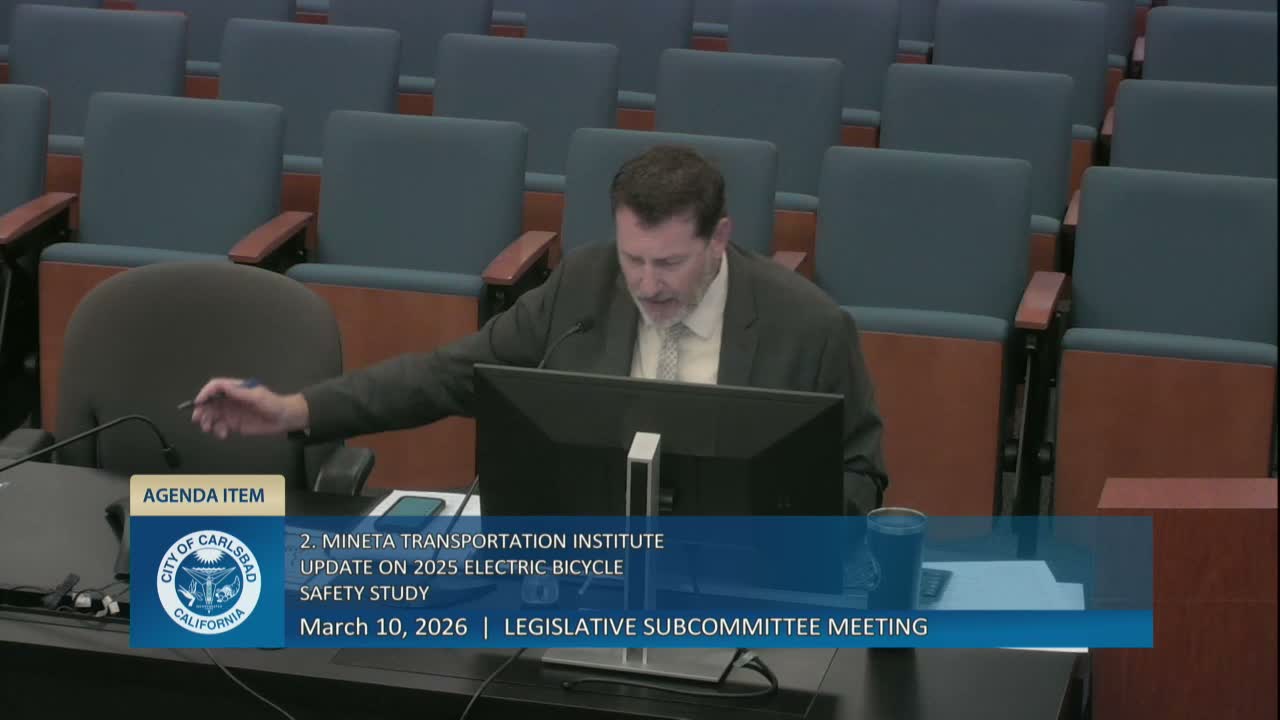
The City of Carlsbad Legislative Subcommittee heard a presentation from Mineta Transportation Institute co‑author Asha Agarwal on a 2025 study of electric bicycle safety, which found rising reports of e‑bike injuries but large data limitations that complicate local policymaking. "The number of reported e‑bike crashes and injuries is rising," Agarwal said, but added that increases in device sales and inconsistent device classification make interpretation difficult.
The study highlighted three practical gaps: poor device identification in crash and hospital data, a lack of exposure metrics (miles traveled or trips taken), and inconsistent reporting standards across police and medical records. Agarwal told the committee volunteers who audited Bay Area school campuses found roughly "88% were not legal e‑bikes," meaning the devices appeared to have motors or throttle capability beyond California's statutory limits; she recommended local audits to determine whether unsafe incidents involve legal e‑bikes or more powerful, moped‑like devices.
Why it matters: Carlsbad and other cities are considering local restrictions and education programs while state lawmakers debate multiple e‑bike bills. The shortage of clear, local evidence can lead to policies that either under‑ or over‑reach; Agarwal said better local data would allow cities to tailor interventions to the actual problem.
Committee members pressed for local context. Councilmember Burkholder described Carlsbad Unified School District’s program that requires students to complete an e‑bike safety course and register devices, and urged continued local audits to verify whether devices brought to campus comply with state definitions. The chair cited a Rady Children's Hospital summary provided to the committee showing pediatric e‑bike trauma cases increasing dramatically — from 1 pediatric e‑bike related ER visit in 2021 to 125 in 2024 and 201 in 2025 — and said that hospital data underscores the urgency of local action.
Agarwal offered several recommendations for city policymakers: launch broad public education (especially for parents and teens), push for simple, statewide rules to reduce enforcement complexity, encourage or require retailers to disclose whether a device meets California statutory e‑bike definitions (class and top speed), and work with police and hospitals to change collision‑reporting and emergency‑care intake to capture brand and model details or photographs. "If you want to know whether the devices are legal, ask police to photograph the device at the scene and ask hospitals to note brand or the presence of a throttle," she said.
The subcommittee discussed state bills that would support some of these goals, including proposals to require safety courses for students who park e‑bikes on campus, to publish lists of non‑compliant devices, and to require speedometers or registration for certain classes. Members said they favored educational and data‑collection measures and agreed to follow state developments.
Next steps: Staff will follow up on recommendations to audit school devices, coordinate with local schools and police on improved reporting, and track pending state legislation that would require retailer disclosure or student safety training.
The study highlighted three practical gaps: poor device identification in crash and hospital data, a lack of exposure metrics (miles traveled or trips taken), and inconsistent reporting standards across police and medical records. Agarwal told the committee volunteers who audited Bay Area school campuses found roughly "88% were not legal e‑bikes," meaning the devices appeared to have motors or throttle capability beyond California's statutory limits; she recommended local audits to determine whether unsafe incidents involve legal e‑bikes or more powerful, moped‑like devices.
Why it matters: Carlsbad and other cities are considering local restrictions and education programs while state lawmakers debate multiple e‑bike bills. The shortage of clear, local evidence can lead to policies that either under‑ or over‑reach; Agarwal said better local data would allow cities to tailor interventions to the actual problem.
Committee members pressed for local context. Councilmember Burkholder described Carlsbad Unified School District’s program that requires students to complete an e‑bike safety course and register devices, and urged continued local audits to verify whether devices brought to campus comply with state definitions. The chair cited a Rady Children's Hospital summary provided to the committee showing pediatric e‑bike trauma cases increasing dramatically — from 1 pediatric e‑bike related ER visit in 2021 to 125 in 2024 and 201 in 2025 — and said that hospital data underscores the urgency of local action.
Agarwal offered several recommendations for city policymakers: launch broad public education (especially for parents and teens), push for simple, statewide rules to reduce enforcement complexity, encourage or require retailers to disclose whether a device meets California statutory e‑bike definitions (class and top speed), and work with police and hospitals to change collision‑reporting and emergency‑care intake to capture brand and model details or photographs. "If you want to know whether the devices are legal, ask police to photograph the device at the scene and ask hospitals to note brand or the presence of a throttle," she said.
The subcommittee discussed state bills that would support some of these goals, including proposals to require safety courses for students who park e‑bikes on campus, to publish lists of non‑compliant devices, and to require speedometers or registration for certain classes. Members said they favored educational and data‑collection measures and agreed to follow state developments.
Next steps: Staff will follow up on recommendations to audit school devices, coordinate with local schools and police on improved reporting, and track pending state legislation that would require retailer disclosure or student safety training.
Don't Miss a Word: See the Full Meeting!
Go beyond summaries. Unlock every video, transcript, and key insight with a Founder Membership.
✓
Get instant access to full meeting videos
✓
Search and clip any phrase from complete transcripts
✓
Receive AI-powered summaries & custom alerts
✓
Enjoy lifetime, unrestricted access to government data
30-day money-back guarantee
