Senate subcommittee outlines resilience plan for 351‑mile Los Angeles rail corridor; Carlsbad presses for local solutions
March 10, 2026 | Carlsbad, San Diego County, California
This article was created by AI summarizing key points discussed. AI makes mistakes, so for full details and context, please refer to the video of the full meeting. Please report any errors so we can fix them. Report an error »
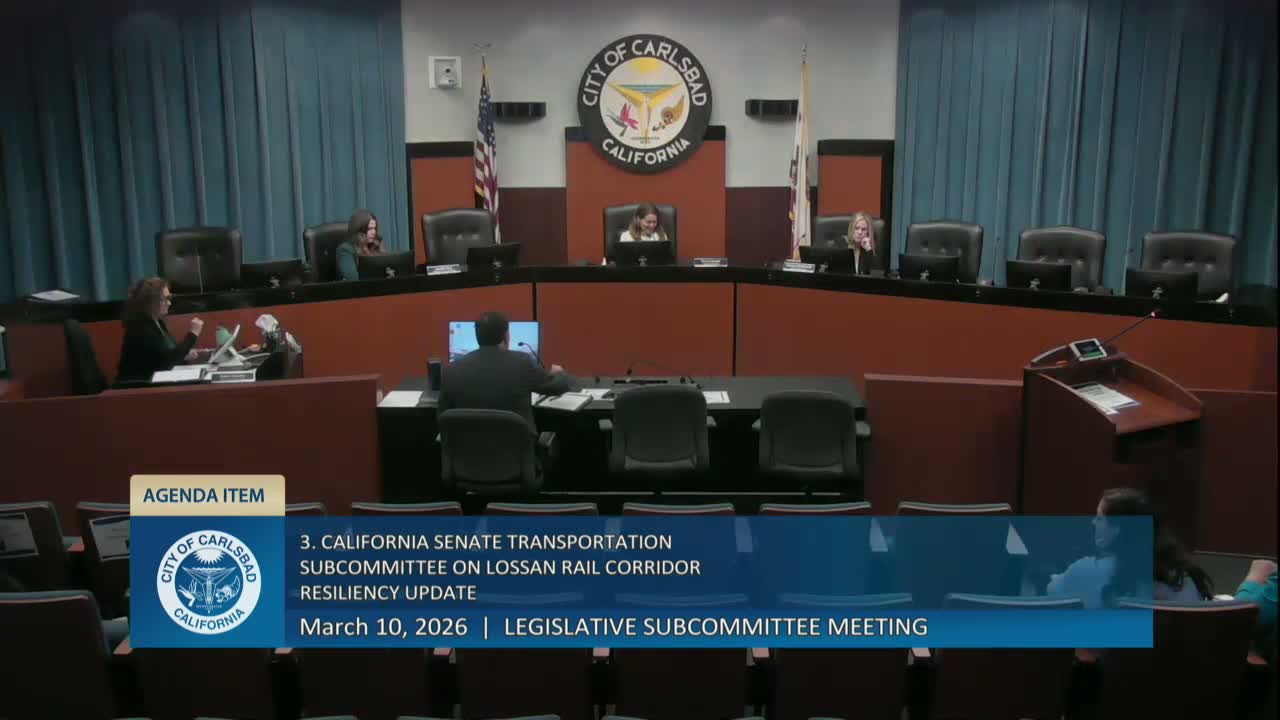
The Carlsbad Legislative Subcommittee received an update on the Los Angeles Rail Corridor from Alex Davis, principal consultant to Senator Blake Spear’s subcommittee on corridor resiliency, who described the corridor’s regional importance for moving people and goods and outlined persistent resiliency challenges including coastal bluff erosion and sea‑level impacts.
Davis framed the subcommittee’s work around three goals: "uplift the corridor profile," "prioritize investments and policies," and "create a shared vision and framework for success around the corridor." He described the corridor as roughly 351 miles long, served by multiple operators (Metrolink, Coaster, Pacific Surfliner) and multiple track owners, and noted the corridor’s importance for ports, freight, and Department of Defense strategic connectivity.
Councilmembers focused questions on near‑term local vulnerabilities and how regional planning would address them. Councilmember Burkholder highlighted everyday rider concerns — cleanliness, homelessness on station trails, and service reliability — and asked how public reporting about conditions should be directed; Davis recommended contacting the responsible local operator (for Carlsbad area tracks, North County Transit District) and MPOs (SANDAG, OCTA, SCAG) depending on the segment in question.
On coastal erosion and realignment, Davis said solutions are locally managed and depend on track ownership and location: some segments need bluff stabilization or toe protection, others face toe‑of‑bluff encroachment requiring more complex interventions; he pointed to work in San Clemente, Del Mar, and Santa Barbara as examples of different approaches.
Why it matters: The corridor carries millions of passengers (pre‑pandemic the three operators moved more than 8 million riders annually) and is critical for regional emissions reduction and freight movement. Local actions — including Carlsbad’s ongoing study and advocacy to trench tracks through Carlsbad Village — need to align with regional and state planning to secure funding and implement durable solutions.
Next steps: Davis encouraged local officials to review subcommittee hearing materials on the Senate website, to contact the listed agencies for project‑specific questions, and to share feedback with the subcommittee. Councilmembers asked staff to continue coordination on local trenching planning and to keep the subcommittee informed of Carlsbad’s project progress.
Davis framed the subcommittee’s work around three goals: "uplift the corridor profile," "prioritize investments and policies," and "create a shared vision and framework for success around the corridor." He described the corridor as roughly 351 miles long, served by multiple operators (Metrolink, Coaster, Pacific Surfliner) and multiple track owners, and noted the corridor’s importance for ports, freight, and Department of Defense strategic connectivity.
Councilmembers focused questions on near‑term local vulnerabilities and how regional planning would address them. Councilmember Burkholder highlighted everyday rider concerns — cleanliness, homelessness on station trails, and service reliability — and asked how public reporting about conditions should be directed; Davis recommended contacting the responsible local operator (for Carlsbad area tracks, North County Transit District) and MPOs (SANDAG, OCTA, SCAG) depending on the segment in question.
On coastal erosion and realignment, Davis said solutions are locally managed and depend on track ownership and location: some segments need bluff stabilization or toe protection, others face toe‑of‑bluff encroachment requiring more complex interventions; he pointed to work in San Clemente, Del Mar, and Santa Barbara as examples of different approaches.
Why it matters: The corridor carries millions of passengers (pre‑pandemic the three operators moved more than 8 million riders annually) and is critical for regional emissions reduction and freight movement. Local actions — including Carlsbad’s ongoing study and advocacy to trench tracks through Carlsbad Village — need to align with regional and state planning to secure funding and implement durable solutions.
Next steps: Davis encouraged local officials to review subcommittee hearing materials on the Senate website, to contact the listed agencies for project‑specific questions, and to share feedback with the subcommittee. Councilmembers asked staff to continue coordination on local trenching planning and to keep the subcommittee informed of Carlsbad’s project progress.
Don't Miss a Word: See the Full Meeting!
Go beyond summaries. Unlock every video, transcript, and key insight with a Founder Membership.
✓
Get instant access to full meeting videos
✓
Search and clip any phrase from complete transcripts
✓
Receive AI-powered summaries & custom alerts
✓
Enjoy lifetime, unrestricted access to government data
30-day money-back guarantee
