Superintendents, charter leaders tell lawmakers clerical certification errors trigger six-figure fines; MDE says law limits discretion
March 09, 2026 | 2025-2026 House Legislature MI, Michigan
This article was created by AI summarizing key points discussed. AI makes mistakes, so for full details and context, please refer to the video of the full meeting. Please report any errors so we can fix them. Report an error »
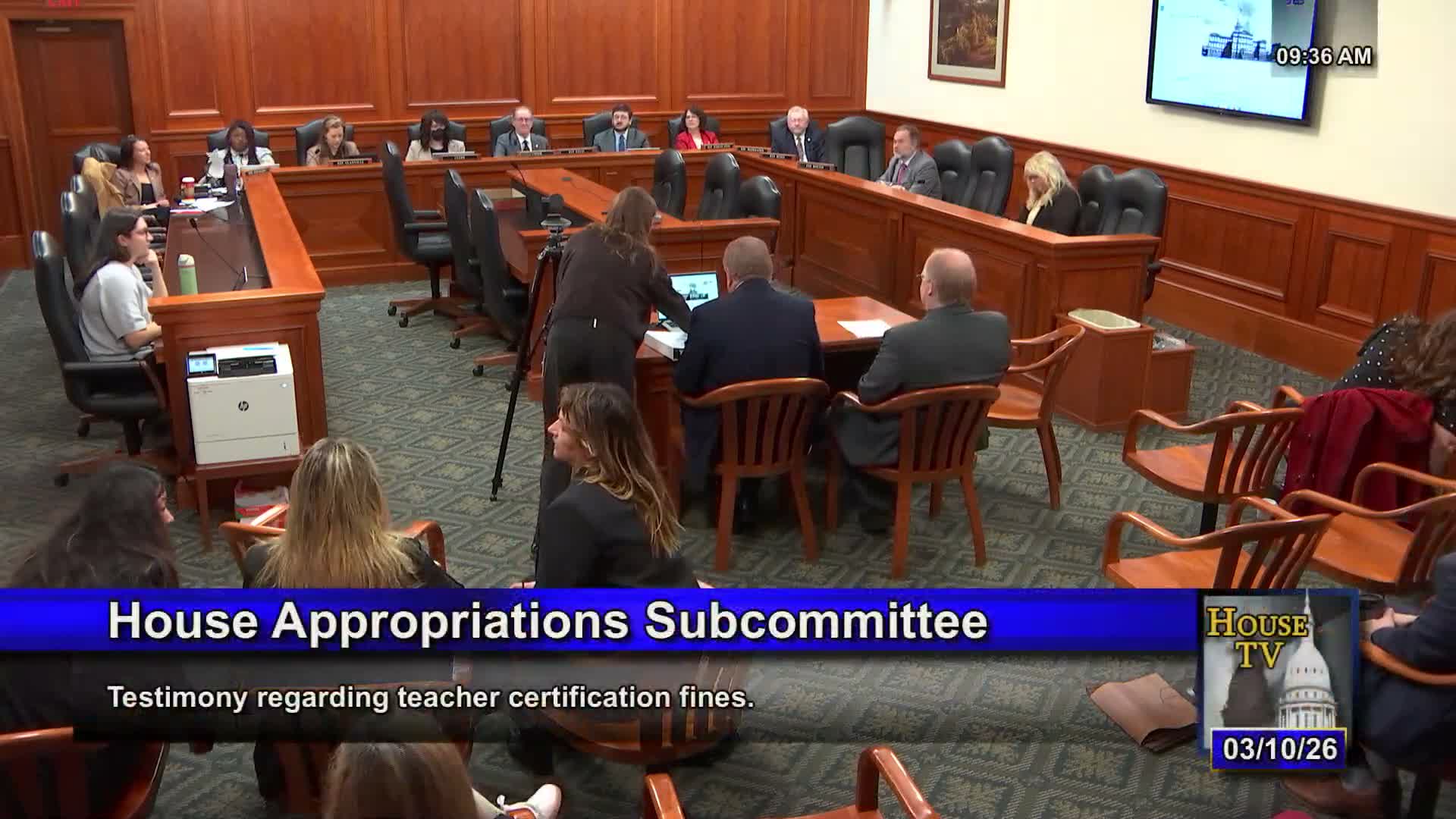
Superintendents and charter leaders told the House Appropriations Subcommittee on School Aid that current pupil-accounting and certification rules can impose disproportionate financial penalties on districts for clerical errors, and they urged lawmakers to change statutory language to allow corrective processes.
"These fines are not unique," Gene Pierce, superintendent at Tuscola Intermediate School District, told the committee, citing a Kingston Community Schools case that received an initial $85,136 penalty that was later reduced to roughly $83,000 after an appeal. Pierce said the state-maintained list of assessed penalties appears incomplete and had not been updated since 2022.
Bruce Tapio, superintendent of Norway–Vulcan Area Schools, described two fines that together totaled about $166,000 — one for $87,000 and another for $82,000 — which he said stemmed from clerical errors and retroactive reporting. "When we take money from a school ... you take from the children," Tapio said, arguing the amounts equaled the cost of hiring nearly two full teachers for his small district.
Nicole Gasper, CEO of the West Michigan Aviation Academy (a public charter high school), described a $160,000 fine her school received after a mistaken permit selection in the MDE system. She told the committee that during the appeal process she learned MDE must follow MCL 3881615 when investigating certification concerns and said the department currently has no discretion to waive or reduce retroactive penalties even for self-reported mistakes.
Representatives asked where fines are deposited. "It lapses back into the school aid fund," Olivia Ponti, legislative liaison for the Michigan Department of Education, told the panel and added the department does not benefit directly from the assessed funds.
Kelly Brozanski, director of MDE’s Office of Educator Excellence, acknowledged penalties can have a negative effect on districts and described steps the department has taken: schools are no longer subject to double penalties for the same employment, salary-deduction penalties have been reduced to 50% in some cases, and MDE has developed a teacher-certification verification report with CEPI to help districts monitor compliance. Brozanski also said the executive budget includes language to require reporting of staffing changes within 30 days to reduce retroactive penalties and give districts earlier notice.
Committee members requested historical accounting of fines and additional information on MDE staffing and administrative capacity to process grants and compliance work. MDE officials committed to follow up with the requested data.
No formal action was taken at the hearing; the committee adjourned after the presentations and questions.
"These fines are not unique," Gene Pierce, superintendent at Tuscola Intermediate School District, told the committee, citing a Kingston Community Schools case that received an initial $85,136 penalty that was later reduced to roughly $83,000 after an appeal. Pierce said the state-maintained list of assessed penalties appears incomplete and had not been updated since 2022.
Bruce Tapio, superintendent of Norway–Vulcan Area Schools, described two fines that together totaled about $166,000 — one for $87,000 and another for $82,000 — which he said stemmed from clerical errors and retroactive reporting. "When we take money from a school ... you take from the children," Tapio said, arguing the amounts equaled the cost of hiring nearly two full teachers for his small district.
Nicole Gasper, CEO of the West Michigan Aviation Academy (a public charter high school), described a $160,000 fine her school received after a mistaken permit selection in the MDE system. She told the committee that during the appeal process she learned MDE must follow MCL 3881615 when investigating certification concerns and said the department currently has no discretion to waive or reduce retroactive penalties even for self-reported mistakes.
Representatives asked where fines are deposited. "It lapses back into the school aid fund," Olivia Ponti, legislative liaison for the Michigan Department of Education, told the panel and added the department does not benefit directly from the assessed funds.
Kelly Brozanski, director of MDE’s Office of Educator Excellence, acknowledged penalties can have a negative effect on districts and described steps the department has taken: schools are no longer subject to double penalties for the same employment, salary-deduction penalties have been reduced to 50% in some cases, and MDE has developed a teacher-certification verification report with CEPI to help districts monitor compliance. Brozanski also said the executive budget includes language to require reporting of staffing changes within 30 days to reduce retroactive penalties and give districts earlier notice.
Committee members requested historical accounting of fines and additional information on MDE staffing and administrative capacity to process grants and compliance work. MDE officials committed to follow up with the requested data.
No formal action was taken at the hearing; the committee adjourned after the presentations and questions.
View the Full Meeting & All Its Details
This article offers just a summary. Unlock complete video, transcripts, and insights as a Founder Member.
✓
Watch full, unedited meeting videos
✓
Search every word spoken in unlimited transcripts
✓
AI summaries & real-time alerts (all government levels)
✓
Permanent access to expanding government content
30-day money-back guarantee
