Southampton County supervisors advertise proposed budget with 76¢ real-estate rate; water, sewer and car taxes set for publication
April 29, 2024 | Southampton County, Virginia
This article was created by AI summarizing key points discussed. AI makes mistakes, so for full details and context, please refer to the video of the full meeting. Please report any errors so we can fix them. Report an error »
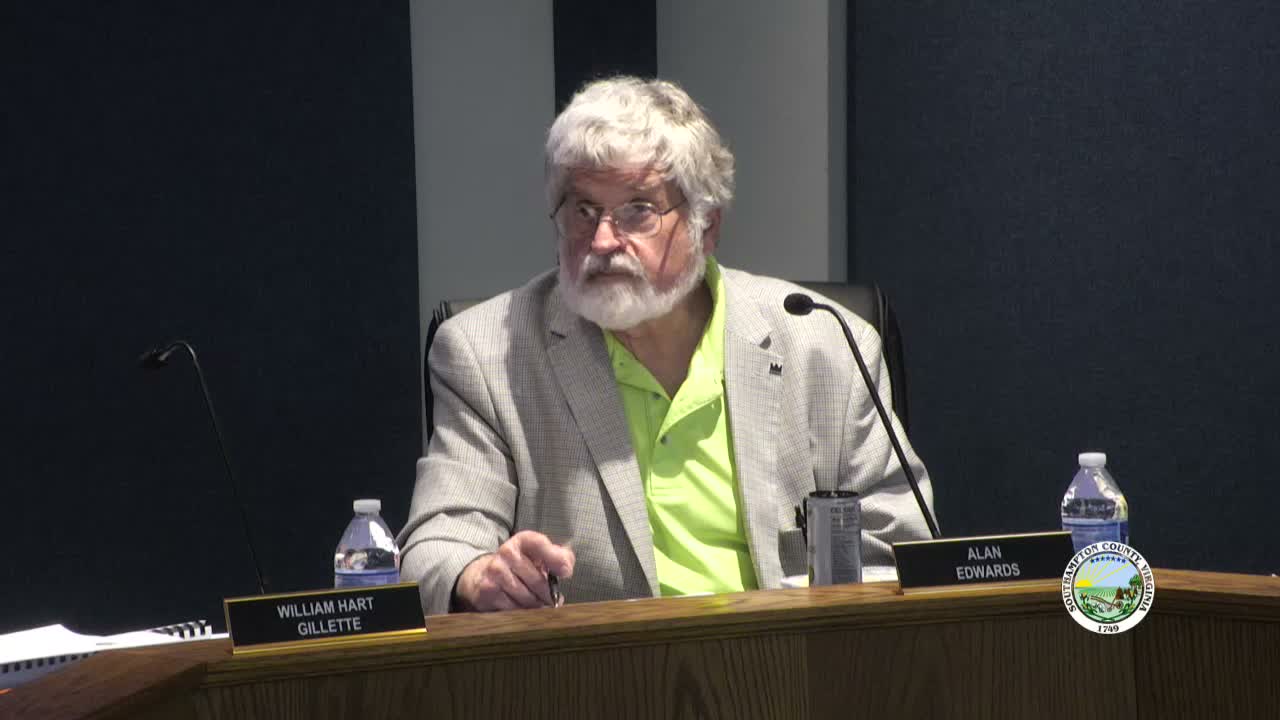
Southampton County supervisors on April 29 directed staff to advertise a proposed fiscal plan that would present a 76¢ real-estate tax rate, a $4.75 personal-property (car) tax rate and higher water and sewer monthly fees for public notice and hearings in May.
The board’s action — taken at a budget work session after more than two hours of public comment and staff briefing — sets the advertised numbers the county will publish for the required public-notice period. A final vote to adopt the budget is scheduled for June 4, after a public hearing on May 21, staff said.
Why it matters: staff warned the board that a county share of a regional radio system and higher courthouse utility costs are driving pressure on the budget. To limit the increase for homeowners, staff presented a package of expenditure reductions and revenue changes that staff said would allow the board to advertise a lower real-estate rate than originally proposed.
“What I see is a lot of questions,” the staff presenter said while walking the board through a laundry list of proposed cuts and shifts. Lynette, a finance staff member who ran updated numbers, told the board that adjustments to land-use relief and other changes altered the value of one penny on the real-estate rate to about $216,710 in the county’s computations.
Public commenters pressed the board to prioritize spending cuts over rate increases. “Why does security cost more when we spent $25,000,000 to be more secure?” resident Warren Simmons asked, questioning a jump in courthouse-security and judicial expenditures even after construction of a new courthouse. Jamie Lee urged the board to “put the new radio system on hold,” saying local vendors had not been asked for bids and that the overall radio project price was “kind of high and ridiculous.” Honor Darden and other speakers raised concerns about a large reassessment that residents said would increase their property tax burden.
Staff said the county’s share of the radio project remains under review. The county has budgeted some funds and staff cited a consultant estimate that the county may need an additional $2.0–$2.5 million of bond financing (county share) to complete the build-out; the city of Franklin serves as procurement agent for the joint project. Staff said parts of the vendor package (notably generators and some maintenance contracts) were still being evaluated and that a final contract and payment schedule were expected to be finalized soon.
School funding was a central point of debate. Lynette reported that state operating support for schools increased substantially (staff stated an increase in the school operating state funds in the transcript), and supervisors discussed a $411,261 reduction already included in the board’s proposal and the possibility of additional reductions. Board members said that even with reductions the schools would receive substantially more combined funding this year because of increased state and federal aid.
On revenue alternatives, staff laid out the arithmetic for shifting costs: increasing water and sewer fees by set increments, eliminating curbside recycling (with operational consequences and likely increased landfill tonnage costs), deferring or eliminating specific capital items and postponing or not filling new half-year positions in order to create the room on the tax rate the board sought.
After discussion, a supervisor moved to advertise the package of proposed rates — 76¢ per $100 of assessed value for real estate, $4.75 on personal property, water at $36 and sewer at $44 monthly under the proposed structure, and no increase for farm machinery — and the motion was seconded and approved by voice/hand raise (transcript records the board’s affirmative vote; no roll-call tally is listed in the transcript). The board directed staff to run the required public notices and to hold the public hearing scheduled for May 21.
What’s next: staff will publish the proposed rates and budget notices, the public will have an opportunity to comment at the May 21 hearing, and the board will consider a final adoption vote on June 4. Staff and several supervisors told the board they will continue to pursue small savings — and expect to revisit the radio project financing schedule — before the final vote.
— “I think there are a lot of aspects of this we haven’t explored,” one supervisor said, urging caution before committing debt service for the radio system.
— Resident Warren Simmons: “Why does security cost more when we spent $25,000,000 to be more secure?”
The meeting closed with an announcement about a solar-ordinance meeting the county planned to host the following night.
The board’s action — taken at a budget work session after more than two hours of public comment and staff briefing — sets the advertised numbers the county will publish for the required public-notice period. A final vote to adopt the budget is scheduled for June 4, after a public hearing on May 21, staff said.
Why it matters: staff warned the board that a county share of a regional radio system and higher courthouse utility costs are driving pressure on the budget. To limit the increase for homeowners, staff presented a package of expenditure reductions and revenue changes that staff said would allow the board to advertise a lower real-estate rate than originally proposed.
“What I see is a lot of questions,” the staff presenter said while walking the board through a laundry list of proposed cuts and shifts. Lynette, a finance staff member who ran updated numbers, told the board that adjustments to land-use relief and other changes altered the value of one penny on the real-estate rate to about $216,710 in the county’s computations.
Public commenters pressed the board to prioritize spending cuts over rate increases. “Why does security cost more when we spent $25,000,000 to be more secure?” resident Warren Simmons asked, questioning a jump in courthouse-security and judicial expenditures even after construction of a new courthouse. Jamie Lee urged the board to “put the new radio system on hold,” saying local vendors had not been asked for bids and that the overall radio project price was “kind of high and ridiculous.” Honor Darden and other speakers raised concerns about a large reassessment that residents said would increase their property tax burden.
Staff said the county’s share of the radio project remains under review. The county has budgeted some funds and staff cited a consultant estimate that the county may need an additional $2.0–$2.5 million of bond financing (county share) to complete the build-out; the city of Franklin serves as procurement agent for the joint project. Staff said parts of the vendor package (notably generators and some maintenance contracts) were still being evaluated and that a final contract and payment schedule were expected to be finalized soon.
School funding was a central point of debate. Lynette reported that state operating support for schools increased substantially (staff stated an increase in the school operating state funds in the transcript), and supervisors discussed a $411,261 reduction already included in the board’s proposal and the possibility of additional reductions. Board members said that even with reductions the schools would receive substantially more combined funding this year because of increased state and federal aid.
On revenue alternatives, staff laid out the arithmetic for shifting costs: increasing water and sewer fees by set increments, eliminating curbside recycling (with operational consequences and likely increased landfill tonnage costs), deferring or eliminating specific capital items and postponing or not filling new half-year positions in order to create the room on the tax rate the board sought.
After discussion, a supervisor moved to advertise the package of proposed rates — 76¢ per $100 of assessed value for real estate, $4.75 on personal property, water at $36 and sewer at $44 monthly under the proposed structure, and no increase for farm machinery — and the motion was seconded and approved by voice/hand raise (transcript records the board’s affirmative vote; no roll-call tally is listed in the transcript). The board directed staff to run the required public notices and to hold the public hearing scheduled for May 21.
What’s next: staff will publish the proposed rates and budget notices, the public will have an opportunity to comment at the May 21 hearing, and the board will consider a final adoption vote on June 4. Staff and several supervisors told the board they will continue to pursue small savings — and expect to revisit the radio project financing schedule — before the final vote.
— “I think there are a lot of aspects of this we haven’t explored,” one supervisor said, urging caution before committing debt service for the radio system.
— Resident Warren Simmons: “Why does security cost more when we spent $25,000,000 to be more secure?”
The meeting closed with an announcement about a solar-ordinance meeting the county planned to host the following night.
View the Full Meeting & All Its Details
This article offers just a summary. Unlock complete video, transcripts, and insights as a Founder Member.
✓
Watch full, unedited meeting videos
✓
Search every word spoken in unlimited transcripts
✓
AI summaries & real-time alerts (all government levels)
✓
Permanent access to expanding government content
30-day money-back guarantee
