Board hears options to stabilize solid‑waste fund; recycling costs and glass markets draw sharp questions
April 02, 2024 | York County, Virginia
This article was created by AI summarizing key points discussed. AI makes mistakes, so for full details and context, please refer to the video of the full meeting. Please report any errors so we can fix them. Report an error »
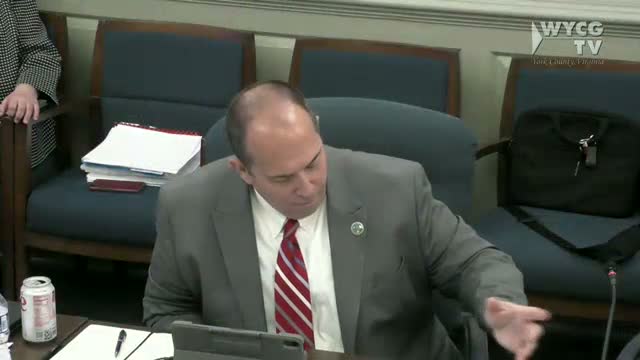
Scott Ashworth, introduced by staff as the Assistant Director of Public Works, reviewed the solid‑waste enterprise fund and told the board that contractual expenses (curbside refuse, transfer‑station hauling, VPSA services) consume roughly 81% of the fund’s $7.6 million budget. "Contractual expenses are 81% of this budget," Ashworth stated, adding that composting, curbside recycling and household chemical collection are material cost drivers (Scott Ashworth, Assistant Director of Public Works).
Staff reported options to balance the fund: (1) reduce services (for example, cut frequency of household chemical collections or senior discounts), (2) continue general‑fund support (which undermines the enterprise fund model), or (3) raise user fees. Staff recommended rate adjustments that—if implemented and held for one year—would make the enterprise fund self‑sustaining; the presentation noted York’s current basic service rate at $24.50 per month and compared neighboring jurisdictions (Hampton, Newport News, Suffolk) for context.
Several supervisors pressed recycling vendors’ practices. One supervisor argued staff had told the board that glass and many mixed plastics currently have limited markets and may be landfilled after processing; he urged reevaluating program scope to avoid paying higher tonnage fees for material that is not being recycled. "If they're going to take the glass and just crush it and take it to the landfill, I'm not putting glass in my recycle bin anymore," a supervisor said. Staff replied they receive monthly market reports from the curbside contractor showing flows of PET #1, cardboard, aluminum and some glass and that contamination and materials markets vary by material.
Why this matters: solid‑waste and recycling services represent a visible service to residents and a non‑trivial portion of the county’s enterprise fund. Raising user fees is a politically sensitive but direct lever to balance the fund; reducing services poses tradeoffs for residents who use curbside recycling and household collections.
Next steps: staff recommended adopting a one‑year rate change to stabilize the fund, monitor participation and materials flows, and return with a 6‑month report on participation, contamination and revenue impacts. The board asked staff to explore options for competition and to continue public education on acceptable curbside materials.
Staff reported options to balance the fund: (1) reduce services (for example, cut frequency of household chemical collections or senior discounts), (2) continue general‑fund support (which undermines the enterprise fund model), or (3) raise user fees. Staff recommended rate adjustments that—if implemented and held for one year—would make the enterprise fund self‑sustaining; the presentation noted York’s current basic service rate at $24.50 per month and compared neighboring jurisdictions (Hampton, Newport News, Suffolk) for context.
Several supervisors pressed recycling vendors’ practices. One supervisor argued staff had told the board that glass and many mixed plastics currently have limited markets and may be landfilled after processing; he urged reevaluating program scope to avoid paying higher tonnage fees for material that is not being recycled. "If they're going to take the glass and just crush it and take it to the landfill, I'm not putting glass in my recycle bin anymore," a supervisor said. Staff replied they receive monthly market reports from the curbside contractor showing flows of PET #1, cardboard, aluminum and some glass and that contamination and materials markets vary by material.
Why this matters: solid‑waste and recycling services represent a visible service to residents and a non‑trivial portion of the county’s enterprise fund. Raising user fees is a politically sensitive but direct lever to balance the fund; reducing services poses tradeoffs for residents who use curbside recycling and household collections.
Next steps: staff recommended adopting a one‑year rate change to stabilize the fund, monitor participation and materials flows, and return with a 6‑month report on participation, contamination and revenue impacts. The board asked staff to explore options for competition and to continue public education on acceptable curbside materials.
View the Full Meeting & All Its Details
This article offers just a summary. Unlock complete video, transcripts, and insights as a Founder Member.
✓
Watch full, unedited meeting videos
✓
Search every word spoken in unlimited transcripts
✓
AI summaries & real-time alerts (all government levels)
✓
Permanent access to expanding government content
30-day money-back guarantee
