Commission examines displacement map, water-supply checks and Commerce checklist in comprehensive plan update
March 04, 2026 | Clallam County, Washington
This article was created by AI summarizing key points discussed. AI makes mistakes, so for full details and context, please refer to the video of the full meeting. Please report any errors so we can fix them. Report an error »
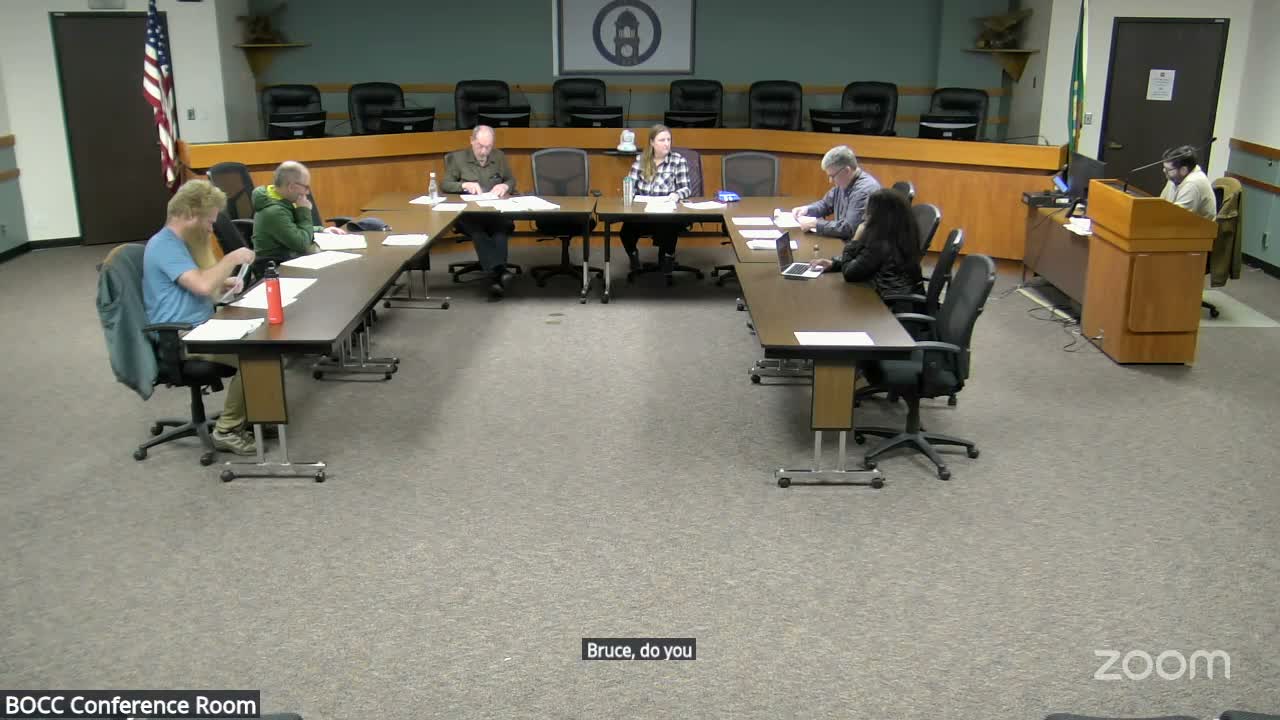
Planning staff used the commission's work session to walk through proposed edits to the comprehensive plan's policy tables and the Department of Commerce checklist, and commissioners discussed several substantive policy proposals raised during testimony.
Staff said the Commerce checklist identifies areas where the county must either adopt policy changes or note exemptions for a largely rural jurisdiction. "Five of the six items were transportation related that Clallam County being a rural county is not obligated to respond to," staff said, adding the county proposed narrative responses where required. Staff also summarized a 2023 draft displacement risk map from the Department of Commerce and recommended standards and resources to address areas potentially at high risk of housing displacement, including core Port Angeles and a Forks-area vicinity.
Commissioners and staff debated specific policy wording. Several commissioners favored relying on state definitions (WAC/RCW) for terms such as "environmental justice" rather than creating new local definitions. On pollutants, commissioners discussed removing the qualifier "conventional" to avoid limiting protections only to an enumerated subset of contaminants.
Water supply emerged as a recurring concern in rural parts of the Western Region. Staff and commissioners proposed tying the county's test for "major new development" to the Department of Ecology threshold that triggers a water-right review (generally described in the meeting as 5,000 gallons per day). Under the suggested language, proposals that require a water right would need to demonstrate that withdrawals would not adversely affect adjacent wells, local water systems or river/stream hydrology before approvals would be recommended.
Transportation mitigation language also drew scrutiny. Commissioners cautioned that measures such as ride-sharing and demand management, while included in state guidance, may be impractical in a rural county and could be misused as catch-all strategies; staff said the phrase in question was framed as "may include" and originated in the RCW.
Staff said it will refine the draft language, fold public testimony into table 3 where appropriate, and bring revised policy text back to the commission for additional wordsmithing at a future meeting. The commission agreed to revisit remaining items — including an ag accessory use topic — at an upcoming session.
Staff said the Commerce checklist identifies areas where the county must either adopt policy changes or note exemptions for a largely rural jurisdiction. "Five of the six items were transportation related that Clallam County being a rural county is not obligated to respond to," staff said, adding the county proposed narrative responses where required. Staff also summarized a 2023 draft displacement risk map from the Department of Commerce and recommended standards and resources to address areas potentially at high risk of housing displacement, including core Port Angeles and a Forks-area vicinity.
Commissioners and staff debated specific policy wording. Several commissioners favored relying on state definitions (WAC/RCW) for terms such as "environmental justice" rather than creating new local definitions. On pollutants, commissioners discussed removing the qualifier "conventional" to avoid limiting protections only to an enumerated subset of contaminants.
Water supply emerged as a recurring concern in rural parts of the Western Region. Staff and commissioners proposed tying the county's test for "major new development" to the Department of Ecology threshold that triggers a water-right review (generally described in the meeting as 5,000 gallons per day). Under the suggested language, proposals that require a water right would need to demonstrate that withdrawals would not adversely affect adjacent wells, local water systems or river/stream hydrology before approvals would be recommended.
Transportation mitigation language also drew scrutiny. Commissioners cautioned that measures such as ride-sharing and demand management, while included in state guidance, may be impractical in a rural county and could be misused as catch-all strategies; staff said the phrase in question was framed as "may include" and originated in the RCW.
Staff said it will refine the draft language, fold public testimony into table 3 where appropriate, and bring revised policy text back to the commission for additional wordsmithing at a future meeting. The commission agreed to revisit remaining items — including an ag accessory use topic — at an upcoming session.
Don't Miss a Word: See the Full Meeting!
Go beyond summaries. Unlock every video, transcript, and key insight with a Founder Membership.
✓
Get instant access to full meeting videos
✓
Search and clip any phrase from complete transcripts
✓
Receive AI-powered summaries & custom alerts
✓
Enjoy lifetime, unrestricted access to government data
30-day money-back guarantee
