Commissioner urges indefinite postponement of ordinance reclassification that could ease data‑center siting; board debates public‑notice concerns
March 10, 2026 | St. Louis County, Minnesota
This article was created by AI summarizing key points discussed. AI makes mistakes, so for full details and context, please refer to the video of the full meeting. Please report any errors so we can fix them. Report an error »
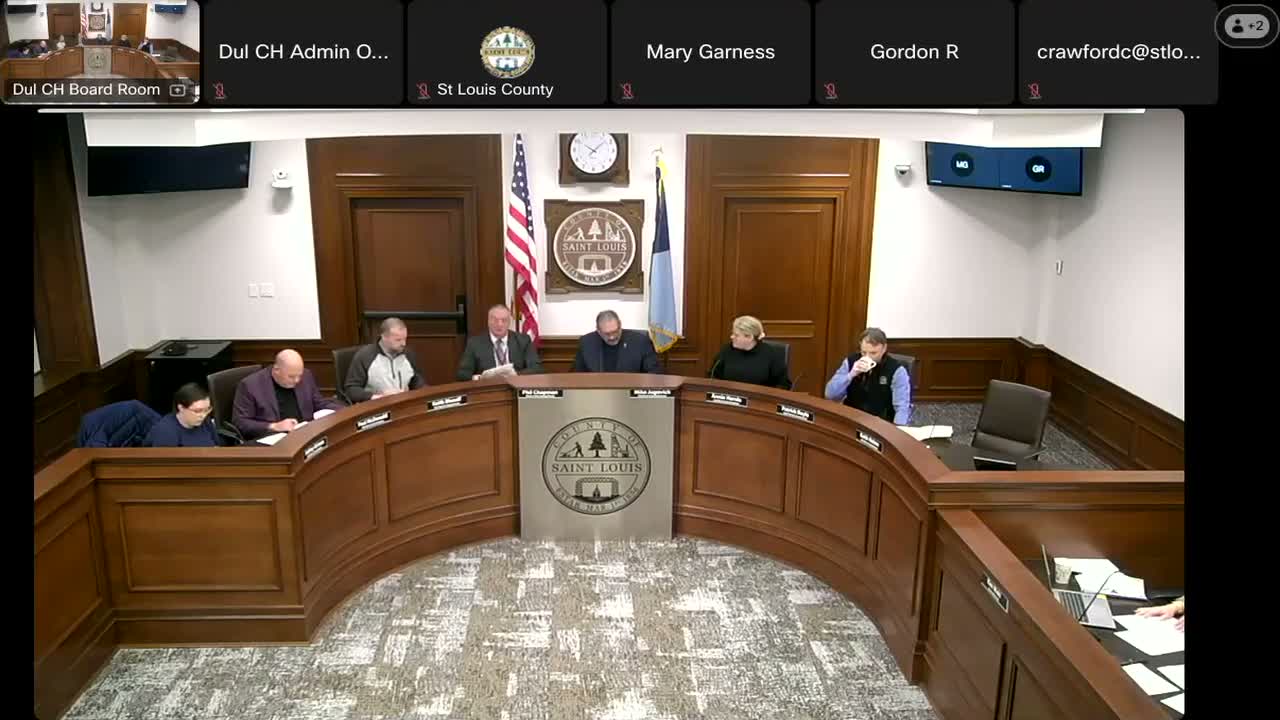
A county commissioner on Wednesday pushed to postpone indefinitely an item tied to amendments to ordinance 62, saying the public did not realize the changes would allow data centers to be reclassified to an industrial designation in areas the county was considering.
"It has never been named that I know of publicly, that these are... a zoning change for data centers," Commissioner Grimm said during debate, arguing that earlier planning‑department public sessions had low attendance while the board chamber had seen large public turnout. "When cannabis was legalized, we named that. The community knew... We need to be clear about what is actually being proposed within ordinance 62."
Attorney Mackey and other staff explained procedural options under Robert’s Rules: a motion to postpone indefinitely would effectively kill the main motion and is fully debatable; the board also uses motions to table to a date certain as an alternative. Mackey said the main motion on the floor at that point was to set a public hearing for April 14, and that subsidiary motions must be resolved before acting on the main motion. (Attorney Mackey)
Commissioners voiced competing views. Some said the county had followed the letter of statutory notice and that affected processes — environmental review and CUPs — still apply; others said the county should explicitly tell residents that ordinance changes include data‑center reclassifications and offer new public‑input sessions to increase awareness.
The transcript records the motion to postpone indefinitely being moved and seconded and then debated; subsequent votes and procedural calls followed during the meeting. The record contains multiple voice and roll‑call exchanges on the related procedural motions; the transcript does not present a single clean roll‑call result for every subsidiary motion in this section of the record.
What happens next: The matter remained subject to procedural resolution in the meeting’s record; the board proceeded with its agenda after addressing the procedural motions and public hearing scheduling.
Reporting note: This article limits factual claims to what appears in the recorded discussion: who moved the postponement, the procedural explanation given by counsel, and the substance of commissioners’ remarks about public notice. It does not assert an ultimate ordinance outcome beyond the procedural votes recorded in the transcript.
"It has never been named that I know of publicly, that these are... a zoning change for data centers," Commissioner Grimm said during debate, arguing that earlier planning‑department public sessions had low attendance while the board chamber had seen large public turnout. "When cannabis was legalized, we named that. The community knew... We need to be clear about what is actually being proposed within ordinance 62."
Attorney Mackey and other staff explained procedural options under Robert’s Rules: a motion to postpone indefinitely would effectively kill the main motion and is fully debatable; the board also uses motions to table to a date certain as an alternative. Mackey said the main motion on the floor at that point was to set a public hearing for April 14, and that subsidiary motions must be resolved before acting on the main motion. (Attorney Mackey)
Commissioners voiced competing views. Some said the county had followed the letter of statutory notice and that affected processes — environmental review and CUPs — still apply; others said the county should explicitly tell residents that ordinance changes include data‑center reclassifications and offer new public‑input sessions to increase awareness.
The transcript records the motion to postpone indefinitely being moved and seconded and then debated; subsequent votes and procedural calls followed during the meeting. The record contains multiple voice and roll‑call exchanges on the related procedural motions; the transcript does not present a single clean roll‑call result for every subsidiary motion in this section of the record.
What happens next: The matter remained subject to procedural resolution in the meeting’s record; the board proceeded with its agenda after addressing the procedural motions and public hearing scheduling.
Reporting note: This article limits factual claims to what appears in the recorded discussion: who moved the postponement, the procedural explanation given by counsel, and the substance of commissioners’ remarks about public notice. It does not assert an ultimate ordinance outcome beyond the procedural votes recorded in the transcript.
View the Full Meeting & All Its Details
This article offers just a summary. Unlock complete video, transcripts, and insights as a Founder Member.
✓
Watch full, unedited meeting videos
✓
Search every word spoken in unlimited transcripts
✓
AI summaries & real-time alerts (all government levels)
✓
Permanent access to expanding government content
30-day money-back guarantee
