Minnesota AG urges funding to expand Medicaid fraud unit; committee approves re‑referral
March 10, 2026 | 2026 Legislature MN, Minnesota
This article was created by AI summarizing key points discussed. AI makes mistakes, so for full details and context, please refer to the video of the full meeting. Please report any errors so we can fix them. Report an error »
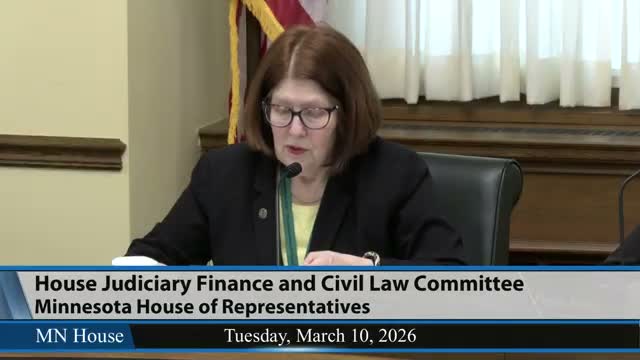
Attorney General Ellison told the House Judiciary Committee on March 10 that an amended Medical Assistance Protection (MAP) Act would expand Minnesota’s Medicaid Fraud Control Unit and sharpen the state’s tools to recover fraudulently obtained Medicaid funds.
Ellison said the bill would add 18 specialized staff to the unit — increasing its size from 32 to 50 — and that Minnesota would pay 25 percent of the cost while the federal government would provide the remaining 75 percent through the matching program. “For the price of one fraud fighter, Minnesota gets three more,” Ellison said.
Representative Matt Norris, the House author, framed the bill as a bipartisan response to rising fraud that diverts money intended for low‑income Minnesotans. Nick Wonka, director of the Medicaid Fraud Control Unit, explained technical changes included in the proposal: expanded subpoena authority limited to Medicaid provider fraud investigations (to obtain bank and financial records), clarified venue rules to permit charging in any county where part of an offense or a claim for payment occurred, and a restitution provision that would allow courts to order repayment for related conduct so long as the state provides notice to the defendant.
Wonka said the subpoena changes are intended to speed investigations: while federal law does not require bank records, ‘to prove a crime of fraud, we need to obtain bank records.’ He also described how MFCU investigators can be affiants on warrants and how sworn officers typically serve and secure search warrants in the field.
Committee members asked several questions about the design and oversight of the program, including whether the Attorney General’s office duplicates the Bureau of Criminal Apprehension (BCA). Ellison and Wonka said federal grant rules require MFCU investigators to be employed by and supervised within the AG’s office and to work exclusively on Medicaid fraud, and they cited increases in referrals and the growing Medicaid budget as reasons for the expansion.
The committee approved a voice motion to re‑refer House File 2354 to the Public Safety Finance & Policy Committee.
What’s next: HF2354 was re‑referred; staff and members asked for additional materials about staffing comparisons and CMS audit findings to inform further review.
Ellison said the bill would add 18 specialized staff to the unit — increasing its size from 32 to 50 — and that Minnesota would pay 25 percent of the cost while the federal government would provide the remaining 75 percent through the matching program. “For the price of one fraud fighter, Minnesota gets three more,” Ellison said.
Representative Matt Norris, the House author, framed the bill as a bipartisan response to rising fraud that diverts money intended for low‑income Minnesotans. Nick Wonka, director of the Medicaid Fraud Control Unit, explained technical changes included in the proposal: expanded subpoena authority limited to Medicaid provider fraud investigations (to obtain bank and financial records), clarified venue rules to permit charging in any county where part of an offense or a claim for payment occurred, and a restitution provision that would allow courts to order repayment for related conduct so long as the state provides notice to the defendant.
Wonka said the subpoena changes are intended to speed investigations: while federal law does not require bank records, ‘to prove a crime of fraud, we need to obtain bank records.’ He also described how MFCU investigators can be affiants on warrants and how sworn officers typically serve and secure search warrants in the field.
Committee members asked several questions about the design and oversight of the program, including whether the Attorney General’s office duplicates the Bureau of Criminal Apprehension (BCA). Ellison and Wonka said federal grant rules require MFCU investigators to be employed by and supervised within the AG’s office and to work exclusively on Medicaid fraud, and they cited increases in referrals and the growing Medicaid budget as reasons for the expansion.
The committee approved a voice motion to re‑refer House File 2354 to the Public Safety Finance & Policy Committee.
What’s next: HF2354 was re‑referred; staff and members asked for additional materials about staffing comparisons and CMS audit findings to inform further review.
View the Full Meeting & All Its Details
This article offers just a summary. Unlock complete video, transcripts, and insights as a Founder Member.
✓
Watch full, unedited meeting videos
✓
Search every word spoken in unlimited transcripts
✓
AI summaries & real-time alerts (all government levels)
✓
Permanent access to expanding government content
30-day money-back guarantee
