Educators at Missoula town hall warn teacher shortages and funding gaps threaten schools
March 09, 2026 | Missoula, Missoula County, Montana
This article was created by AI summarizing key points discussed. AI makes mistakes, so for full details and context, please refer to the video of the full meeting. Please report any errors so we can fix them. Report an error »
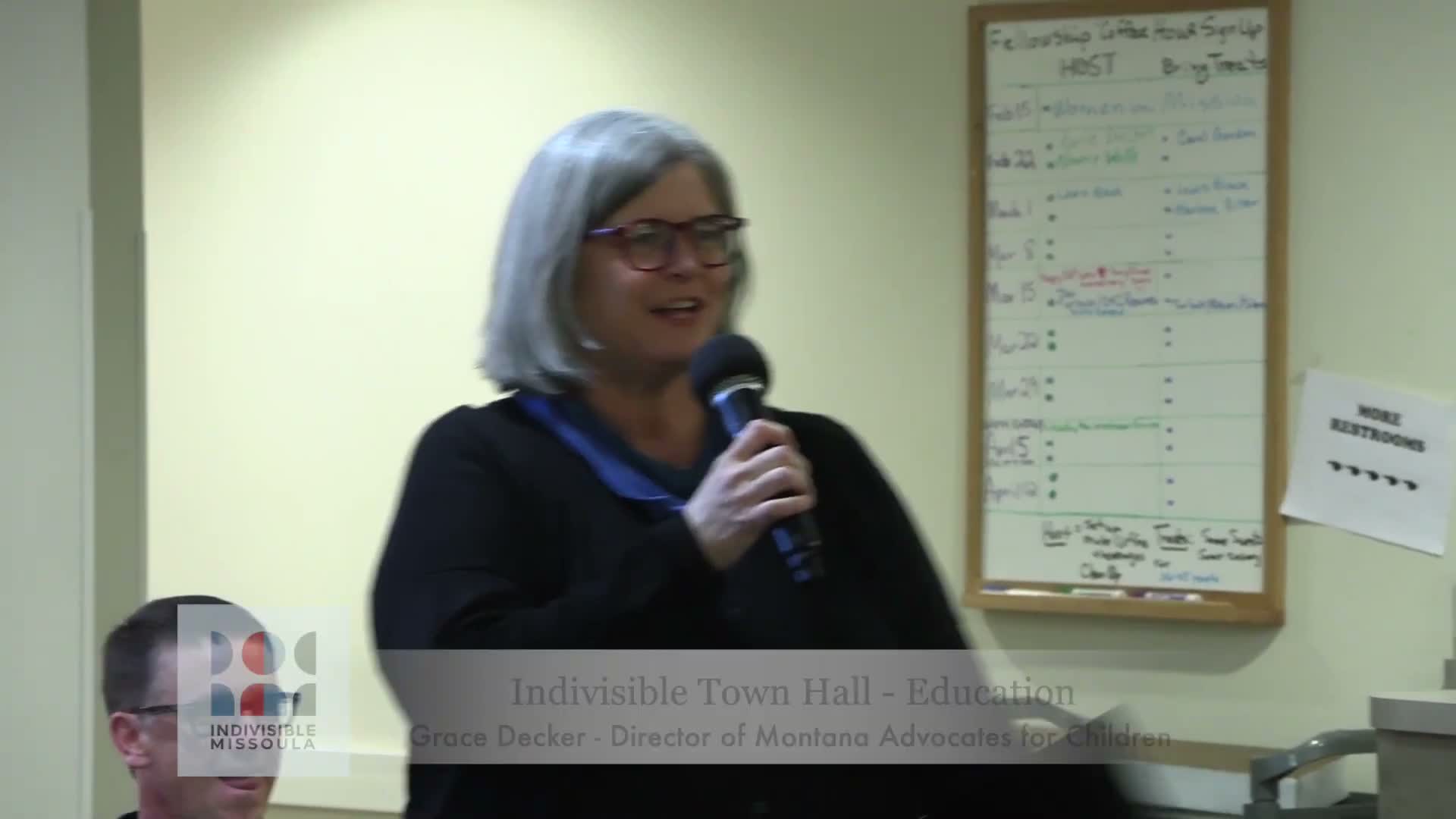
Educators and community organizers at an Indivisible Missoula town hall on education said budget shortfalls, teacher shortages and a politicized classroom environment are reducing schools' capacity to serve students and urged residents to organize to pass levies and support school staff.
The panel — moderated by Denise Juno, introduced as a longtime educator and recently sworn associate justice for the Court of Appeals for the Confederated Salish and Kootenai tribes — framed the discussion around early childhood through K–12 needs and asked the audience to help define immediate steps for the next legislative session.
Micah Hill, superintendent of Missoula County Public Schools, said the district is “losing teachers faster than we’re replacing them,” and described a confluence of challenges: recruitment declines, budget limits and new legal requirements that make classroom instruction more legally fraught. “When there’s a classroom that doesn’t have a special-education teacher, that’s someone really missing out on opportunity,” Hill said, urging residents to back levies and local organizing.
Grace Decker, director of Montana Advocates for Children, opened the meeting by emphasizing the importance of the birth–5 window and the underpaid workforce that serves it, noting early-care providers often earn “wages lower than we pay dishwashers” and calling for pay and policies that treat childcare as public infrastructure.
Panelists also pressed for clearer, multi-year state commitments if federal funding shifts. Brandon Brown, director of special services at Hellgate Elementary, pointed to IDEA’s intent that excess costs be reimbursed and said Montana historically receives far less than the statute’s target, making districts reliant on unpredictable local levies and ad hoc community supports.
Why it matters: local funding choices and state policy decisions will shape whether Missoula schools can keep teachers, provide special-education services and expand supports such as counseling and early-childhood care. Panelists urged residents to engage year-round — not only in election season — and offered organizing tactics including forming local “packs” to support levies, canvassing, and encouraging experienced educators to run for office.
The town hall closed with practical next steps: micro-grants and a Courage Collective pathway for groups to fund media and canvassing, and an invitation to continued local organizing and monthly topic meetings.
The panel — moderated by Denise Juno, introduced as a longtime educator and recently sworn associate justice for the Court of Appeals for the Confederated Salish and Kootenai tribes — framed the discussion around early childhood through K–12 needs and asked the audience to help define immediate steps for the next legislative session.
Micah Hill, superintendent of Missoula County Public Schools, said the district is “losing teachers faster than we’re replacing them,” and described a confluence of challenges: recruitment declines, budget limits and new legal requirements that make classroom instruction more legally fraught. “When there’s a classroom that doesn’t have a special-education teacher, that’s someone really missing out on opportunity,” Hill said, urging residents to back levies and local organizing.
Grace Decker, director of Montana Advocates for Children, opened the meeting by emphasizing the importance of the birth–5 window and the underpaid workforce that serves it, noting early-care providers often earn “wages lower than we pay dishwashers” and calling for pay and policies that treat childcare as public infrastructure.
Panelists also pressed for clearer, multi-year state commitments if federal funding shifts. Brandon Brown, director of special services at Hellgate Elementary, pointed to IDEA’s intent that excess costs be reimbursed and said Montana historically receives far less than the statute’s target, making districts reliant on unpredictable local levies and ad hoc community supports.
Why it matters: local funding choices and state policy decisions will shape whether Missoula schools can keep teachers, provide special-education services and expand supports such as counseling and early-childhood care. Panelists urged residents to engage year-round — not only in election season — and offered organizing tactics including forming local “packs” to support levies, canvassing, and encouraging experienced educators to run for office.
The town hall closed with practical next steps: micro-grants and a Courage Collective pathway for groups to fund media and canvassing, and an invitation to continued local organizing and monthly topic meetings.
View the Full Meeting & All Its Details
This article offers just a summary. Unlock complete video, transcripts, and insights as a Founder Member.
✓
Watch full, unedited meeting videos
✓
Search every word spoken in unlimited transcripts
✓
AI summaries & real-time alerts (all government levels)
✓
Permanent access to expanding government content
30-day money-back guarantee
