MDHHS official outlines child‑welfare reforms and residential bed strategy amid service gaps
March 09, 2026 | 2025-2026 House Legislature MI, Michigan
This article was created by AI summarizing key points discussed. AI makes mistakes, so for full details and context, please refer to the video of the full meeting. Please report any errors so we can fix them. Report an error »
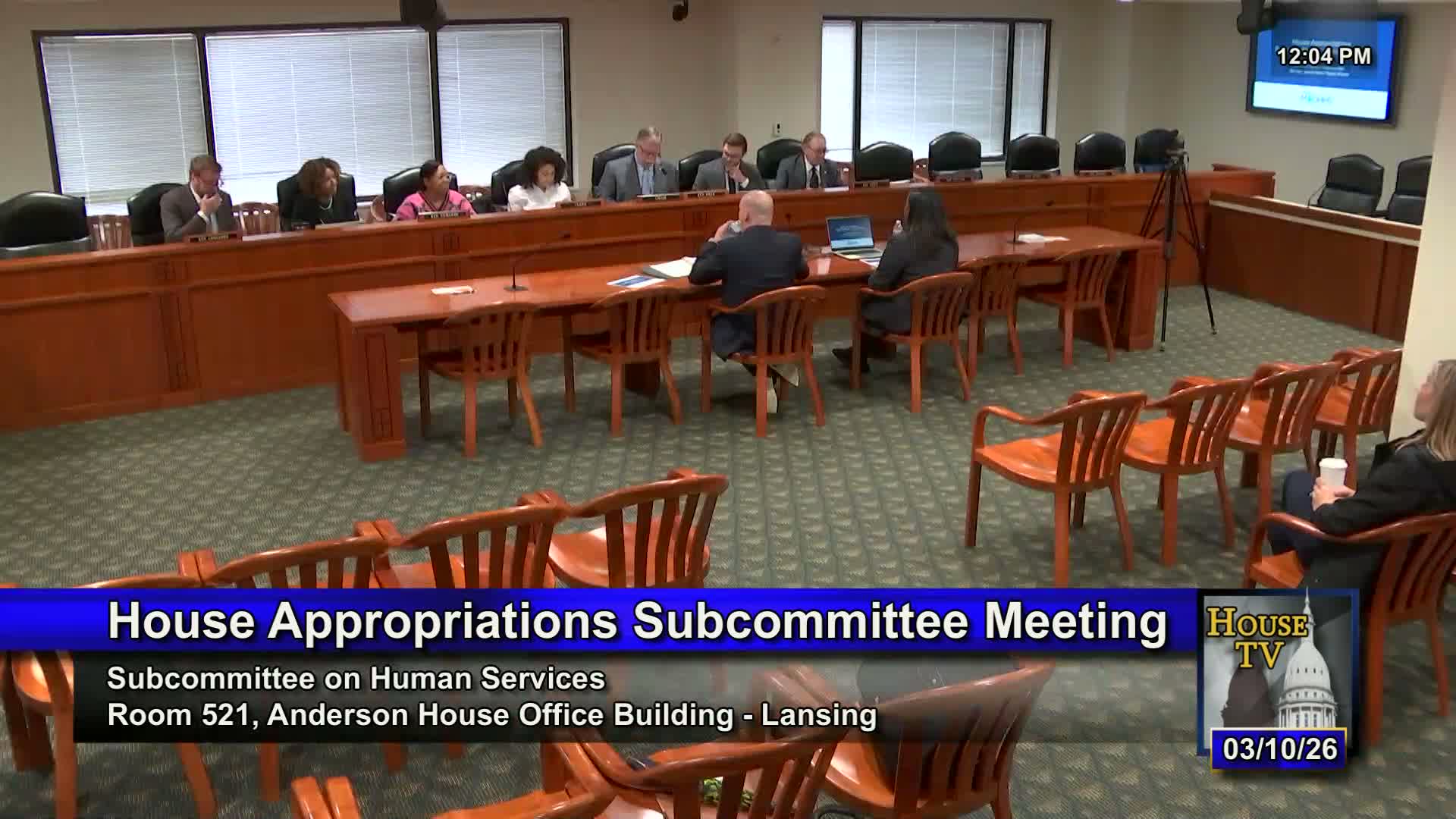
Tim Click, interim senior deputy director for the Children’s Services Administration at the Michigan Department of Health and Human Services, told the House Appropriations Subcommittee on Human Services that the department has reduced monitored obligations from earlier versions of the federal consent decree and is focused on targeted outcomes to exit federal oversight.
"We are now down to 42 commitments," Click said, referencing the streamlined modified implementation, sustainability and exit plan. He told the panel that recent court hearings found the department met or exceeded performance standards in six monitored areas and was within 10% in three more.
Why it matters: the department framed recent gains — including a rise in permanency within 12 months from about 9.5% for the 2023 cohort to nearly 23% for the 2024 cohort — as evidence that targeted strategies (permanent resource managers, earlier attorney engagement and more frequent team decision-making meetings) are improving outcomes for children.
Click described structural changes the department has made: a division of continuous quality improvement, a statewide centralized intake unit that fields child-protection reports 24/7, a full maltreatment care unit, and increased oversight of congregate-care facilities to boost safety and quality.
On residential capacity and the Michigan Youth Treatment Center (MYTC): Click said the department has shifted away from legacy facilities, closing the Shawano center in December 2024 because of staffing, infrastructure and quality concerns, and relocating services to a phased MYTC intake in Macomb County. "We began accepting youth on 06/30/2025," he said. "The center is intentionally designed to scale to approximately 60 beds. However, any expansion is contingent on workforce readiness, clinical capacity, and meeting established quality benchmarks."
Committee members pressed for specifics on occupancy and wait lists. Click said MYTC had 16 youth in place and capacity for up to 60, and that statewide there were about 60 youth on a wait list — a metric that has varied (he cited earlier highs near 120 and lows near 40). He emphasized that the wait list reflects a need for specialized programs, not only bed availability: "Beds aren't the issue here. Service availability is the issue here," Click said, adding that many youth on the wait list require intensive treatment and programs tailored to specific clinical needs.
MDHHS described contracting changes intended to stabilize providers: a new rate structure with an approximate 5.14% base-rate increase, payment for contracted beds whether occupied or vacant to allow providers to plan staffing, and incentive payments to encourage acceptance of appropriate referrals and reduce unplanned discharges. The department also eliminated "general residential" as a placement category to reserve residential care for youth who require intensive treatment.
On juvenile justice reforms, Click credited recent legislation (the Justice for Kids and Communities Act, in effect October 2024) and a reimbursement-rate increase to 75% for community-based services with helping keep youth closer to home. Click said the change supported services for more than 110,000 youth in FY2025 across 83 counties and 12 tribes, with an investment of over $137 million.
Tools and next steps: MDHHS has launched a centralized bed-management tool to show real-time availability and plans a separate statewide bed-and-services needs survey recommended by the Residential Facilities Advisory Committee. Click said Phase 2 of the bed-management tool — developed with the University of Michigan Adolescent Data Lab — will support more efficient, data-driven placement decisions.
Requests and follow-up: Committee members asked for a list of the 42 remaining metrics and for the validated screening and training tools used statewide; Click said the department would provide those materials. Several members also asked the department to follow up with which states have exited federal oversight and how those exits were achieved; Click said he would circulate that information.
The subcommittee concluded without votes on policy items; the minutes for the meeting were approved at the outset.
Next procedural step: MDHHS committed to provide the committee with the list of 42 monitored metrics, screening tools, and additional follow-up on states that have exited oversight.
"We are now down to 42 commitments," Click said, referencing the streamlined modified implementation, sustainability and exit plan. He told the panel that recent court hearings found the department met or exceeded performance standards in six monitored areas and was within 10% in three more.
Why it matters: the department framed recent gains — including a rise in permanency within 12 months from about 9.5% for the 2023 cohort to nearly 23% for the 2024 cohort — as evidence that targeted strategies (permanent resource managers, earlier attorney engagement and more frequent team decision-making meetings) are improving outcomes for children.
Click described structural changes the department has made: a division of continuous quality improvement, a statewide centralized intake unit that fields child-protection reports 24/7, a full maltreatment care unit, and increased oversight of congregate-care facilities to boost safety and quality.
On residential capacity and the Michigan Youth Treatment Center (MYTC): Click said the department has shifted away from legacy facilities, closing the Shawano center in December 2024 because of staffing, infrastructure and quality concerns, and relocating services to a phased MYTC intake in Macomb County. "We began accepting youth on 06/30/2025," he said. "The center is intentionally designed to scale to approximately 60 beds. However, any expansion is contingent on workforce readiness, clinical capacity, and meeting established quality benchmarks."
Committee members pressed for specifics on occupancy and wait lists. Click said MYTC had 16 youth in place and capacity for up to 60, and that statewide there were about 60 youth on a wait list — a metric that has varied (he cited earlier highs near 120 and lows near 40). He emphasized that the wait list reflects a need for specialized programs, not only bed availability: "Beds aren't the issue here. Service availability is the issue here," Click said, adding that many youth on the wait list require intensive treatment and programs tailored to specific clinical needs.
MDHHS described contracting changes intended to stabilize providers: a new rate structure with an approximate 5.14% base-rate increase, payment for contracted beds whether occupied or vacant to allow providers to plan staffing, and incentive payments to encourage acceptance of appropriate referrals and reduce unplanned discharges. The department also eliminated "general residential" as a placement category to reserve residential care for youth who require intensive treatment.
On juvenile justice reforms, Click credited recent legislation (the Justice for Kids and Communities Act, in effect October 2024) and a reimbursement-rate increase to 75% for community-based services with helping keep youth closer to home. Click said the change supported services for more than 110,000 youth in FY2025 across 83 counties and 12 tribes, with an investment of over $137 million.
Tools and next steps: MDHHS has launched a centralized bed-management tool to show real-time availability and plans a separate statewide bed-and-services needs survey recommended by the Residential Facilities Advisory Committee. Click said Phase 2 of the bed-management tool — developed with the University of Michigan Adolescent Data Lab — will support more efficient, data-driven placement decisions.
Requests and follow-up: Committee members asked for a list of the 42 remaining metrics and for the validated screening and training tools used statewide; Click said the department would provide those materials. Several members also asked the department to follow up with which states have exited federal oversight and how those exits were achieved; Click said he would circulate that information.
The subcommittee concluded without votes on policy items; the minutes for the meeting were approved at the outset.
Next procedural step: MDHHS committed to provide the committee with the list of 42 monitored metrics, screening tools, and additional follow-up on states that have exited oversight.
Don't Miss a Word: See the Full Meeting!
Go beyond summaries. Unlock every video, transcript, and key insight with a Founder Membership.
✓
Get instant access to full meeting videos
✓
Search and clip any phrase from complete transcripts
✓
Receive AI-powered summaries & custom alerts
✓
Enjoy lifetime, unrestricted access to government data
30-day money-back guarantee
