Officials debate haul-road terms, inspections and dust control in Garrison Diversion pipeline agreement
March 10, 2026 | Griggs County, North Dakota
This article was created by AI summarizing key points discussed. AI makes mistakes, so for full details and context, please refer to the video of the full meeting. Please report any errors so we can fix them. Report an error »
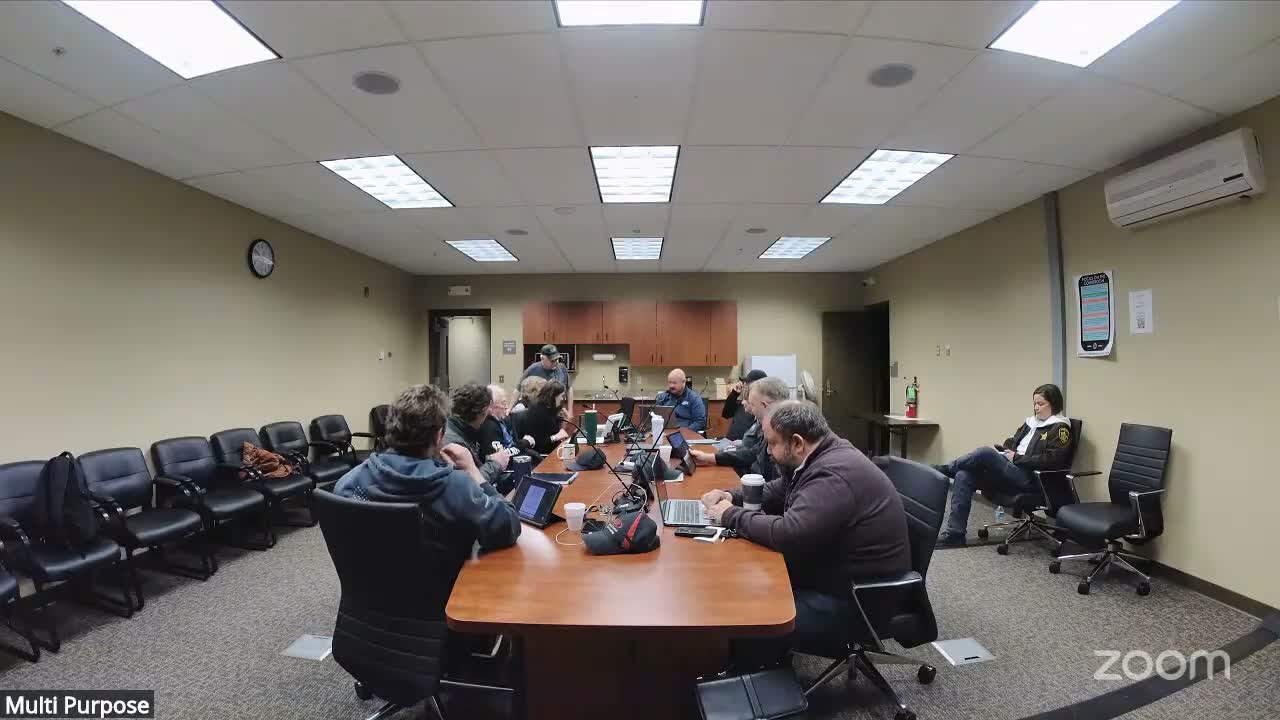
County attorneys and representatives of Garrison Diversion spent the bulk of the March 9 meeting negotiating the draft haul-road agreement for a pipeline project that will use county roads.
The county attorney (State's Attorney S2) flagged several redlines, including a change in the blading payment unit and a $5,000,000 surety bond reference. “There is one where we talked about the $5,000,000 surety bond,” S2 said, urging commissioners to review bond and indemnity language. Garrison Diversion’s representative (S11) told the board that the construction contract already requires contractor inspections: “As part of the construction contract…Carstensen Contracting…they have to do these inspections, road inspections, pre‑preconstruction. They videotape them.” S11 proposed using those contractor inspections where feasible to avoid duplicate billing to the county.
A key unresolved point was who performs and certifies the pre‑ and post‑haul inspections. The county’s draft calls for a third‑party consultant (the county had planned to use KLJ) to document road conditions before and after hauling; commissioners emphasized consistent measurement points. S2 recommended fixing the measurement standard in the contract: “I think I’ll just put at least four measurements per mile must be taken,” to produce a reliable average for pre/post comparisons. Commissioners signaled they wanted both preconstruction and postconstruction assessments to verify whether restoration obligations had been met.
Contract language on permitted vehicles was also tightened. Commissioners voiced concern about heavier off‑road equipment and articulated dump trucks, and S2 said the contract should explicitly exclude those vehicles from haul‑road traffic. “We definitely don’t want those on the road,” one commissioner said in support of an exclusion.
Dust control and roadway protection were addressed in detail. The draft requires the project to apply a palliative treatment: “Garrison shall provide palliative dust…a 38% concentrated calcium chloride treatment to control the dust and protect the road surface,” S2 read from the draft. Commissioners debated whether to specify a minimum number of applications or allow treatment "as needed." The board leaned toward a minimum (for example, twice a year) while allowing additional applications when conditions require.
The draft fee schedule drew questions about supervision and vehicle charges. Discussion clarified potentially inconsistent wording: staff noted a vehicle charge and a personnel supervision rate, later summarized in the draft as law‑enforcement response at $80 per hour per person and $25 per hour per vehicle, while meeting comments sometimes referenced a $75 vehicle daily charge in practice. Commissioners asked staff to reconcile the contract language to reflect the county’s intended billing approach.
On grading/blading rates, the draft contained a substantial unit change that commissioners generally supported. The attorney noted the blading payment had been edited from a small per‑unit figure to a proposed $400 per mile; several commissioners said that matched recent local agreements and recommended approving the higher per‑mile payment for this project.
Township engagement and next steps: commissioners asked staff to bring the draft to the County Township Officers Association meeting scheduled for 1:30 p.m. the next day to collect township input; staff and Garrison representatives said they would circulate a revised draft and could call a short special meeting later in the week to finalize the agreement. Commissioner and staff requests make oversight and documented pre/post inspections a condition of moving forward.
The meeting closed with staff committed to updating the contract and sharing the revised document with commissioners and townships for review.
The county attorney (State's Attorney S2) flagged several redlines, including a change in the blading payment unit and a $5,000,000 surety bond reference. “There is one where we talked about the $5,000,000 surety bond,” S2 said, urging commissioners to review bond and indemnity language. Garrison Diversion’s representative (S11) told the board that the construction contract already requires contractor inspections: “As part of the construction contract…Carstensen Contracting…they have to do these inspections, road inspections, pre‑preconstruction. They videotape them.” S11 proposed using those contractor inspections where feasible to avoid duplicate billing to the county.
A key unresolved point was who performs and certifies the pre‑ and post‑haul inspections. The county’s draft calls for a third‑party consultant (the county had planned to use KLJ) to document road conditions before and after hauling; commissioners emphasized consistent measurement points. S2 recommended fixing the measurement standard in the contract: “I think I’ll just put at least four measurements per mile must be taken,” to produce a reliable average for pre/post comparisons. Commissioners signaled they wanted both preconstruction and postconstruction assessments to verify whether restoration obligations had been met.
Contract language on permitted vehicles was also tightened. Commissioners voiced concern about heavier off‑road equipment and articulated dump trucks, and S2 said the contract should explicitly exclude those vehicles from haul‑road traffic. “We definitely don’t want those on the road,” one commissioner said in support of an exclusion.
Dust control and roadway protection were addressed in detail. The draft requires the project to apply a palliative treatment: “Garrison shall provide palliative dust…a 38% concentrated calcium chloride treatment to control the dust and protect the road surface,” S2 read from the draft. Commissioners debated whether to specify a minimum number of applications or allow treatment "as needed." The board leaned toward a minimum (for example, twice a year) while allowing additional applications when conditions require.
The draft fee schedule drew questions about supervision and vehicle charges. Discussion clarified potentially inconsistent wording: staff noted a vehicle charge and a personnel supervision rate, later summarized in the draft as law‑enforcement response at $80 per hour per person and $25 per hour per vehicle, while meeting comments sometimes referenced a $75 vehicle daily charge in practice. Commissioners asked staff to reconcile the contract language to reflect the county’s intended billing approach.
On grading/blading rates, the draft contained a substantial unit change that commissioners generally supported. The attorney noted the blading payment had been edited from a small per‑unit figure to a proposed $400 per mile; several commissioners said that matched recent local agreements and recommended approving the higher per‑mile payment for this project.
Township engagement and next steps: commissioners asked staff to bring the draft to the County Township Officers Association meeting scheduled for 1:30 p.m. the next day to collect township input; staff and Garrison representatives said they would circulate a revised draft and could call a short special meeting later in the week to finalize the agreement. Commissioner and staff requests make oversight and documented pre/post inspections a condition of moving forward.
The meeting closed with staff committed to updating the contract and sharing the revised document with commissioners and townships for review.
Don't Miss a Word: See the Full Meeting!
Go beyond summaries. Unlock every video, transcript, and key insight with a Founder Membership.
✓
Get instant access to full meeting videos
✓
Search and clip any phrase from complete transcripts
✓
Receive AI-powered summaries & custom alerts
✓
Enjoy lifetime, unrestricted access to government data
30-day money-back guarantee
