County reviews updated Community Wildfire Protection Plan with expanded smoke and climate analyses
March 09, 2026 | Clallam County, Washington
This article was created by AI summarizing key points discussed. AI makes mistakes, so for full details and context, please refer to the video of the full meeting. Please report any errors so we can fix them. Report an error »
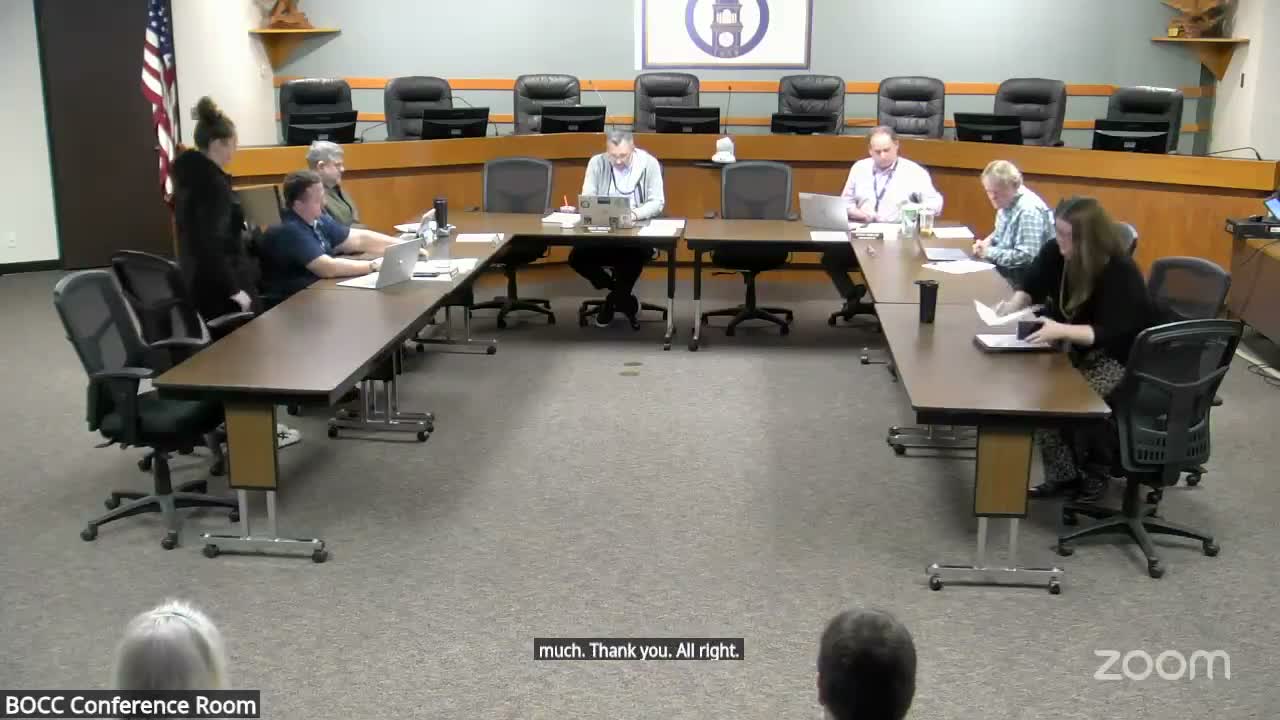
Clallam County staff and consultants presented an updated Community Wildfire Protection Plan (CWPP) at the March 9 work session that adds new wildfire-risk modeling, community field assessments, smoke-impact analysis and a future climate assessment to the county’s 2009 plan.
Diane (county staff, speaker 15) told commissioners the plan was a collaborative effort across county departments, the sheriff’s office, emergency management and public-health partners and was supported by a USDA grant plus state health funding to allow smoke and climate work. Matt Cook of SWCA (speaker 10) said the firm used a Quantitative Wildfire Risk Assessment (QWRA) plus field surveys in 23 communities to identify high-risk areas, evacuation-route constraints and priority mitigation projects.
Key recommendations include home ignition-zone work and defensible-space outreach, targeted fuel treatments near wildland–urban interface areas, roadside fuel buffers to improve evacuation corridors, measures to protect critical infrastructure (communications towers), and evaluating building-code changes or voluntary home-hardening approaches. The plan also includes recommendation matrices that list priority, timeline, lead agency, methodology and potential funding sources to make the work actionable.
Commissioners asked about water-storage options for firefighting in remote western communities and whether storage could be dual-purpose for potable use; consultants said investigating existing water sources and portable tank sites would be an important next step. Several commissioners urged emergency management and community development to review code- and policy-level recommendations and return with a timeline and priorities for potential county actions.
Next steps: staff said the CWPP will be posted online for public access and that the board is expected to adopt the plan at its next regular meeting; the steering committee will remain in place to move priority actions forward.
Diane (county staff, speaker 15) told commissioners the plan was a collaborative effort across county departments, the sheriff’s office, emergency management and public-health partners and was supported by a USDA grant plus state health funding to allow smoke and climate work. Matt Cook of SWCA (speaker 10) said the firm used a Quantitative Wildfire Risk Assessment (QWRA) plus field surveys in 23 communities to identify high-risk areas, evacuation-route constraints and priority mitigation projects.
Key recommendations include home ignition-zone work and defensible-space outreach, targeted fuel treatments near wildland–urban interface areas, roadside fuel buffers to improve evacuation corridors, measures to protect critical infrastructure (communications towers), and evaluating building-code changes or voluntary home-hardening approaches. The plan also includes recommendation matrices that list priority, timeline, lead agency, methodology and potential funding sources to make the work actionable.
Commissioners asked about water-storage options for firefighting in remote western communities and whether storage could be dual-purpose for potable use; consultants said investigating existing water sources and portable tank sites would be an important next step. Several commissioners urged emergency management and community development to review code- and policy-level recommendations and return with a timeline and priorities for potential county actions.
Next steps: staff said the CWPP will be posted online for public access and that the board is expected to adopt the plan at its next regular meeting; the steering committee will remain in place to move priority actions forward.
Don't Miss a Word: See the Full Meeting!
Go beyond summaries. Unlock every video, transcript, and key insight with a Founder Membership.
✓
Get instant access to full meeting videos
✓
Search and clip any phrase from complete transcripts
✓
Receive AI-powered summaries & custom alerts
✓
Enjoy lifetime, unrestricted access to government data
30-day money-back guarantee
