Board tables amendment to community wellness center design after debate over evacuation priorities
March 09, 2026 | Madera County, California
This article was created by AI summarizing key points discussed. AI makes mistakes, so for full details and context, please refer to the video of the full meeting. Please report any errors so we can fix them. Report an error »
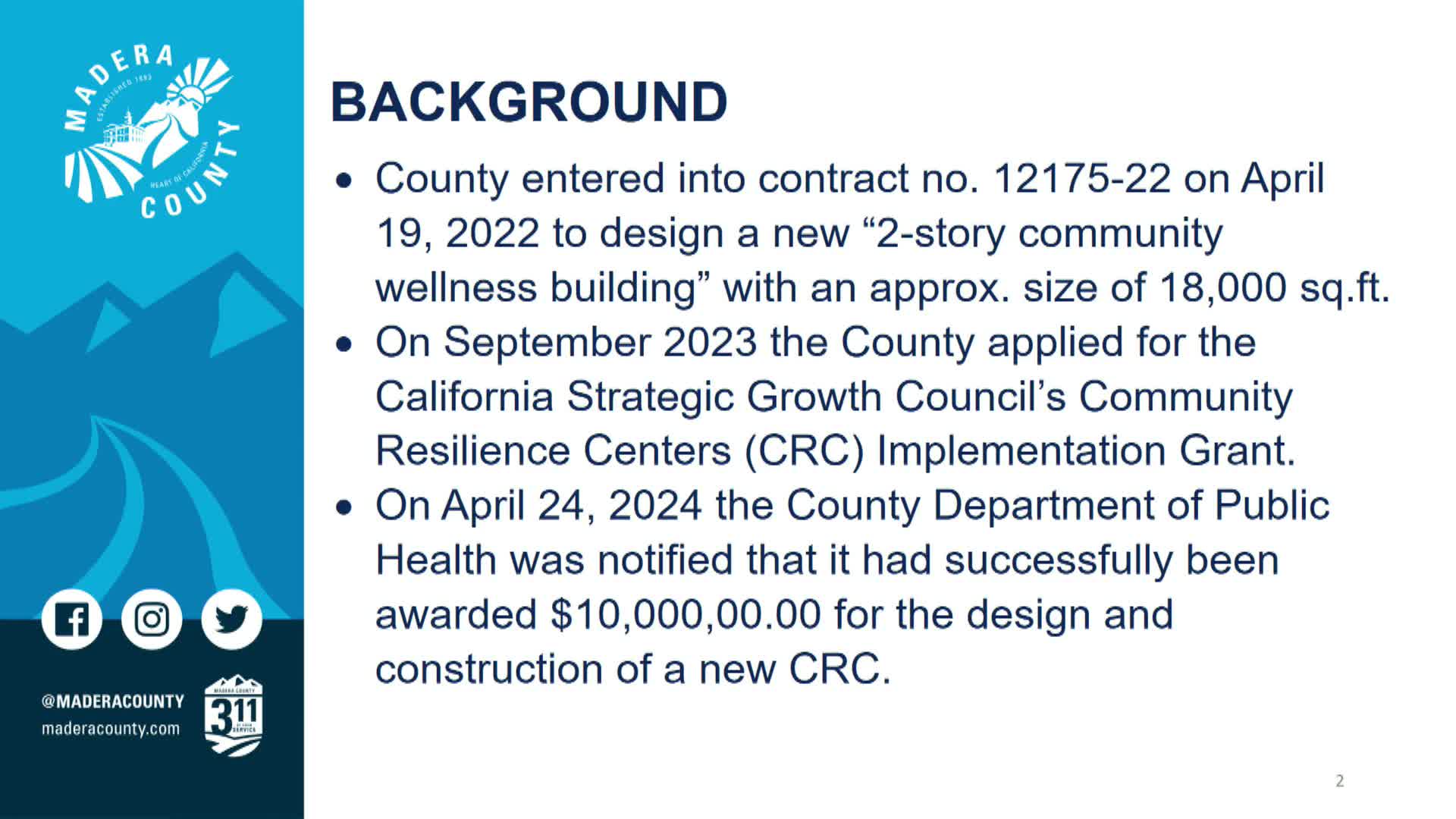
Madera County supervisors on March 10 paused a planned contract amendment for the county’s proposed Community Wellness/Community Resiliency Center after a heated discussion about whether design changes and added spending prioritize valley needs over mountain-area evacuation facilities.
County administrative staff asked the board to approve an amendment to architect Contract 121758-25 for up to $1,017,265 to expand conceptual design and services after the county secured a $10,000,000 Strategic Growth Council implementation grant. County staff said the grant increased the project’s planned size from about 18,000 square feet to roughly 30,000 square feet and shifted more space to service/warehouse and multi-use functions under the CRC model.
"The design and scope has changed from the original that was developed to submit the grant," Joel Bugay, county administrative office staff, said, explaining the increased design effort and the reasoning tied to architectural standards and grant requirements. Senior project manager Jorge Mendoza said schematic designs show a multipurpose area that can seat about 483 for presentations and shelter approximately 361 residents under FEMA-space-allocation assumptions.
Several supervisors said they supported the project’s community benefits but questioned the siting and whether funds would better address evacuation readiness in mountain communities. "I just don't see this ever being used as an evacuation center," Chair McCauley said, adding that primary evacuation needs historically occur in the mountains and that the county’s Oakhurst facility remains in poor condition.
Other board members pressed whether the $10 million grant and local public-health dollars could be redirected or leveraged to improve a mountain evacuation center instead of expanding a facility in the city of Madera. County staff warned the board that the grant award was tied to the plans and approved location and that revisiting the site's siting could place the grant at risk, though staff repeatedly described the risk as low if the board sought a brief pause.
"If we remove the evacuation-center component from this project in the valley, could public-health dollars continue to fund the remainder of the building?" a supervisor asked; staff said they would evaluate what funds are flexible and return with details.
After the discussion, a supervisor moved to table the matter to the board’s next available meeting; a second was offered and the board continued the item to the April 7 agenda so staff could provide firm answers about funding commitments, pivot options and timeline risks.
What happens next: Staff committed to return with detailed information about which local funds are committed, whether grant funds could be redirected, and options to minimize schedule risk. The board’s April 7 meeting will revisit the amendment request and any recommended adjustments.
County administrative staff asked the board to approve an amendment to architect Contract 121758-25 for up to $1,017,265 to expand conceptual design and services after the county secured a $10,000,000 Strategic Growth Council implementation grant. County staff said the grant increased the project’s planned size from about 18,000 square feet to roughly 30,000 square feet and shifted more space to service/warehouse and multi-use functions under the CRC model.
"The design and scope has changed from the original that was developed to submit the grant," Joel Bugay, county administrative office staff, said, explaining the increased design effort and the reasoning tied to architectural standards and grant requirements. Senior project manager Jorge Mendoza said schematic designs show a multipurpose area that can seat about 483 for presentations and shelter approximately 361 residents under FEMA-space-allocation assumptions.
Several supervisors said they supported the project’s community benefits but questioned the siting and whether funds would better address evacuation readiness in mountain communities. "I just don't see this ever being used as an evacuation center," Chair McCauley said, adding that primary evacuation needs historically occur in the mountains and that the county’s Oakhurst facility remains in poor condition.
Other board members pressed whether the $10 million grant and local public-health dollars could be redirected or leveraged to improve a mountain evacuation center instead of expanding a facility in the city of Madera. County staff warned the board that the grant award was tied to the plans and approved location and that revisiting the site's siting could place the grant at risk, though staff repeatedly described the risk as low if the board sought a brief pause.
"If we remove the evacuation-center component from this project in the valley, could public-health dollars continue to fund the remainder of the building?" a supervisor asked; staff said they would evaluate what funds are flexible and return with details.
After the discussion, a supervisor moved to table the matter to the board’s next available meeting; a second was offered and the board continued the item to the April 7 agenda so staff could provide firm answers about funding commitments, pivot options and timeline risks.
What happens next: Staff committed to return with detailed information about which local funds are committed, whether grant funds could be redirected, and options to minimize schedule risk. The board’s April 7 meeting will revisit the amendment request and any recommended adjustments.
View the Full Meeting & All Its Details
This article offers just a summary. Unlock complete video, transcripts, and insights as a Founder Member.
✓
Watch full, unedited meeting videos
✓
Search every word spoken in unlimited transcripts
✓
AI summaries & real-time alerts (all government levels)
✓
Permanent access to expanding government content
30-day money-back guarantee
