Council reviews $3.2M pavement preservation request and bridge-repair options
May 08, 2024 | Oro Valley, Pima County, Arizona
This article was created by AI summarizing key points discussed. AI makes mistakes, so for full details and context, please refer to the video of the full meeting. Please report any errors so we can fix them. Report an error »
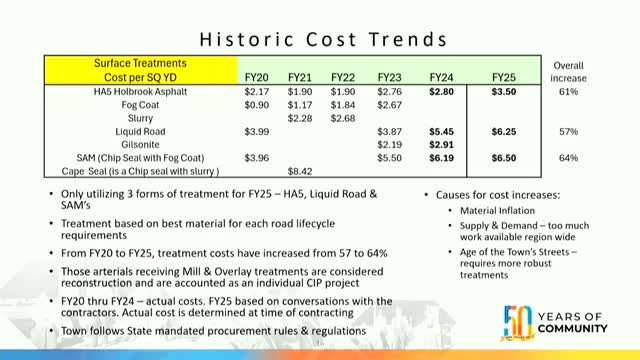
Public Works Director Paul Keesler told the Town Council on May 8 that the town is asking for $3.2 million for pavement preservation in FY24-25, a $600,000 increase from the prior year to keep the street network near its present condition.
Keesler said the town's asset-management regime selects streets based on field inspections and degradation modeling. "This year, we're asking for, as Mr. Shattuck mentioned, 3,200,000.0 to continue the program and to keep network up to its present standards," he said. Staff estimate the program will treat roughly 67 lane miles, about 15% of the town network.
Contractor rates and material inflation are key drivers: Keesler told council that unit costs contractors returned to staff are approximately 12% higher than last year and that material costs have risen roughly 60% over the past five years. That combination informed the increase from a figure that would have funded about $2.7 million of work under last year's rates.
On bridges, Keesler recommended establishing a line item for bridge maintenance and sidewalk repairs with a $140,000 request for minor bridge repairs and JOC contractor work. He said ADOT provides biennial bridge inspections and that most town bridges currently rate in the five-to-six range (fair to satisfactory). For full deck replacements he cited conventional unit costs of about $120'$140 per square foot for conventional concrete repair, explaining why a long deck can reach multi-million-dollar totals.
Keesler also described nontraditional approaches staff are studying to avoid very large conventional repairs on long bridge decks, including asphalt wearing courses, an epoxy polymer treatment used in Phoenix and polyester concrete. He emphasized guardrails on technical risk: any overlay option must preserve structure and weight-rating standards.
Council questions focused on whether the town should hire outside technical consultants to evaluate alternative bridge treatments and whether staff should reprioritize the CIP to preserve core street and bridge maintenance over lower-priority projects. Staff said they have reached out regionally and will use consultants when needed for structural analysis and to vet alternative repair technologies.
Next steps: staff will move forward with the asset-driven pavement plan and return with refined project lists and cost estimates as contracts are prepared for fall procurement.
Keesler said the town's asset-management regime selects streets based on field inspections and degradation modeling. "This year, we're asking for, as Mr. Shattuck mentioned, 3,200,000.0 to continue the program and to keep network up to its present standards," he said. Staff estimate the program will treat roughly 67 lane miles, about 15% of the town network.
Contractor rates and material inflation are key drivers: Keesler told council that unit costs contractors returned to staff are approximately 12% higher than last year and that material costs have risen roughly 60% over the past five years. That combination informed the increase from a figure that would have funded about $2.7 million of work under last year's rates.
On bridges, Keesler recommended establishing a line item for bridge maintenance and sidewalk repairs with a $140,000 request for minor bridge repairs and JOC contractor work. He said ADOT provides biennial bridge inspections and that most town bridges currently rate in the five-to-six range (fair to satisfactory). For full deck replacements he cited conventional unit costs of about $120'$140 per square foot for conventional concrete repair, explaining why a long deck can reach multi-million-dollar totals.
Keesler also described nontraditional approaches staff are studying to avoid very large conventional repairs on long bridge decks, including asphalt wearing courses, an epoxy polymer treatment used in Phoenix and polyester concrete. He emphasized guardrails on technical risk: any overlay option must preserve structure and weight-rating standards.
Council questions focused on whether the town should hire outside technical consultants to evaluate alternative bridge treatments and whether staff should reprioritize the CIP to preserve core street and bridge maintenance over lower-priority projects. Staff said they have reached out regionally and will use consultants when needed for structural analysis and to vet alternative repair technologies.
Next steps: staff will move forward with the asset-driven pavement plan and return with refined project lists and cost estimates as contracts are prepared for fall procurement.
View the Full Meeting & All Its Details
This article offers just a summary. Unlock complete video, transcripts, and insights as a Founder Member.
✓
Watch full, unedited meeting videos
✓
Search every word spoken in unlimited transcripts
✓
AI summaries & real-time alerts (all government levels)
✓
Permanent access to expanding government content
30-day money-back guarantee
