Council presses staff on vehicle-replacement numbers and transit bus funding
May 08, 2024 | Oro Valley, Pima County, Arizona
This article was created by AI summarizing key points discussed. AI makes mistakes, so for full details and context, please refer to the video of the full meeting. Please report any errors so we can fix them. Report an error »
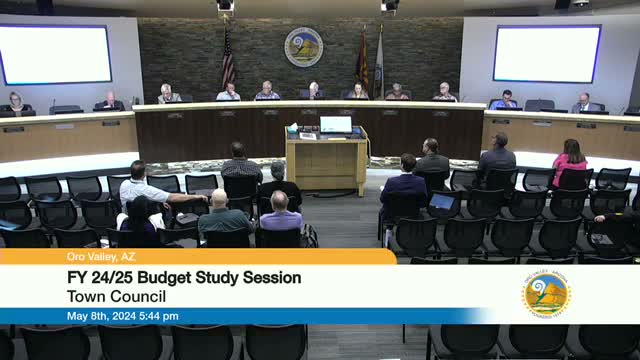
Council members focused sustained attention on the town's vehicle replacement program after noticing inconsistent numbers in the packet and presentation slides. Councilmember Bowen said the budget materials she received showed $3.6 million for vehicle replacement in the CIP while a slide displayed $1.6 million.
Town staff clarified the distinction: the slide figure was vehicle replacements charged to the capital fund for the coming fiscal year; the larger number includes rollover carryover and transit vehicle replacements funded in other funds. Staff further explained that transit vehicle procurements are largely grant-funded; roughly 80% of the nearly $2 million in vehicle dollars for transit would be reimbursed by grants (as staff put it, the roughly $1.6M in the slide excludes transit buses and carryforward amounts).
Staff also described a shift in methodology: rather than applying an arbitrary target, they recalculated replacement needs on a zero-base approach reflecting the age, availability and current prices of rolling stock. That analysis increased the out-year replacement schedule and produced higher multi-year totals on the nine-year CIP outlook. Staff warned that supply-chain limits, vehicle lead times and steep price increases (transit buses previously estimated at $65,000 now cost about $160,000) are inflating replacement budgets.
Councilmembers urged clearer packet presentation and asked staff for itemized point-of-sale or vehicle-by-vehicle data to reconcile year-to-year fluctuations. Staff agreed to provide further breakdowns and account codes so council and the public can trace carryover and fund sources.
There was no formal action or vote during the study session; staff said they would return with refined numbers.
Town staff clarified the distinction: the slide figure was vehicle replacements charged to the capital fund for the coming fiscal year; the larger number includes rollover carryover and transit vehicle replacements funded in other funds. Staff further explained that transit vehicle procurements are largely grant-funded; roughly 80% of the nearly $2 million in vehicle dollars for transit would be reimbursed by grants (as staff put it, the roughly $1.6M in the slide excludes transit buses and carryforward amounts).
Staff also described a shift in methodology: rather than applying an arbitrary target, they recalculated replacement needs on a zero-base approach reflecting the age, availability and current prices of rolling stock. That analysis increased the out-year replacement schedule and produced higher multi-year totals on the nine-year CIP outlook. Staff warned that supply-chain limits, vehicle lead times and steep price increases (transit buses previously estimated at $65,000 now cost about $160,000) are inflating replacement budgets.
Councilmembers urged clearer packet presentation and asked staff for itemized point-of-sale or vehicle-by-vehicle data to reconcile year-to-year fluctuations. Staff agreed to provide further breakdowns and account codes so council and the public can trace carryover and fund sources.
There was no formal action or vote during the study session; staff said they would return with refined numbers.
View the Full Meeting & All Its Details
This article offers just a summary. Unlock complete video, transcripts, and insights as a Founder Member.
✓
Watch full, unedited meeting videos
✓
Search every word spoken in unlimited transcripts
✓
AI summaries & real-time alerts (all government levels)
✓
Permanent access to expanding government content
30-day money-back guarantee
