Committee approves CDM Smith change order for PFAS study after testing delays; no extra cost reported
March 10, 2026 | Evanston, Cook County, Illinois
This article was created by AI summarizing key points discussed. AI makes mistakes, so for full details and context, please refer to the video of the full meeting. Please report any errors so we can fix them. Report an error »
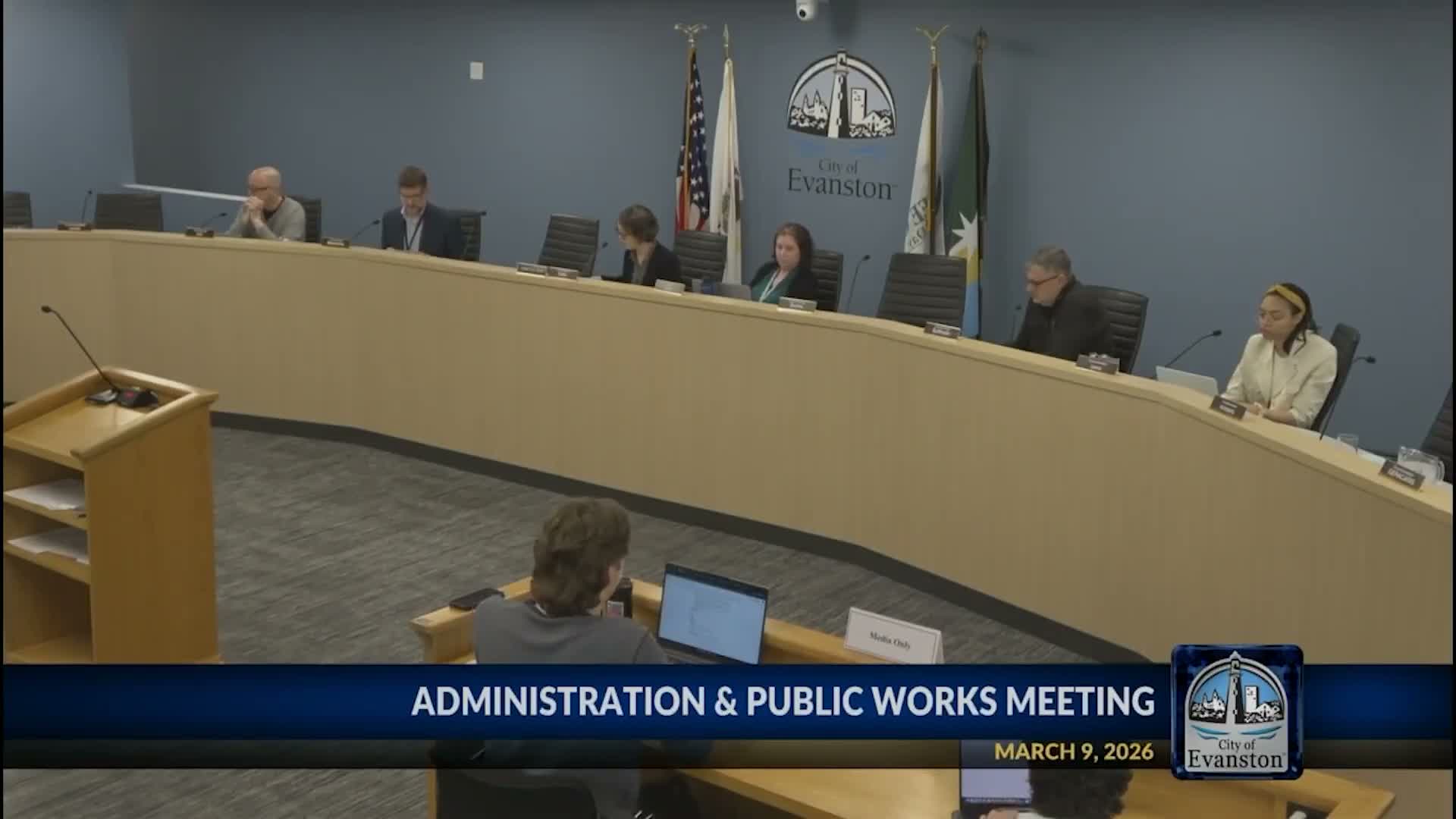
The Evanston Administration & Public Works Committee on March 9 approved change order number 1 to the agreement with CDM Smith for a PFAS treatment technique study (RP23‑01), the committee’s chair announced after a 6–0 roll‑call vote.
Daryl King, water production bureau chief, told the committee the city has spent “just a little over $1,000,000” so far on the roughly $1,500,000 project and described the cause of a two‑year delay: custom‑built test skids and columns arrived but some were not functioning properly and had to be removed and replaced. King said CDM Smith completed initial data review, modeling, jar testing with powder activated carbon, desktop testing of GAC and ion exchange, and membrane testing including reverse osmosis and nanofiltration.
King said the study’s scope includes assessing techniques that remove PFAS as well as other emerging contaminants and microplastics. He confirmed the team tested additional PFAS compounds and “emerging contaminants” and is evaluating how each treatment performs against multiple contaminants.
When asked about contingency plans if CDM Smith could not finish by 2026, King said the city currently has no backup contractor arrangement and does not anticipate needing one. He also told the committee there are no expected cost increases tied to the delay. "I'm not anticipating having to use that," King said about contingency measures.
On regulatory timing, King explained the new federal maximum contaminant levels (MCLs) for the two PFAS chemicals detected in Evanston’s water are 4 parts per trillion. "We're under that," he said, noting that if the city exceeded the new levels communities generally have until about 2029 to comply.
Committee members pressed whether the city had consulted other municipalities; King said Evanston was aware of treatment approaches elsewhere, including Ann Arbor’s use of granular activated carbon, but had not had direct conversations with those cities. The change order was presented as a schedule adjustment to complete the study’s field testing and analysis.
The motion to approve the change order passed by roll call, 6–0.
The committee record shows the item as a contract change order only; no additional funds were requested at the meeting. Staff said the study’s final recommendations would be available when CDM Smith completes testing and analysis.
Daryl King, water production bureau chief, told the committee the city has spent “just a little over $1,000,000” so far on the roughly $1,500,000 project and described the cause of a two‑year delay: custom‑built test skids and columns arrived but some were not functioning properly and had to be removed and replaced. King said CDM Smith completed initial data review, modeling, jar testing with powder activated carbon, desktop testing of GAC and ion exchange, and membrane testing including reverse osmosis and nanofiltration.
King said the study’s scope includes assessing techniques that remove PFAS as well as other emerging contaminants and microplastics. He confirmed the team tested additional PFAS compounds and “emerging contaminants” and is evaluating how each treatment performs against multiple contaminants.
When asked about contingency plans if CDM Smith could not finish by 2026, King said the city currently has no backup contractor arrangement and does not anticipate needing one. He also told the committee there are no expected cost increases tied to the delay. "I'm not anticipating having to use that," King said about contingency measures.
On regulatory timing, King explained the new federal maximum contaminant levels (MCLs) for the two PFAS chemicals detected in Evanston’s water are 4 parts per trillion. "We're under that," he said, noting that if the city exceeded the new levels communities generally have until about 2029 to comply.
Committee members pressed whether the city had consulted other municipalities; King said Evanston was aware of treatment approaches elsewhere, including Ann Arbor’s use of granular activated carbon, but had not had direct conversations with those cities. The change order was presented as a schedule adjustment to complete the study’s field testing and analysis.
The motion to approve the change order passed by roll call, 6–0.
The committee record shows the item as a contract change order only; no additional funds were requested at the meeting. Staff said the study’s final recommendations would be available when CDM Smith completes testing and analysis.
Don't Miss a Word: See the Full Meeting!
Go beyond summaries. Unlock every video, transcript, and key insight with a Founder Membership.
✓
Get instant access to full meeting videos
✓
Search and clip any phrase from complete transcripts
✓
Receive AI-powered summaries & custom alerts
✓
Enjoy lifetime, unrestricted access to government data
30-day money-back guarantee
