County reports energy-audit wins, expands EV fleet and takes on Charleston compost effort
March 10, 2026 | Charleston County, South Carolina
This article was created by AI summarizing key points discussed. AI makes mistakes, so for full details and context, please refer to the video of the full meeting. Please report any errors so we can fix them. Report an error »
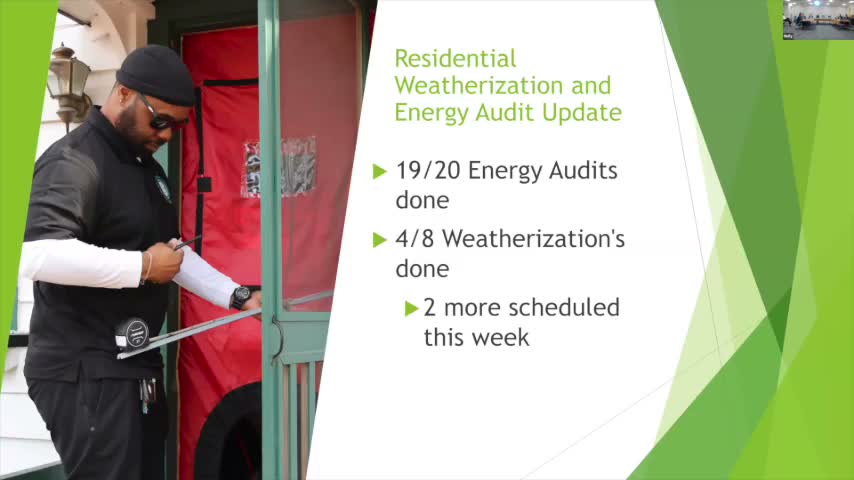
County sustainability staff provided program-level updates on the state Energy Efficiency and Conservation Block Grant (EECBG), the county's first sustainability-plan report and related projects.
Ally (staff) said the county has completed 19 of 20 energy audits under the EECBG and finished four of eight planned weatherizations, with two more scheduled. Using a recent case study, Ally said the audited home had an estimated CO2 footprint of 3.9 tons and the audit predicted a $313 annual savings; after weatherization the team reported emissions falling to roughly 2 tons and higher-than-expected annual savings (transcript reported as "406 dollars"). Ally also said the Sustainability Institute found and repaired a minor gas leak discovered during work and certified the home to the BPI health-and-safety criteria.
Ally described the county's electric-vehicle program: "We do have 6 electric vehicles, and both public and fleet chargers for the county." She said three vehicles came from the state grant, two were purchased or leased earlier, and the motor pool includes other EV models. New county buildings are being pre-plumbed with conduit for future charging stations.
The county is also taking on the Charleston compost effort (originally created by the City of Charleston in 2022) and plans to expand its reach. Ally said the division's sustainability-plan report highlights key accomplishments, implementation strategies and an interactive inventory of about 185 local projects.
The committee discussed making the report available to county council members and agreed to provide newsletter copies to council and to schedule a formal update at a future council meeting. Ally said staff will post materials online and share event details for public workshops and tours.
No formal funding votes were recorded during the meeting.
Ally (staff) said the county has completed 19 of 20 energy audits under the EECBG and finished four of eight planned weatherizations, with two more scheduled. Using a recent case study, Ally said the audited home had an estimated CO2 footprint of 3.9 tons and the audit predicted a $313 annual savings; after weatherization the team reported emissions falling to roughly 2 tons and higher-than-expected annual savings (transcript reported as "406 dollars"). Ally also said the Sustainability Institute found and repaired a minor gas leak discovered during work and certified the home to the BPI health-and-safety criteria.
Ally described the county's electric-vehicle program: "We do have 6 electric vehicles, and both public and fleet chargers for the county." She said three vehicles came from the state grant, two were purchased or leased earlier, and the motor pool includes other EV models. New county buildings are being pre-plumbed with conduit for future charging stations.
The county is also taking on the Charleston compost effort (originally created by the City of Charleston in 2022) and plans to expand its reach. Ally said the division's sustainability-plan report highlights key accomplishments, implementation strategies and an interactive inventory of about 185 local projects.
The committee discussed making the report available to county council members and agreed to provide newsletter copies to council and to schedule a formal update at a future council meeting. Ally said staff will post materials online and share event details for public workshops and tours.
No formal funding votes were recorded during the meeting.
View the Full Meeting & All Its Details
This article offers just a summary. Unlock complete video, transcripts, and insights as a Founder Member.
✓
Watch full, unedited meeting videos
✓
Search every word spoken in unlimited transcripts
✓
AI summaries & real-time alerts (all government levels)
✓
Permanent access to expanding government content
30-day money-back guarantee
