Committee advances package of health‑related bills; votes at a glance
March 09, 2026 | 2026 Legislature Arizona, Arizona
This article was created by AI summarizing key points discussed. AI makes mistakes, so for full details and context, please refer to the video of the full meeting. Please report any errors so we can fix them. Report an error »
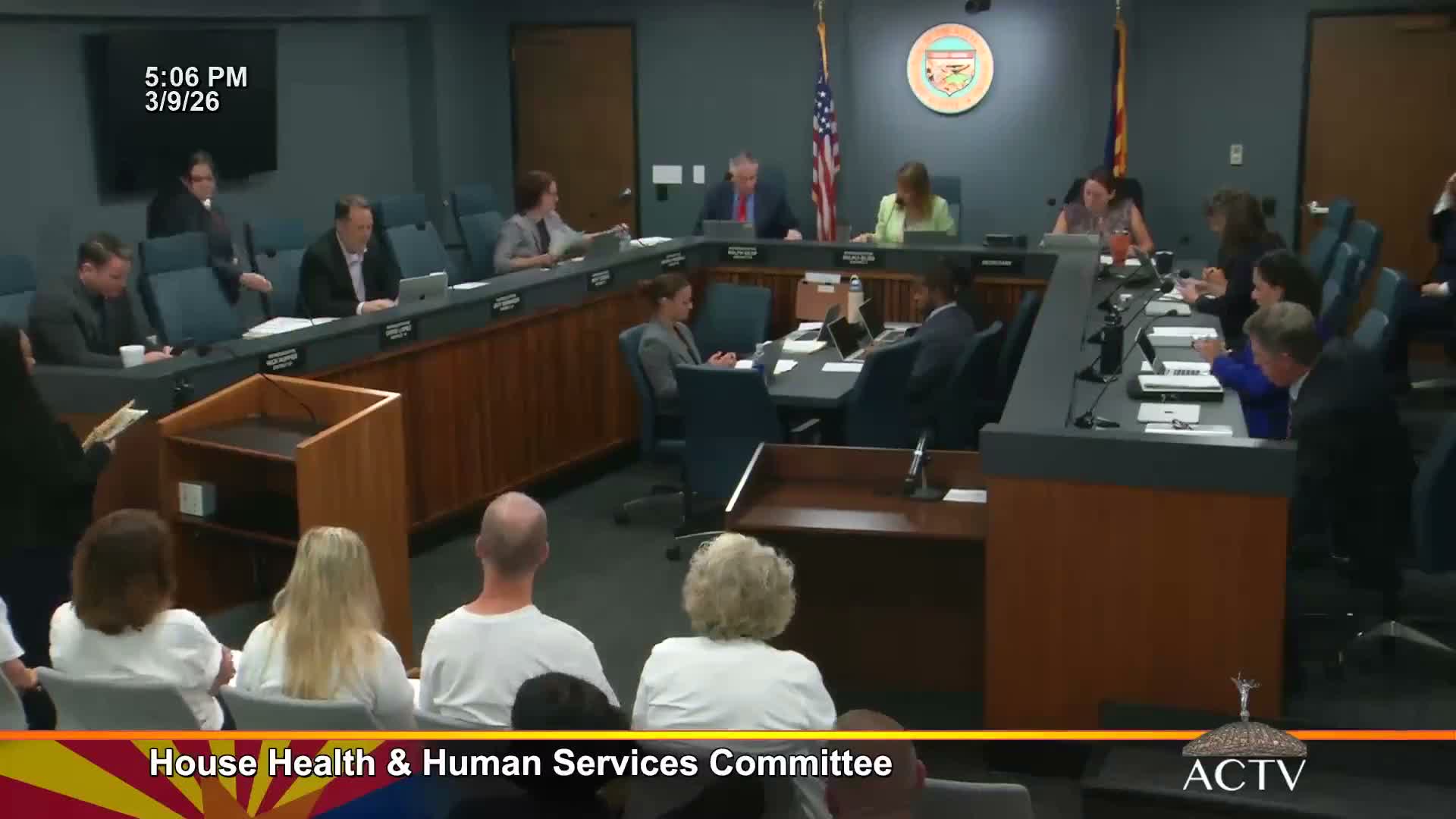
The Arizona House Committee on Health and Human Services advanced a package of Senate bills on Monday evening, adopting amendments on several measures and returning each with a due‑pass recommendation to the full legislature.
The committee considered more than a half dozen bills spanning mental‑health procedures, behavioral‑health payment rules, medical‑training supervision, tribal memoranda of understanding, breast‑cancer screening cost sharing, the protection of emergency‑responder licensing data, and consumer protections for senior‑referral agencies. Most bills passed the committee unanimously or with wide support after sponsor remarks and brief witness testimony.
Votes at a glance
- SB 11‑13 (service of legal documents at screening/evaluation agencies): Adopted Bliss Amendment (03/06/2026 10:32AM); committee vote 12‑0 in favor. The amendment conditions county reimbursement on a contract between the county and the agency.
- SB 11‑22 (limits on prepayment review for behavioral‑health services; effective 01/01/2027): Committee vote 12‑0. Sponsors said the change aims to prevent payment delays for compliant providers.
- SB 11‑23 (forensic‑pathology supervision): Committee vote 12‑0. The bill allows a licensed physician trained in forensic pathology (not necessarily board certified) to supervise trainees to address pipeline timing issues.
- SB 11‑25 (DCS tribal MOUs): Committee vote 12‑0. The measure directs the Department of Child Safety to annually attempt to enter memoranda of understanding with tribes that lack them.
- SB 11‑65 (eliminate certain cost sharing for breast‑cancer diagnostic follow‑up; effective 01/01/2027): Committee vote 12‑0. Sponsors and advocates said the bill removes a financial barrier to timely diagnostics after an abnormal screening.
- SB 12‑43 (guardian notice and procedures for court‑ordered treatment): Committee vote 10‑0 (2 absent). The bill adds a guardian to required notifications and creates a process for guardians to apply to continue court‑ordered treatment.
- SB 13‑18 (breast‑density notification cleanup): Committee vote 11‑0 (1 absent). The bill aligns state notice language with the FDA's format.
- SB 11‑88 (align state controlled‑substance schedules with federal rescheduling): Committee vote 8‑2 (2 absent). Supporters said automatic alignment speeds access to FDA/DEA‑approved therapies; some lawmakers expressed reservations about relying solely on federal determinations.
- SB 11‑93 (limit DHS sale/disclosure of EMT identifying data for commercial purposes): Committee vote 10‑0 (2 absent). Witnesses said vendors regularly request licensee data and the bill would prohibit commercial sale without consent.
- SB 14‑77 (referral‑agency background checks and insurance for senior placement): Committee vote 10‑0 (2 absent). The bill requires documentation that referral agents are not on adult‑protective registries or the use of nationally accredited criminal‑history services, plus specified liability insurance.
What comes next
All advanced bills were returned with due‑pass recommendations and will be scheduled for subsequent committee or floor consideration according to the House calendar. Several sponsors said they worked with stakeholders during the interim or while developing amendments, and several supporters asked the full House to maintain the committee versions as drafted.
The committee considered more than a half dozen bills spanning mental‑health procedures, behavioral‑health payment rules, medical‑training supervision, tribal memoranda of understanding, breast‑cancer screening cost sharing, the protection of emergency‑responder licensing data, and consumer protections for senior‑referral agencies. Most bills passed the committee unanimously or with wide support after sponsor remarks and brief witness testimony.
Votes at a glance
- SB 11‑13 (service of legal documents at screening/evaluation agencies): Adopted Bliss Amendment (03/06/2026 10:32AM); committee vote 12‑0 in favor. The amendment conditions county reimbursement on a contract between the county and the agency.
- SB 11‑22 (limits on prepayment review for behavioral‑health services; effective 01/01/2027): Committee vote 12‑0. Sponsors said the change aims to prevent payment delays for compliant providers.
- SB 11‑23 (forensic‑pathology supervision): Committee vote 12‑0. The bill allows a licensed physician trained in forensic pathology (not necessarily board certified) to supervise trainees to address pipeline timing issues.
- SB 11‑25 (DCS tribal MOUs): Committee vote 12‑0. The measure directs the Department of Child Safety to annually attempt to enter memoranda of understanding with tribes that lack them.
- SB 11‑65 (eliminate certain cost sharing for breast‑cancer diagnostic follow‑up; effective 01/01/2027): Committee vote 12‑0. Sponsors and advocates said the bill removes a financial barrier to timely diagnostics after an abnormal screening.
- SB 12‑43 (guardian notice and procedures for court‑ordered treatment): Committee vote 10‑0 (2 absent). The bill adds a guardian to required notifications and creates a process for guardians to apply to continue court‑ordered treatment.
- SB 13‑18 (breast‑density notification cleanup): Committee vote 11‑0 (1 absent). The bill aligns state notice language with the FDA's format.
- SB 11‑88 (align state controlled‑substance schedules with federal rescheduling): Committee vote 8‑2 (2 absent). Supporters said automatic alignment speeds access to FDA/DEA‑approved therapies; some lawmakers expressed reservations about relying solely on federal determinations.
- SB 11‑93 (limit DHS sale/disclosure of EMT identifying data for commercial purposes): Committee vote 10‑0 (2 absent). Witnesses said vendors regularly request licensee data and the bill would prohibit commercial sale without consent.
- SB 14‑77 (referral‑agency background checks and insurance for senior placement): Committee vote 10‑0 (2 absent). The bill requires documentation that referral agents are not on adult‑protective registries or the use of nationally accredited criminal‑history services, plus specified liability insurance.
What comes next
All advanced bills were returned with due‑pass recommendations and will be scheduled for subsequent committee or floor consideration according to the House calendar. Several sponsors said they worked with stakeholders during the interim or while developing amendments, and several supporters asked the full House to maintain the committee versions as drafted.
Don't Miss a Word: See the Full Meeting!
Go beyond summaries. Unlock every video, transcript, and key insight with a Founder Membership.
✓
Get instant access to full meeting videos
✓
Search and clip any phrase from complete transcripts
✓
Receive AI-powered summaries & custom alerts
✓
Enjoy lifetime, unrestricted access to government data
30-day money-back guarantee
