Winslow special-education director warns rising caseloads, out-of-district placement costs strain budget
March 10, 2026 | Winslow Schools, School Districts, Maine
This article was created by AI summarizing key points discussed. AI makes mistakes, so for full details and context, please refer to the video of the full meeting. Please report any errors so we can fix them. Report an error »
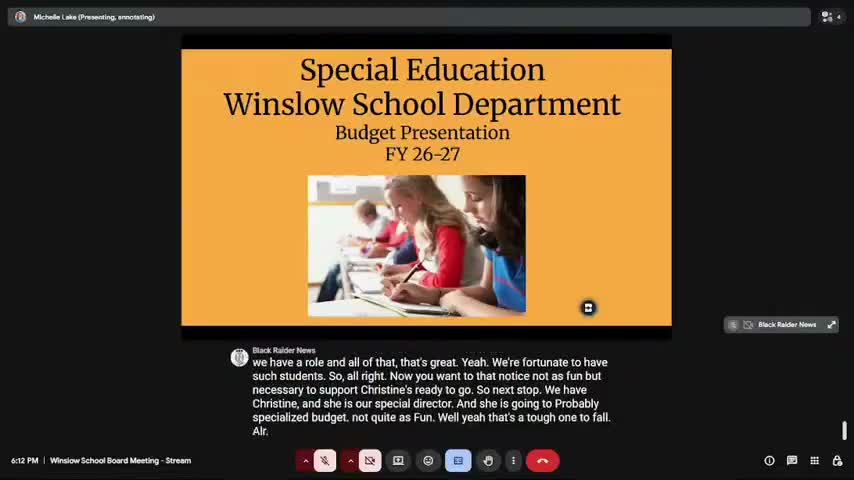
Christine, the district’s special education director, outlined sharply rising demands and costs in the Winslow special education program during a special budget workshop.
"The special education budget is a pretty complex budget as far as the planning," Christine said, explaining that caseloads and mandated services can change day to day and that the district must plan for variables such as out-of-district placements and high-cost contracted services. She told the board that some out-of-district preschool placements can cost "anywhere from 57,000 to 75,000 per student per year." (Speaker: Christine, Special education director.)
Christine said the district currently identifies about 303 students with individual education plans (IEPs) across K–12 in a total district enrollment of roughly 1,123 students, or about 27 percent identified for special education. She described program performance and supports, noting that roughly 22.2 percent of special-education students are performing at or above grade level in math and 39.8 percent in reading, and she urged the board to consider those results alongside the rising service requirements.
On evaluations and timelines, Christine told trustees the district has two school-based psychologists and had completed 92 psychological evaluations last year; as of March 6 this year they were at about 118 with another 17 students in referral. She warned that federally and state-mandated timelines for evaluations are strict (45 school days), and that contracting out evaluations could be expensive — private evaluations can range from about $1,500 to $2,300 each and contracting out a portion of the workload could cost in the low six figures.
Board members pressed Christine about staffing and caseload limits. She said the elementary autism classroom currently has a caseload of 17 — above the commonly referenced cap of 15 — and asked the board to approve converting an existing contracted-service line (an American Sign Language interpreter position budgeted in the current year) into a licensed autism classroom teacher next year so the district could bring two preschool students back from out-of-district placements and avoid paying their tuition.
"If we hired that additional teacher, we would be able to service those students here in our district and not have to pay $57,000 a year per student out-of-district," Christine said, framing the change as both compliance-driven and cost-saving. Multiple board members and staff noted that hiring licensed staff is difficult, and that if the district cannot recruit for a hard-to-fill position it may need to rely on contracted services despite the higher ongoing cost.
Christine and trustees also discussed the district’s speech and language, occupational and physical therapy resources, assistive-technology needs and BCBA consultation for some students. She listed current special-education staffing counts she used in the budget: 10 resource teachers, four self-contained teachers (day treatment/life-skills/autism), about 17 educational-technician support staff, two full-time psychologists, three speech clinicians, one full-time occupational therapist (with additional contracted support), a contracted physical therapist, and three social workers.
The presentation concluded with Christine emphasizing federal requirements — including the Individuals with Disabilities Education Act (IDEA) — and the district’s obligation to meet evaluation timelines and provide a free appropriate public education even when federal funding does not fully cover costs. "Even though federally it's supposed to be 40 percent, we're only being funded at 12 percent," she said, noting the gap between statutory expectations and actual federal reimbursements.
Next procedural steps: the board will consider Christine’s requests when the proposed budget is finalized at the march workshop and when the budget goes to the town council later in the month.
"The special education budget is a pretty complex budget as far as the planning," Christine said, explaining that caseloads and mandated services can change day to day and that the district must plan for variables such as out-of-district placements and high-cost contracted services. She told the board that some out-of-district preschool placements can cost "anywhere from 57,000 to 75,000 per student per year." (Speaker: Christine, Special education director.)
Christine said the district currently identifies about 303 students with individual education plans (IEPs) across K–12 in a total district enrollment of roughly 1,123 students, or about 27 percent identified for special education. She described program performance and supports, noting that roughly 22.2 percent of special-education students are performing at or above grade level in math and 39.8 percent in reading, and she urged the board to consider those results alongside the rising service requirements.
On evaluations and timelines, Christine told trustees the district has two school-based psychologists and had completed 92 psychological evaluations last year; as of March 6 this year they were at about 118 with another 17 students in referral. She warned that federally and state-mandated timelines for evaluations are strict (45 school days), and that contracting out evaluations could be expensive — private evaluations can range from about $1,500 to $2,300 each and contracting out a portion of the workload could cost in the low six figures.
Board members pressed Christine about staffing and caseload limits. She said the elementary autism classroom currently has a caseload of 17 — above the commonly referenced cap of 15 — and asked the board to approve converting an existing contracted-service line (an American Sign Language interpreter position budgeted in the current year) into a licensed autism classroom teacher next year so the district could bring two preschool students back from out-of-district placements and avoid paying their tuition.
"If we hired that additional teacher, we would be able to service those students here in our district and not have to pay $57,000 a year per student out-of-district," Christine said, framing the change as both compliance-driven and cost-saving. Multiple board members and staff noted that hiring licensed staff is difficult, and that if the district cannot recruit for a hard-to-fill position it may need to rely on contracted services despite the higher ongoing cost.
Christine and trustees also discussed the district’s speech and language, occupational and physical therapy resources, assistive-technology needs and BCBA consultation for some students. She listed current special-education staffing counts she used in the budget: 10 resource teachers, four self-contained teachers (day treatment/life-skills/autism), about 17 educational-technician support staff, two full-time psychologists, three speech clinicians, one full-time occupational therapist (with additional contracted support), a contracted physical therapist, and three social workers.
The presentation concluded with Christine emphasizing federal requirements — including the Individuals with Disabilities Education Act (IDEA) — and the district’s obligation to meet evaluation timelines and provide a free appropriate public education even when federal funding does not fully cover costs. "Even though federally it's supposed to be 40 percent, we're only being funded at 12 percent," she said, noting the gap between statutory expectations and actual federal reimbursements.
Next procedural steps: the board will consider Christine’s requests when the proposed budget is finalized at the march workshop and when the budget goes to the town council later in the month.
View the Full Meeting & All Its Details
This article offers just a summary. Unlock complete video, transcripts, and insights as a Founder Member.
✓
Watch full, unedited meeting videos
✓
Search every word spoken in unlimited transcripts
✓
AI summaries & real-time alerts (all government levels)
✓
Permanent access to expanding government content
30-day money-back guarantee
