Fort Worth installs live-view cameras at East Side hotspots and outlines enforcement tools to curb illegal dumping
March 10, 2026 | Fort Worth, Tarrant County, Texas
This article was created by AI summarizing key points discussed. AI makes mistakes, so for full details and context, please refer to the video of the full meeting. Please report any errors so we can fix them. Report an error »
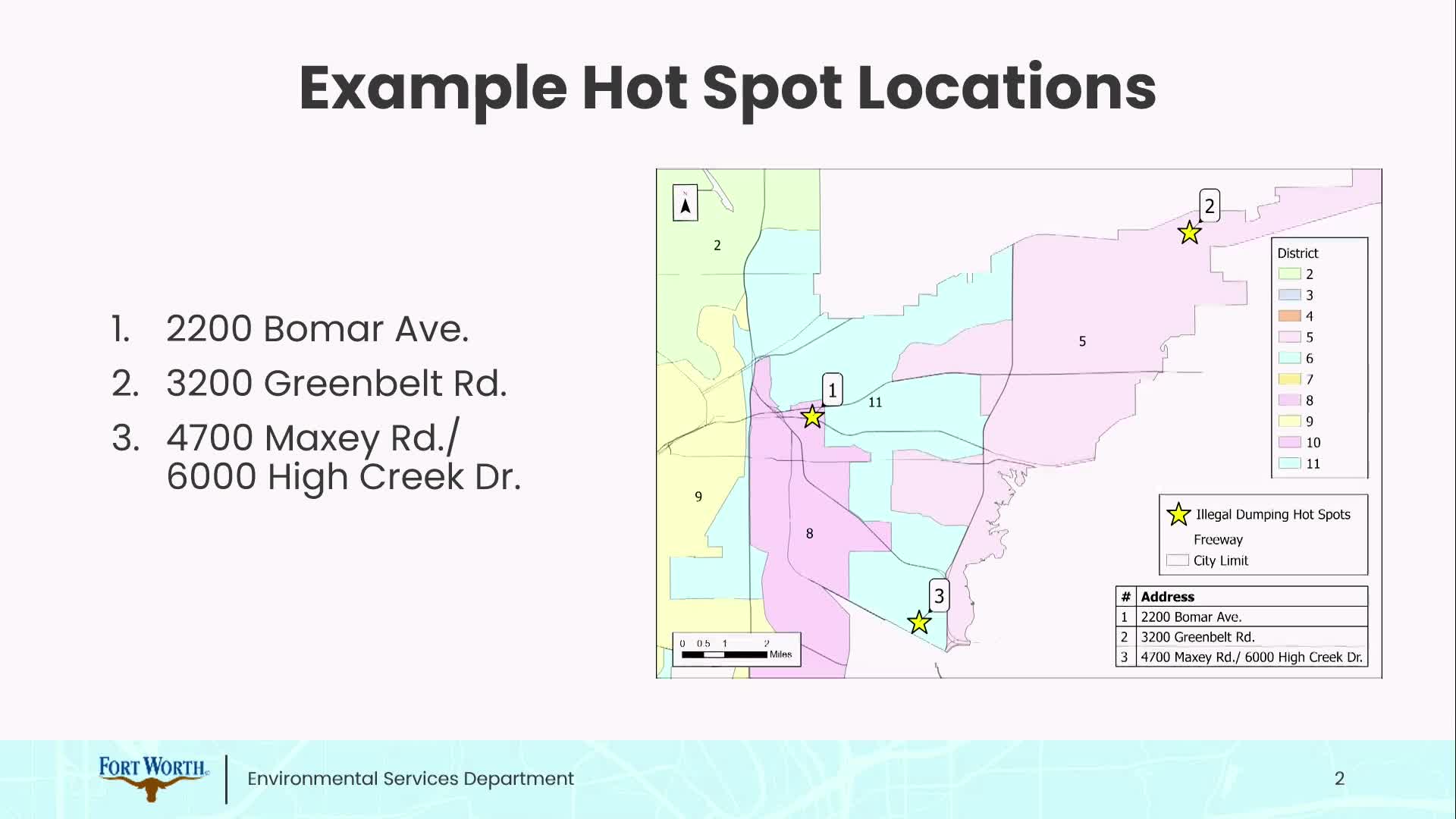
Wendy Turpin, environmental services assistant director, told the committee the city has installed a mix of live-view and pan-tilt-zoom cameras at several East Side illegal-dumping hotspots and credited the systems with deterring camps and producing evidence for enforcement.
“At 2200 Beaumont we cleared vegetation, installed a pan-tilt-zoom camera and a license-plate reader,” Turpin said, adding that the camera footage and plate reads generated a felony case and four citations and that “since then, there have been no illegal camps.” Turpin described another site, 3200 Green Belt, where passive “game” cameras were replaced in January 2026 by a live-view unit with two-way audio and lights; she said the live system lets staff warn trespassers remotely and has reduced repeat dumping.
Turpin and Cody Wittenberg, environmental services director, said the smaller passive cameras are less expensive but that live-view and STS360 systems provide active monitoring. The department monitors many cameras and shares access with the police department; when staff observe illegal activity they notify officers to respond.
Benjamin Samprack of the city attorney’s office summarized the city’s enforcement toolbox. Properties deemed substandard can be referred to the Building Standards Commission for orders to repair, demolish or pay civil penalties. The city may also pursue lawsuits under Chapter 54 for code violations and Chapter 211 for zoning violations; Samprack said those actions can produce injunctive relief and civil penalties up to $1,000 per day.
Turpin walked committee members through the practical enforcement cadence: staff issue a notice of violation and typically allow seven days for voluntary correction; if the owner does not address the problem, the city can abate the nuisance within roughly 24–48 hours once it is scheduled and then place a lien on the property to recover cleanup costs. She said the Environmental Investigation Unit works closely with police to document large-scale dumping (weight, video, admissions) and escalate some cases to felony prosecution when warranted.
The department is piloting enforcement specific to donation bins after finding many bins on improperly zoned commercial properties and said it supports the habitual-nuisance ordinance scheduled for council consideration. Turpin also noted coordination with other departments about relocating cameras when property changes—such as a planned private expansion or fencing—reduce the need at a specific site.
The committee asked about prosecution support from the district attorney’s office; Turpin said staff have not experienced difficulty advancing cases when camera evidence and witness statements exist.
Next steps: staff will continue the pilot projects (including donation-bin enforcement), coordinate with police on monitoring, and support the habitual-nuisance ordinance coming to council.
“At 2200 Beaumont we cleared vegetation, installed a pan-tilt-zoom camera and a license-plate reader,” Turpin said, adding that the camera footage and plate reads generated a felony case and four citations and that “since then, there have been no illegal camps.” Turpin described another site, 3200 Green Belt, where passive “game” cameras were replaced in January 2026 by a live-view unit with two-way audio and lights; she said the live system lets staff warn trespassers remotely and has reduced repeat dumping.
Turpin and Cody Wittenberg, environmental services director, said the smaller passive cameras are less expensive but that live-view and STS360 systems provide active monitoring. The department monitors many cameras and shares access with the police department; when staff observe illegal activity they notify officers to respond.
Benjamin Samprack of the city attorney’s office summarized the city’s enforcement toolbox. Properties deemed substandard can be referred to the Building Standards Commission for orders to repair, demolish or pay civil penalties. The city may also pursue lawsuits under Chapter 54 for code violations and Chapter 211 for zoning violations; Samprack said those actions can produce injunctive relief and civil penalties up to $1,000 per day.
Turpin walked committee members through the practical enforcement cadence: staff issue a notice of violation and typically allow seven days for voluntary correction; if the owner does not address the problem, the city can abate the nuisance within roughly 24–48 hours once it is scheduled and then place a lien on the property to recover cleanup costs. She said the Environmental Investigation Unit works closely with police to document large-scale dumping (weight, video, admissions) and escalate some cases to felony prosecution when warranted.
The department is piloting enforcement specific to donation bins after finding many bins on improperly zoned commercial properties and said it supports the habitual-nuisance ordinance scheduled for council consideration. Turpin also noted coordination with other departments about relocating cameras when property changes—such as a planned private expansion or fencing—reduce the need at a specific site.
The committee asked about prosecution support from the district attorney’s office; Turpin said staff have not experienced difficulty advancing cases when camera evidence and witness statements exist.
Next steps: staff will continue the pilot projects (including donation-bin enforcement), coordinate with police on monitoring, and support the habitual-nuisance ordinance coming to council.
View the Full Meeting & All Its Details
This article offers just a summary. Unlock complete video, transcripts, and insights as a Founder Member.
✓
Watch full, unedited meeting videos
✓
Search every word spoken in unlimited transcripts
✓
AI summaries & real-time alerts (all government levels)
✓
Permanent access to expanding government content
30-day money-back guarantee
