Planning Commission approves zoning-code amendments to reflect recent state housing laws; commissioners warn of reduced notice
March 10, 2026 | Sacramento County, California
This article was created by AI summarizing key points discussed. AI makes mistakes, so for full details and context, please refer to the video of the full meeting. Please report any errors so we can fix them. Report an error »
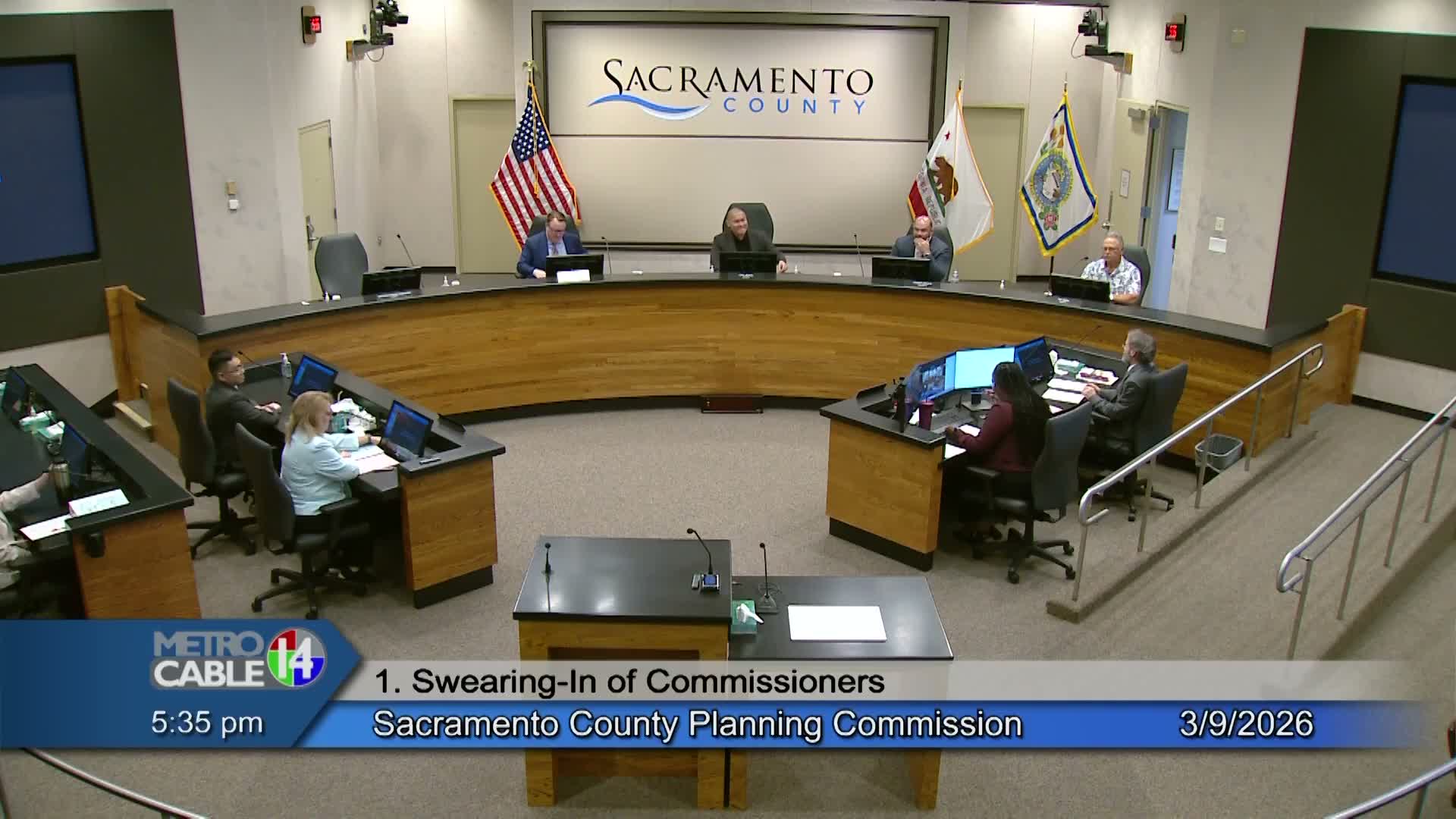
The Sacramento County Planning Commission voted to approve PLMP2024-00194, a countywide amendment to the zoning code that incorporates multiple California laws passed between 2023 and 2025 aimed at streamlining housing approvals.
Staff said the package implements bills such as SB 1123, which ‘‘allows subdivision of parcels into up to 10 lots if they meet certain criteria’’ and can be processed at the staff (ministerial) level, and SB 4, which includes a ‘‘100% affordability requirement’’ for housing on certain religious or campus sites, a provision staff described as a high barrier to use. Planning staffer Matthew Chiramoy summarized the scope: “SB 1123, which is a subdivision of parcels into up to 10 lots if they meet certain criteria. If they are able to meet the criteria, it would just be a staff level decision for that item.”
Commissioners pressed staff on what public notice and review would remain under the new rules. Planning staff (addressed in the meeting as Miss Hartman/Hartley) explained that qualifying projects would often be processed nondiscretionarily, making them exempt from CEQA and removing public hearings and mailed neighborhood notices in many cases. Staff said design review (DRAC) could still apply depending on project size, but ‘‘there would be no public hearing on those items’’ and ‘‘not nondiscretionary design review does not have sign posted posted on them,’’ a point commissioners flagged as significant for community awareness.
Several commissioners warned that ministerial processing could mean neighbors learn of developments only when construction begins. One commissioner framed the change bluntly: if an applicant meets objective criteria, ‘‘there’s just a checklist and staff can just check the boxes’’ and the project may not come before the commission or board. Another commissioner asked whether the commission or the Board of Supervisors could receive periodic reports on which projects used the state streamlining provisions; staff responded that many housing-related changes are tracked through the housing element annual report and other annual mechanisms but not every bill is guaranteed to be captured.
Before the vote, the chair asked whether there were public comments; staff reported none had been received. A motion was made, seconded, and the chair announced the item passed with the members present ‘‘all voting yes.’’ The motion approved the zoning-code amendments and the associated notice-of-exemption environmental determination.
The commission’s action implements state-directed objective standards that, if met, can accelerate approvals but limit discretionary review and traditional neighborhood notice. Commissioners requested ongoing tracking and reporting so the commission and public can see how frequently projects use the new ministerial pathways. The planning director’s office said staff will include many of these items in annual reporting related to the housing element but cautioned that not every statute may appear in that tracking.
What’s next: The zoning-code amendments are adopted as presented; staff noted the county will continue design-review procedures for qualifying projects and will post materials and tracking information online. The commission did not receive public comment on the item at the hearing.
Staff said the package implements bills such as SB 1123, which ‘‘allows subdivision of parcels into up to 10 lots if they meet certain criteria’’ and can be processed at the staff (ministerial) level, and SB 4, which includes a ‘‘100% affordability requirement’’ for housing on certain religious or campus sites, a provision staff described as a high barrier to use. Planning staffer Matthew Chiramoy summarized the scope: “SB 1123, which is a subdivision of parcels into up to 10 lots if they meet certain criteria. If they are able to meet the criteria, it would just be a staff level decision for that item.”
Commissioners pressed staff on what public notice and review would remain under the new rules. Planning staff (addressed in the meeting as Miss Hartman/Hartley) explained that qualifying projects would often be processed nondiscretionarily, making them exempt from CEQA and removing public hearings and mailed neighborhood notices in many cases. Staff said design review (DRAC) could still apply depending on project size, but ‘‘there would be no public hearing on those items’’ and ‘‘not nondiscretionary design review does not have sign posted posted on them,’’ a point commissioners flagged as significant for community awareness.
Several commissioners warned that ministerial processing could mean neighbors learn of developments only when construction begins. One commissioner framed the change bluntly: if an applicant meets objective criteria, ‘‘there’s just a checklist and staff can just check the boxes’’ and the project may not come before the commission or board. Another commissioner asked whether the commission or the Board of Supervisors could receive periodic reports on which projects used the state streamlining provisions; staff responded that many housing-related changes are tracked through the housing element annual report and other annual mechanisms but not every bill is guaranteed to be captured.
Before the vote, the chair asked whether there were public comments; staff reported none had been received. A motion was made, seconded, and the chair announced the item passed with the members present ‘‘all voting yes.’’ The motion approved the zoning-code amendments and the associated notice-of-exemption environmental determination.
The commission’s action implements state-directed objective standards that, if met, can accelerate approvals but limit discretionary review and traditional neighborhood notice. Commissioners requested ongoing tracking and reporting so the commission and public can see how frequently projects use the new ministerial pathways. The planning director’s office said staff will include many of these items in annual reporting related to the housing element but cautioned that not every statute may appear in that tracking.
What’s next: The zoning-code amendments are adopted as presented; staff noted the county will continue design-review procedures for qualifying projects and will post materials and tracking information online. The commission did not receive public comment on the item at the hearing.
View the Full Meeting & All Its Details
This article offers just a summary. Unlock complete video, transcripts, and insights as a Founder Member.
✓
Watch full, unedited meeting videos
✓
Search every word spoken in unlimited transcripts
✓
AI summaries & real-time alerts (all government levels)
✓
Permanent access to expanding government content
30-day money-back guarantee
