Emergency Management seeks staffing boost and funds for Haula resilience hub as council presses shelter readiness
March 10, 2026 | Honolulu City, Honolulu County, Hawaii
This article was created by AI summarizing key points discussed. AI makes mistakes, so for full details and context, please refer to the video of the full meeting. Please report any errors so we can fix them. Report an error »
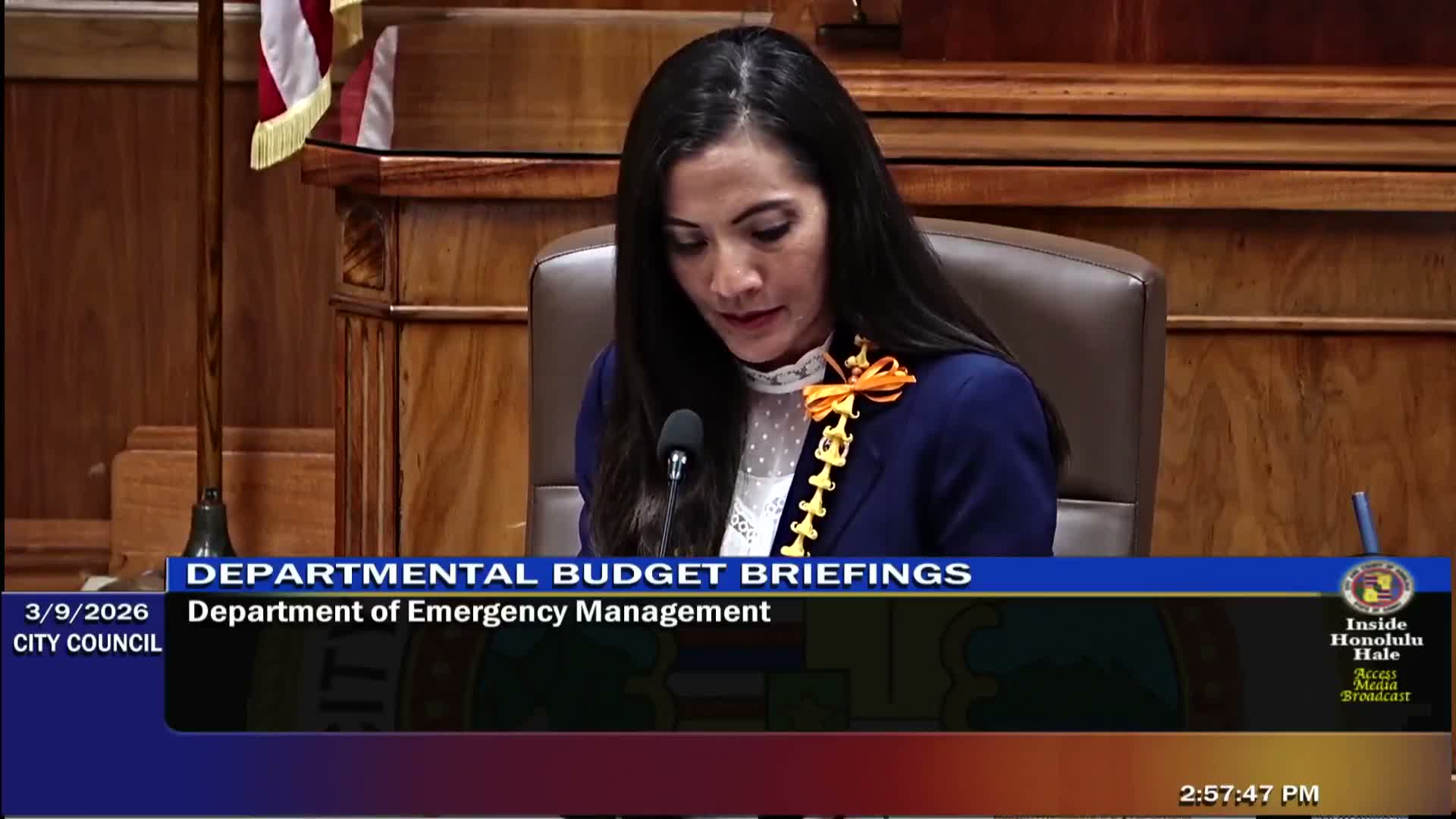
The Department of Emergency Management told the Budget Committee on March 9 that its FY27 request reflects a stepped‑up push to expand disaster preparedness, including eight new full‑time positions and CIP investment in remote resilience infrastructure.
Director Randall Collins said the FY27 package represents roughly a 30% increase overall, driven largely by a 40% salary increase that covers eight FTEs and prorated hiring across the year. “We are looking at a... fairly significant increase, which reflects the mayor’s focus on improving disaster preparedness and emergency management across Oʻahu,” Collins said.
On capital items, Collins highlighted a $2,000,000 request for the Haula Resilience Hub — a remote site intended to reduce isolation and provide shelter, services and staging in a high‑risk area — plus smaller CIP items: $200,000 for required underground storage tank conversion at a regional operations center and $130,000 for HVAC and generator improvements. DEM also requested $62,500 to replace an aging 2005 vehicle.
Council Chair Waters and other members asked pointed questions about shelter suitability for large storms. Collins replied that no publicly used facilities on Oʻahu are rated to withstand hurricane‑force winds and that the city uses designated “last refuge” locations only for high‑risk households when evacuation to sturdier buildings is not available. “We don’t really advocate for sheltering before the storm,” Collins said, adding that investments such as the Haula hub are early steps toward larger shelter resilience.
Members also explored staffing and grant strategy. Collins explained DEM plans to convert about four federally funded positions to civil service to stabilize staffing and then redeploy the federal funds to new grant‑eligible positions. He said homeland security grants are being used for PPE and some vehicle replacement, and that DEM is open to contracting standby logistics providers to augment surge capacity.
The committee did not vote; members asked DEM to provide more detail on facility standards, siting plans for resilience hubs and the sequencing of the new hires as part of departmental follow‑up.
Director Randall Collins said the FY27 package represents roughly a 30% increase overall, driven largely by a 40% salary increase that covers eight FTEs and prorated hiring across the year. “We are looking at a... fairly significant increase, which reflects the mayor’s focus on improving disaster preparedness and emergency management across Oʻahu,” Collins said.
On capital items, Collins highlighted a $2,000,000 request for the Haula Resilience Hub — a remote site intended to reduce isolation and provide shelter, services and staging in a high‑risk area — plus smaller CIP items: $200,000 for required underground storage tank conversion at a regional operations center and $130,000 for HVAC and generator improvements. DEM also requested $62,500 to replace an aging 2005 vehicle.
Council Chair Waters and other members asked pointed questions about shelter suitability for large storms. Collins replied that no publicly used facilities on Oʻahu are rated to withstand hurricane‑force winds and that the city uses designated “last refuge” locations only for high‑risk households when evacuation to sturdier buildings is not available. “We don’t really advocate for sheltering before the storm,” Collins said, adding that investments such as the Haula hub are early steps toward larger shelter resilience.
Members also explored staffing and grant strategy. Collins explained DEM plans to convert about four federally funded positions to civil service to stabilize staffing and then redeploy the federal funds to new grant‑eligible positions. He said homeland security grants are being used for PPE and some vehicle replacement, and that DEM is open to contracting standby logistics providers to augment surge capacity.
The committee did not vote; members asked DEM to provide more detail on facility standards, siting plans for resilience hubs and the sequencing of the new hires as part of departmental follow‑up.
View the Full Meeting & All Its Details
This article offers just a summary. Unlock complete video, transcripts, and insights as a Founder Member.
✓
Watch full, unedited meeting videos
✓
Search every word spoken in unlimited transcripts
✓
AI summaries & real-time alerts (all government levels)
✓
Permanent access to expanding government content
30-day money-back guarantee
