Committee adopts amendment to SB334 to bar sale and manufacture of narrowly defined “machine-gun convertible” pistols; debate centers on overlap with existing U
March 10, 2026 | Judicial Proceedings Committee, SENATE, SENATE, Committees, Legislative, Maryland
This article was created by AI summarizing key points discussed. AI makes mistakes, so for full details and context, please refer to the video of the full meeting. Please report any errors so we can fix them. Report an error »
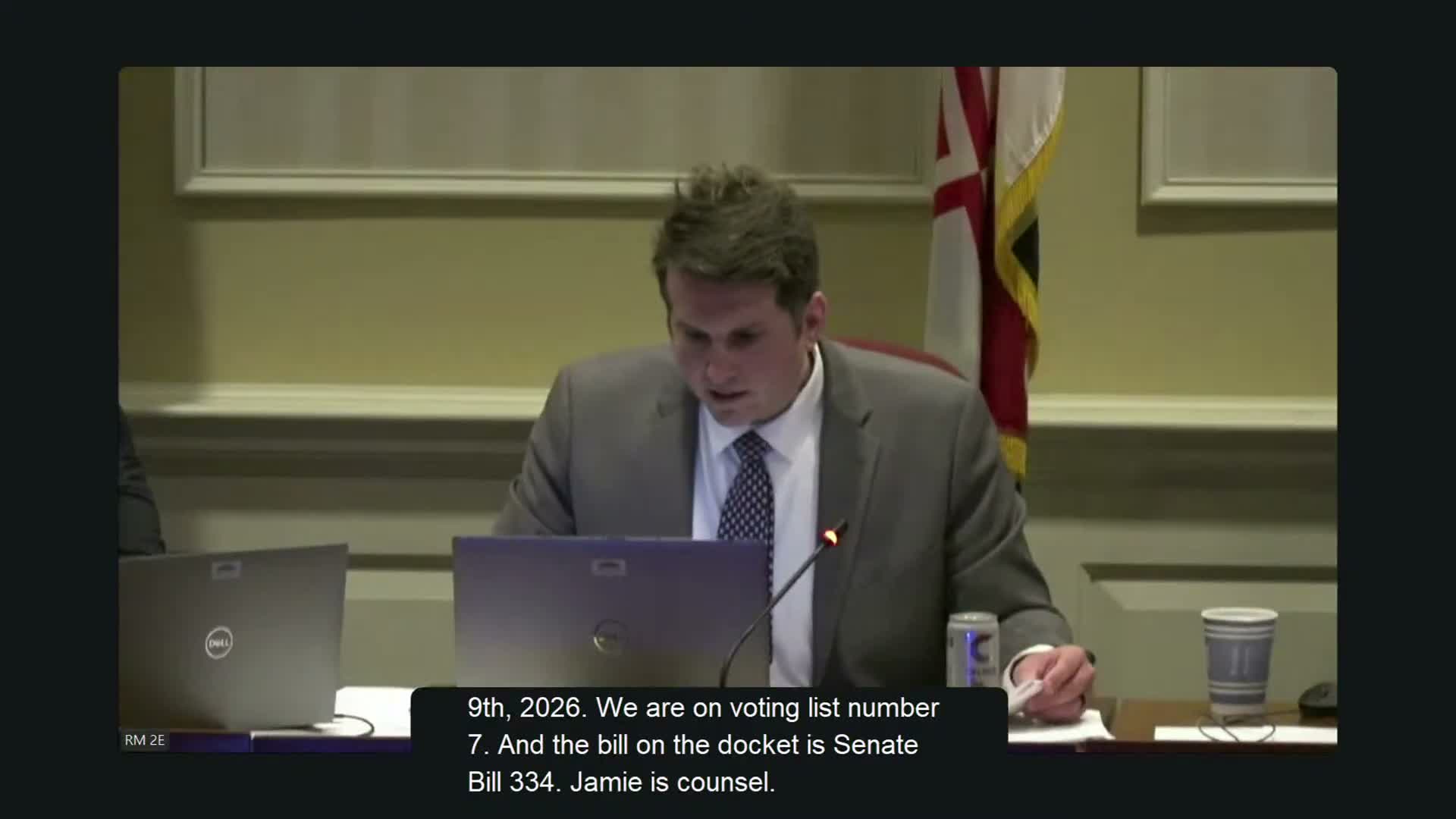
The Judicial Proceedings Committee adopted an amendment to Senate Bill 334 on March 9, 2026, that would prohibit the manufacture, sale, offer for sale, purchase, receipt or transfer of a narrowly defined "machine gun convertible pistol" beginning Jan. 1, 2027, subject to specified exceptions for law-enforcement use and inheritance.
Jamie (counsel to the committee) told members the amendment corrects several technical points from the prior reprint and narrows the scope by explicitly excluding "striker-fired semiautomatic pistols without a cruciform trigger bar." Counsel said the bill also expands the definition of "rapid fire activator" to add "pistol converter," and changes regulatory language so that the Department of State Police shall adopt implementing regulations, including publishing a list of prohibited machine-gun-convertible pistols. "A violator is guilty of a misdemeanor punishable by imprisonment for up to 3 years and/or a $5,000 maximum fine," counsel said during the summary of the measure.
Supporters said the bill targets a specific, easily converted pistol design and aims to limit proliferation of inexpensive "switches" and 3-D-printed parts law enforcement increasingly recover. "These do-it-yourself machine guns are proliferating," Senator Sarah Love said, arguing the measure addresses a design that can be converted with common household tools or cheaply produced parts and that law enforcement had requested the change.
Opponents on the committee pressed counsel on how the bill differs from existing federal and state prohibitions. Several members noted that Glock switches and similar devices are already addressed by federal law and by Maryland statutes governing machine guns and "rapid fire activators." One committee member questioned whether the proposal merely duplicates existing crimes and therefore would be vulnerable to constitutional challenge. "I think, first blush, I'm worried that it may be unconstitutional," that member said, while also acknowledging the "horror" of the conversion devices shown in evidentiary videos.
Counsel clarified distinctions among offenses: mere possession of a prohibited device is treated differently from using a converted firearm in the commission of a violent felony. Under provisions discussed during the hearing, a general statutory violation involving a machine-gun-convertible pistol carries a maximum penalty of three years, while the statute addressing use of an assault-weapon rapid-fire activator in the commission of a felony carries an escalated penalty with a mandatory minimum of five years and up to 20 years on conviction. Counsel also cited the Uniform Machine Gun Act (Criminal Law Article §§4401–4407), under which possession of an unregistered machine gun for an offensive purpose can carry penalties of up to 10 years.
Members also debated carve-outs in the bill. The reprint exempts the subtitle for law-enforcement personnel acting within the scope of official business and includes limited language for retired officers if the firearm was sold or transferred by the agency on retirement or was acquired for official use before retirement. Committee members asked for clearer language on whether an active officer could purchase the same pistol for off-duty carry and whether retired officers who carried the firearm for decades would be able to retain or later purchase similar models. Counsel acknowledged some ambiguity in the current reprint and said the committee could add clarifying language by amendment.
A related question concerned transfers among family members and inheritance. Counsel pointed members to reprint language that exempts receipt of an assault weapon or machine-gun-convertible pistol by inheritance "if the decedent lawfully possessed" the item, but she noted the statute does not specify the particular instrument or relationship that governs such transfers.
At the hearing a member requested data on harms tied specifically to these modified pistols; Senator Love said she had prepared an eight-page list of "switch incidents" in Maryland and cited several local cases, and she offered to share that list with colleagues.
The committee adopted the single amendment (amendment SB334653124) during the session. Members did not take a final committee vote on the underlying bill; one senator asked to hold the measure while staff and members draft narrower language to clarify law-enforcement and retired-officer exceptions. The chair said the committee will reconvene immediately after floor session the next day to continue consideration.
Next steps: the measure remains before the Judicial Proceedings Committee as amended; members signaled continuing work on precise carve-outs and technical drafting ahead of any final committee vote.
Sources: Remarks and explanations by Jamie (committee counsel), Senator Sarah Love and multiple committee members during the Judicial Proceedings Committee hearing on March 9, 2026.
Jamie (counsel to the committee) told members the amendment corrects several technical points from the prior reprint and narrows the scope by explicitly excluding "striker-fired semiautomatic pistols without a cruciform trigger bar." Counsel said the bill also expands the definition of "rapid fire activator" to add "pistol converter," and changes regulatory language so that the Department of State Police shall adopt implementing regulations, including publishing a list of prohibited machine-gun-convertible pistols. "A violator is guilty of a misdemeanor punishable by imprisonment for up to 3 years and/or a $5,000 maximum fine," counsel said during the summary of the measure.
Supporters said the bill targets a specific, easily converted pistol design and aims to limit proliferation of inexpensive "switches" and 3-D-printed parts law enforcement increasingly recover. "These do-it-yourself machine guns are proliferating," Senator Sarah Love said, arguing the measure addresses a design that can be converted with common household tools or cheaply produced parts and that law enforcement had requested the change.
Opponents on the committee pressed counsel on how the bill differs from existing federal and state prohibitions. Several members noted that Glock switches and similar devices are already addressed by federal law and by Maryland statutes governing machine guns and "rapid fire activators." One committee member questioned whether the proposal merely duplicates existing crimes and therefore would be vulnerable to constitutional challenge. "I think, first blush, I'm worried that it may be unconstitutional," that member said, while also acknowledging the "horror" of the conversion devices shown in evidentiary videos.
Counsel clarified distinctions among offenses: mere possession of a prohibited device is treated differently from using a converted firearm in the commission of a violent felony. Under provisions discussed during the hearing, a general statutory violation involving a machine-gun-convertible pistol carries a maximum penalty of three years, while the statute addressing use of an assault-weapon rapid-fire activator in the commission of a felony carries an escalated penalty with a mandatory minimum of five years and up to 20 years on conviction. Counsel also cited the Uniform Machine Gun Act (Criminal Law Article §§4401–4407), under which possession of an unregistered machine gun for an offensive purpose can carry penalties of up to 10 years.
Members also debated carve-outs in the bill. The reprint exempts the subtitle for law-enforcement personnel acting within the scope of official business and includes limited language for retired officers if the firearm was sold or transferred by the agency on retirement or was acquired for official use before retirement. Committee members asked for clearer language on whether an active officer could purchase the same pistol for off-duty carry and whether retired officers who carried the firearm for decades would be able to retain or later purchase similar models. Counsel acknowledged some ambiguity in the current reprint and said the committee could add clarifying language by amendment.
A related question concerned transfers among family members and inheritance. Counsel pointed members to reprint language that exempts receipt of an assault weapon or machine-gun-convertible pistol by inheritance "if the decedent lawfully possessed" the item, but she noted the statute does not specify the particular instrument or relationship that governs such transfers.
At the hearing a member requested data on harms tied specifically to these modified pistols; Senator Love said she had prepared an eight-page list of "switch incidents" in Maryland and cited several local cases, and she offered to share that list with colleagues.
The committee adopted the single amendment (amendment SB334653124) during the session. Members did not take a final committee vote on the underlying bill; one senator asked to hold the measure while staff and members draft narrower language to clarify law-enforcement and retired-officer exceptions. The chair said the committee will reconvene immediately after floor session the next day to continue consideration.
Next steps: the measure remains before the Judicial Proceedings Committee as amended; members signaled continuing work on precise carve-outs and technical drafting ahead of any final committee vote.
Sources: Remarks and explanations by Jamie (committee counsel), Senator Sarah Love and multiple committee members during the Judicial Proceedings Committee hearing on March 9, 2026.
View the Full Meeting & All Its Details
This article offers just a summary. Unlock complete video, transcripts, and insights as a Founder Member.
✓
Watch full, unedited meeting videos
✓
Search every word spoken in unlimited transcripts
✓
AI summaries & real-time alerts (all government levels)
✓
Permanent access to expanding government content
30-day money-back guarantee
