Draft would pause ALPR and CCTV data collection for 60 days when data could be used in immigration or reproductive-health enforcement
March 10, 2026 | Seattle, King County, Washington
This article was created by AI summarizing key points discussed. AI makes mistakes, so for full details and context, please refer to the video of the full meeting. Please report any errors so we can fix them. Report an error »
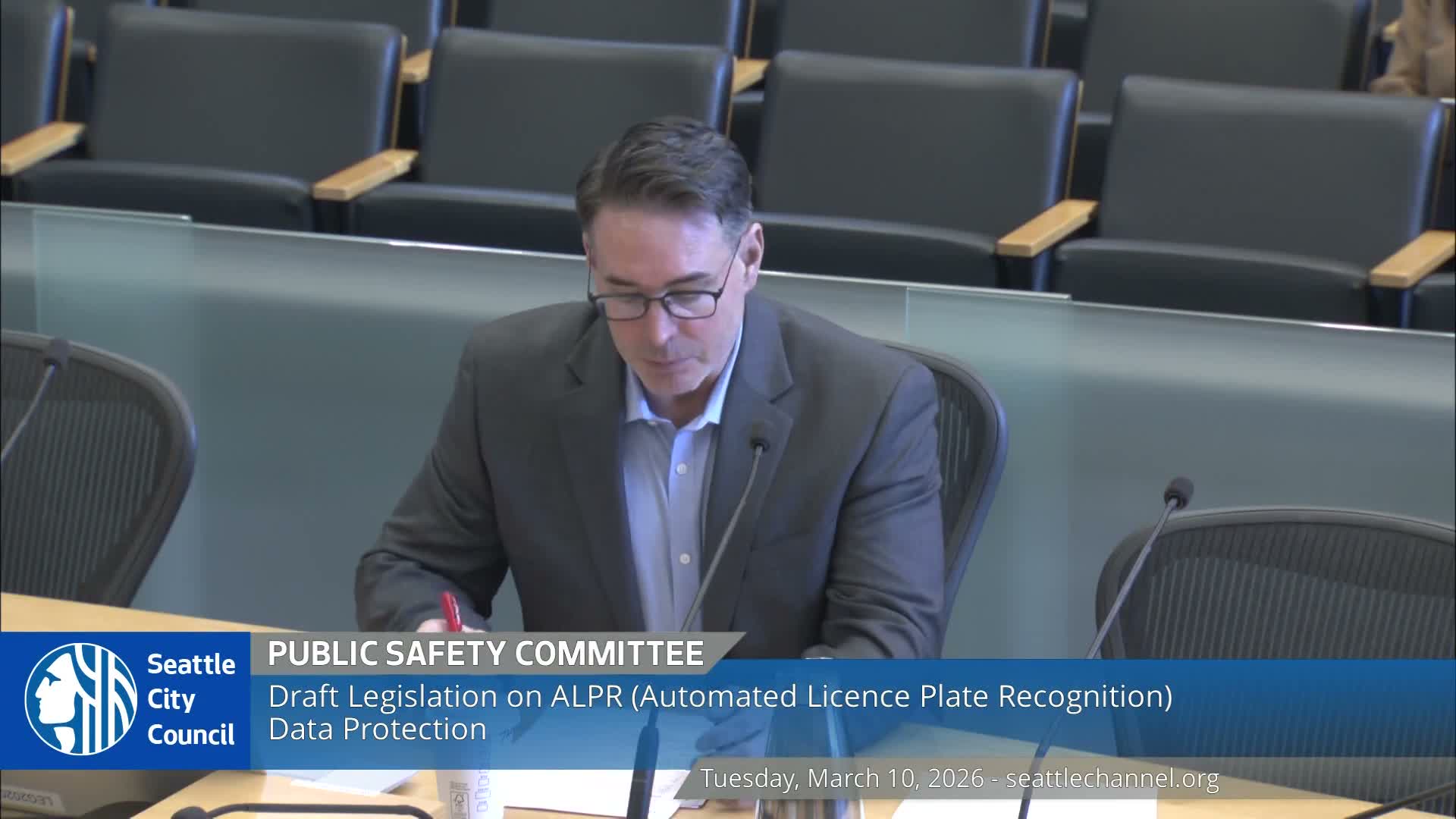
A draft Seattle City Council bill (TMP12288), discussed March 10 in Public Safety Committee, would require a mandatory 60-day pause in data collection by the Seattle Police Department’s automated license-plate recognition (ALPR) system and align ALPR with an existing 60-day pause for CCTV when data is requested for civil immigration enforcement or reproductive-health enforcement. Council member Rankin, the draft sponsor, told the committee she intends to add gender-affirming care explicitly as a protected category.
Greg Doss, council central staff, told the committee the draft mirrors protections previously placed on CCTV during expansion of the city’s surveillance programs and would expand the pause provision to SPD’s patrol ALPR system. He said the pause would also apply if a vendor or the city received a warrant, subpoena or court order seeking CCTV or ALPR data that might be used in civil immigration enforcement or to enforce reproductive-health laws; the mayor and police chief could also determine a pause was warranted if increased civil immigration enforcement presence suggested data could be used for those purposes. "Axon said it can implement within about a day a system wide shutdown of the ALPR network," Doss said, and staff said the draft is expected to return to the committee as an official bill with opportunities for amendments at the next meeting.
Several council members praised prior privacy safeguards built into the ALPR/CCTV programs — including limits on who can access data, vendor-notification and vendor legal-retention provisions — and emphasized that the 60-day pause is the draft’s principal change. One council member raised a substantive legal question about the bill’s language, asking whether the pause triggers on an administrative warrant or must be limited to judicial warrants with probable cause. The member argued administrative administrative warrants are not equivalent to judicial warrants and urged the staff to consult with law on whether the draft should specify "judicial warrant." Doss said he would follow up with the City Attorney and prepare amendments as needed.
Sponsor Rankin said explicitly naming gender-affirming care in the draft would align the measure with past Council steps to protect reproductive and other sensitive health services. Committee chair Robert Kettle said the pause was intended as a safeguard to prevent surveillance data from being "weaponized" against residents seeking reproductive health or gender-affirming care or facing immigration enforcement.
Next steps: Doss said the draft will be formally introduced next Tuesday and return to the Public Safety Committee for a second hearing, where members may propose amendments (including clarifying the warrant language and explicitly naming gender-affirming care).
Greg Doss, council central staff, told the committee the draft mirrors protections previously placed on CCTV during expansion of the city’s surveillance programs and would expand the pause provision to SPD’s patrol ALPR system. He said the pause would also apply if a vendor or the city received a warrant, subpoena or court order seeking CCTV or ALPR data that might be used in civil immigration enforcement or to enforce reproductive-health laws; the mayor and police chief could also determine a pause was warranted if increased civil immigration enforcement presence suggested data could be used for those purposes. "Axon said it can implement within about a day a system wide shutdown of the ALPR network," Doss said, and staff said the draft is expected to return to the committee as an official bill with opportunities for amendments at the next meeting.
Several council members praised prior privacy safeguards built into the ALPR/CCTV programs — including limits on who can access data, vendor-notification and vendor legal-retention provisions — and emphasized that the 60-day pause is the draft’s principal change. One council member raised a substantive legal question about the bill’s language, asking whether the pause triggers on an administrative warrant or must be limited to judicial warrants with probable cause. The member argued administrative administrative warrants are not equivalent to judicial warrants and urged the staff to consult with law on whether the draft should specify "judicial warrant." Doss said he would follow up with the City Attorney and prepare amendments as needed.
Sponsor Rankin said explicitly naming gender-affirming care in the draft would align the measure with past Council steps to protect reproductive and other sensitive health services. Committee chair Robert Kettle said the pause was intended as a safeguard to prevent surveillance data from being "weaponized" against residents seeking reproductive health or gender-affirming care or facing immigration enforcement.
Next steps: Doss said the draft will be formally introduced next Tuesday and return to the Public Safety Committee for a second hearing, where members may propose amendments (including clarifying the warrant language and explicitly naming gender-affirming care).
View the Full Meeting & All Its Details
This article offers just a summary. Unlock complete video, transcripts, and insights as a Founder Member.
✓
Watch full, unedited meeting videos
✓
Search every word spoken in unlimited transcripts
✓
AI summaries & real-time alerts (all government levels)
✓
Permanent access to expanding government content
30-day money-back guarantee
