Board approves Yorktown Dockmaster and waterfront operations buildings, staff to include archaeology protections
April 16, 2024 | York County, Virginia
This article was created by AI summarizing key points discussed. AI makes mistakes, so for full details and context, please refer to the video of the full meeting. Please report any errors so we can fix them. Report an error »
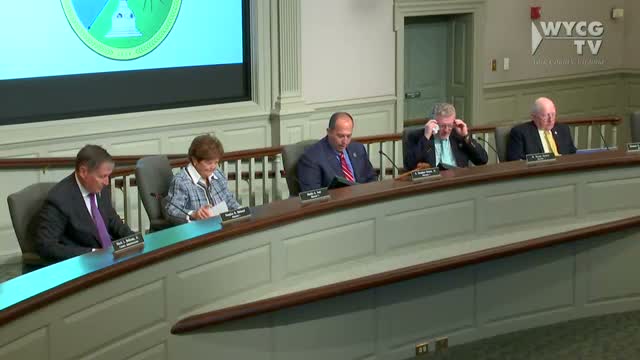
The York County Board of Supervisors approved two Yorktown village‑activity applications to replace aging waterfront facilities and create a dedicated waterfront operations office, citing both visitor needs and public‑safety advantages.
Planning staff said the Dockmaster office and adjacent restroom buildings — built in the 1970s and lacking climate control and ADA compliance — will be replaced with modern facilities that provide ADA‑accessible restrooms and a consolidated visitor information point. The board approved Resolution R24‑66 to permit the Dockmaster building replacement after staff and public engagement produced a design that reduces height and responds to earlier Historic Yorktown Design Committee concerns.
In a separate but related application, supervisors approved Resolution R24‑65 for a new waterfront operations building to house permanent staff and to serve as an operational hub for waterfront ambassadors, parking services and event logistics. Planning staff described the building as roughly 1,860 square feet and said it would serve as an on‑site command and coordination center during large events; engineering’s initial cost guidance for the two waterfront buildings together was $1.5 million to $2.0 million.
Multiple residents and board members urged archaeology safeguards. Bonnie Karwack and others asked that ground‑penetrating radar and phased archaeological study be required before ground disturbance, and staff confirmed that required phase‑1 reviews and additional study when artifacts are suspected will be incorporated into design and permitting. Staff also noted prior GPR work in the area and said consultant archaeologists are already engaged.
Board members pressed for clarity on cost and timing; staff and the county engineer said the approvals tonight establish land‑use permissions and direction to proceed with design, not an immediate appropriation or ground‑breaking. County staff said they plan a phased procurement and will return to the board with firm cost estimates and contract terms before proceeding on the second building.
The board approved both resolutions by roll call (R24‑66 and R24‑65) and instructed staff to include archaeology protections and to present final cost and contract details in subsequent procurement steps.
Planning staff said the Dockmaster office and adjacent restroom buildings — built in the 1970s and lacking climate control and ADA compliance — will be replaced with modern facilities that provide ADA‑accessible restrooms and a consolidated visitor information point. The board approved Resolution R24‑66 to permit the Dockmaster building replacement after staff and public engagement produced a design that reduces height and responds to earlier Historic Yorktown Design Committee concerns.
In a separate but related application, supervisors approved Resolution R24‑65 for a new waterfront operations building to house permanent staff and to serve as an operational hub for waterfront ambassadors, parking services and event logistics. Planning staff described the building as roughly 1,860 square feet and said it would serve as an on‑site command and coordination center during large events; engineering’s initial cost guidance for the two waterfront buildings together was $1.5 million to $2.0 million.
Multiple residents and board members urged archaeology safeguards. Bonnie Karwack and others asked that ground‑penetrating radar and phased archaeological study be required before ground disturbance, and staff confirmed that required phase‑1 reviews and additional study when artifacts are suspected will be incorporated into design and permitting. Staff also noted prior GPR work in the area and said consultant archaeologists are already engaged.
Board members pressed for clarity on cost and timing; staff and the county engineer said the approvals tonight establish land‑use permissions and direction to proceed with design, not an immediate appropriation or ground‑breaking. County staff said they plan a phased procurement and will return to the board with firm cost estimates and contract terms before proceeding on the second building.
The board approved both resolutions by roll call (R24‑66 and R24‑65) and instructed staff to include archaeology protections and to present final cost and contract details in subsequent procurement steps.
Don't Miss a Word: See the Full Meeting!
Go beyond summaries. Unlock every video, transcript, and key insight with a Founder Membership.
✓
Get instant access to full meeting videos
✓
Search and clip any phrase from complete transcripts
✓
Receive AI-powered summaries & custom alerts
✓
Enjoy lifetime, unrestricted access to government data
30-day money-back guarantee
