Commission approves ornate gate for Saint John's Lutheran Church despite preservation concerns
March 04, 2026 | San Antonio, Bexar County, Texas
This article was created by AI summarizing key points discussed. AI makes mistakes, so for full details and context, please refer to the video of the full meeting. Please report any errors so we can fix them. Report an error »
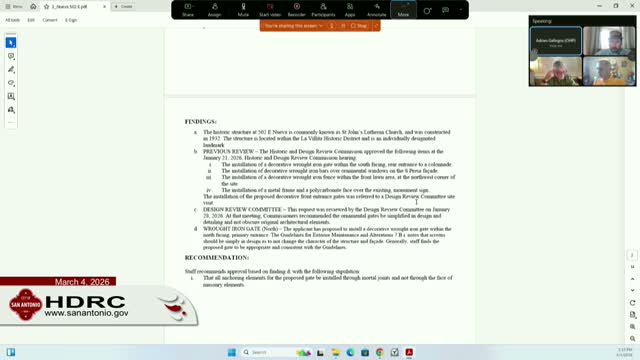
The Historic and Design Review Commission voted to approve a wrought-iron gate for Saint John’s Lutheran Church after staff said the feature would be reversible and would not overwhelm the building’s character.
Commission Chair J. Maurice Gibbs opened the discussion, and staff told commissioners the gate had been reviewed previously and that an updated design had been submitted after the first HDRC hearing. “Staff found that this gate, due to the scale of the building, would not overwhelm or negatively impact the character and also that the gate is a reversible condition,” staff said in presenting the case.
The applicant, the Rev. Burke, said the gate was intended primarily to extend a perimeter to deter people who have been sleeping on the porch and damaging the doors: “...the homeless will defecate, urinate. They will, destroy things on the church. As you can see, the bottom of the church has been, the bottom of the doors has been, totally destroyed,” he said, explaining why the gate would be placed toward the front of the step rather than inset.
Architect Kelis Alman described the structural conditions and anchoring options, telling commissioners the best place to anchor the gate is at a concrete column behind the inset and that bolts could be set into mortar joints and the columns for a secure installation.
Several commissioners said they understood the security need but questioned whether the ornate gate design would obscure the church’s historic features. “To obscure that with... the gate and all of the decor, as beautiful as it is on its own, just seems to be taking away so much from the original design,” Commissioner Sabino said, citing the building’s leaded glass, Gothic motifs and the church’s frontispiece.
After discussion, a commissioner moved to approve the simpler of two submitted gate options; the motion was seconded and passed by roll call, with at least one commissioner recorded in opposition. The commission’s approval included the version that reduces decorative elements so the architectural features of the entry remain visible.
The commission noted that an HDRC approval does not replace other required permits and that a certificate of appropriateness would be emailed within 10 business days. The church may still be required to obtain building permits and must follow any conditions set by staff.
Commission Chair J. Maurice Gibbs opened the discussion, and staff told commissioners the gate had been reviewed previously and that an updated design had been submitted after the first HDRC hearing. “Staff found that this gate, due to the scale of the building, would not overwhelm or negatively impact the character and also that the gate is a reversible condition,” staff said in presenting the case.
The applicant, the Rev. Burke, said the gate was intended primarily to extend a perimeter to deter people who have been sleeping on the porch and damaging the doors: “...the homeless will defecate, urinate. They will, destroy things on the church. As you can see, the bottom of the church has been, the bottom of the doors has been, totally destroyed,” he said, explaining why the gate would be placed toward the front of the step rather than inset.
Architect Kelis Alman described the structural conditions and anchoring options, telling commissioners the best place to anchor the gate is at a concrete column behind the inset and that bolts could be set into mortar joints and the columns for a secure installation.
Several commissioners said they understood the security need but questioned whether the ornate gate design would obscure the church’s historic features. “To obscure that with... the gate and all of the decor, as beautiful as it is on its own, just seems to be taking away so much from the original design,” Commissioner Sabino said, citing the building’s leaded glass, Gothic motifs and the church’s frontispiece.
After discussion, a commissioner moved to approve the simpler of two submitted gate options; the motion was seconded and passed by roll call, with at least one commissioner recorded in opposition. The commission’s approval included the version that reduces decorative elements so the architectural features of the entry remain visible.
The commission noted that an HDRC approval does not replace other required permits and that a certificate of appropriateness would be emailed within 10 business days. The church may still be required to obtain building permits and must follow any conditions set by staff.
View the Full Meeting & All Its Details
This article offers just a summary. Unlock complete video, transcripts, and insights as a Founder Member.
✓
Watch full, unedited meeting videos
✓
Search every word spoken in unlimited transcripts
✓
AI summaries & real-time alerts (all government levels)
✓
Permanent access to expanding government content
30-day money-back guarantee
