Waukesha board approves guardrail at 524 Madison Street after residents cite repeated crashes
March 05, 2026 | Waukesha City, Waukesha County, Wisconsin
This article was created by AI summarizing key points discussed. AI makes mistakes, so for full details and context, please refer to the video of the full meeting. Please report any errors so we can fix them. Report an error »
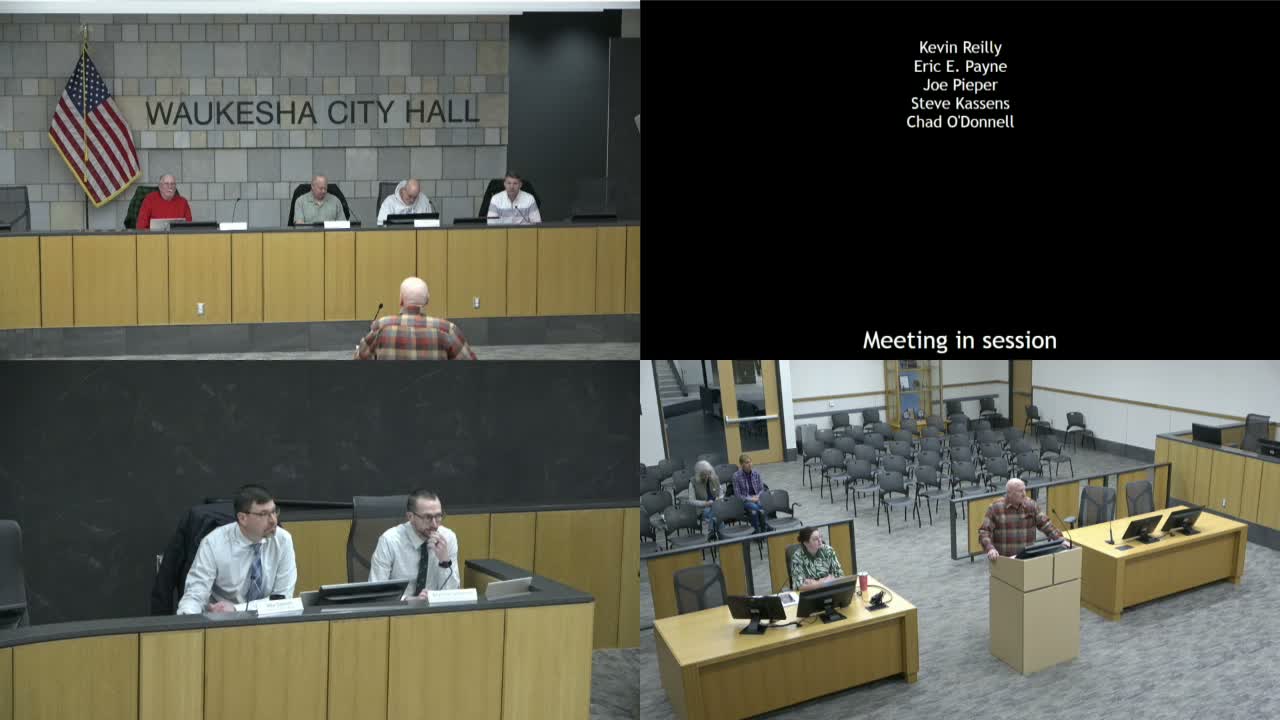
Alderman Eric Payne moved and the Waukesha Board of Public Works approved installing a guardrail near 524 Madison Street after residents described multiple accidents where vehicles ran off the curve and struck private property.
Resident Frank Palm told the board he lives at 625 Chicago Avenue and described two crashes in recent years in which vehicles “jumped the curb over the sidewalk” and struck houses or retaining walls, arguing a guardrail — which he estimated would cost about $1,500 — would better protect people and property than additional chevron signs. “I think there needs to be a guardrail,” Palm said.
Lisa Salb, a resident at 434 Madison Street and a member of the Tower Hill Neighborhood Association, said the curve is visible from neighborhood windows and that heavy concrete planters in the area have already been struck. “Wouldn't it be better for them to bounce off of a guardrail than hitting that head on?” Salb asked, citing pedestrian safety and planter damage.
City engineering staff told the board the department’s recommendation was to not install a guardrail at that location and to pursue alternatives such as additional chevrons or concrete bollards. Brandon, an engineering staff member, said guardrails are typically used where the hazard behind the rail is worse than the risk of striking the rail itself and noted the site cannot accommodate a crash‑rated end terminal; he said some end treatments that would fit are associated with greater risk of driver injury.
Alderman Eric Payne responded that his primary concern is pedestrians and residents on the sidewalk, not vehicle occupants. Payne cited calls for service and local observations, saying there had been multiple reported incidents at the location over recent years and that signage alone has not prevented crashes: “The signs might do their job for a normal, sober speed limit driver, but it does nothing for the impaired person.”
Payne moved to approve installation of a guardrail to cover the indicated span, authorizing up to $7,000 for the work; Piper seconded the motion. After a brief board discussion and no further public comment, the board voted to approve the installation. The board directed staff to proceed with implementation and, if necessary, make any budget reallocations to cover the cost.
The board’s action was limited to authorizing installation; staff retained discretion about exact design and any safety mitigations required on the site. The motion passed and the board closed public comment on the item.
Next steps: staff will arrange installation and address any right‑of‑way or design constraints identified by engineering during implementation.
Resident Frank Palm told the board he lives at 625 Chicago Avenue and described two crashes in recent years in which vehicles “jumped the curb over the sidewalk” and struck houses or retaining walls, arguing a guardrail — which he estimated would cost about $1,500 — would better protect people and property than additional chevron signs. “I think there needs to be a guardrail,” Palm said.
Lisa Salb, a resident at 434 Madison Street and a member of the Tower Hill Neighborhood Association, said the curve is visible from neighborhood windows and that heavy concrete planters in the area have already been struck. “Wouldn't it be better for them to bounce off of a guardrail than hitting that head on?” Salb asked, citing pedestrian safety and planter damage.
City engineering staff told the board the department’s recommendation was to not install a guardrail at that location and to pursue alternatives such as additional chevrons or concrete bollards. Brandon, an engineering staff member, said guardrails are typically used where the hazard behind the rail is worse than the risk of striking the rail itself and noted the site cannot accommodate a crash‑rated end terminal; he said some end treatments that would fit are associated with greater risk of driver injury.
Alderman Eric Payne responded that his primary concern is pedestrians and residents on the sidewalk, not vehicle occupants. Payne cited calls for service and local observations, saying there had been multiple reported incidents at the location over recent years and that signage alone has not prevented crashes: “The signs might do their job for a normal, sober speed limit driver, but it does nothing for the impaired person.”
Payne moved to approve installation of a guardrail to cover the indicated span, authorizing up to $7,000 for the work; Piper seconded the motion. After a brief board discussion and no further public comment, the board voted to approve the installation. The board directed staff to proceed with implementation and, if necessary, make any budget reallocations to cover the cost.
The board’s action was limited to authorizing installation; staff retained discretion about exact design and any safety mitigations required on the site. The motion passed and the board closed public comment on the item.
Next steps: staff will arrange installation and address any right‑of‑way or design constraints identified by engineering during implementation.
Don't Miss a Word: See the Full Meeting!
Go beyond summaries. Unlock every video, transcript, and key insight with a Founder Membership.
✓
Get instant access to full meeting videos
✓
Search and clip any phrase from complete transcripts
✓
Receive AI-powered summaries & custom alerts
✓
Enjoy lifetime, unrestricted access to government data
30-day money-back guarantee
