Huntington County staff describe statewide checkpoint reports and how teachers will use them
March 10, 2026 | Huntington Co Com Sch Corp, School Boards, Indiana
This article was created by AI summarizing key points discussed. AI makes mistakes, so for full details and context, please refer to the video of the full meeting. Please report any errors so we can fix them. Report an error »
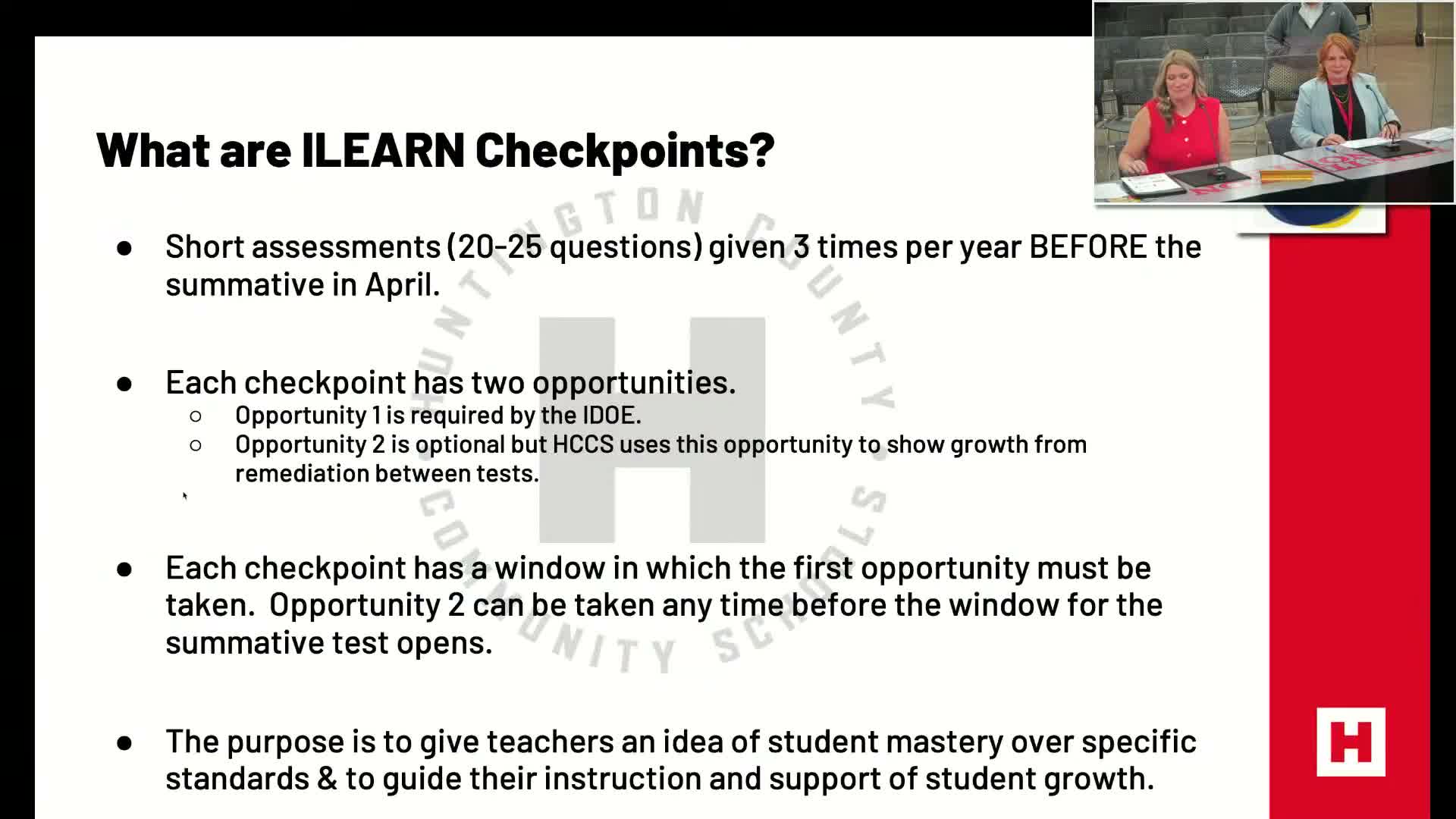
District leaders told the Huntington County board on March 9 that new statewide checkpoint (formative) assessments will change how teachers plan instruction and track growth.
"They really are for teachers so that we can find where students have gaps and fill those gaps," said Lauren Hogue, the district's elementary professional-development coordinator, describing checkpoints as short assessments parents will also receive in report form. Hogue explained the state requires the first opportunity each checkpoint and districts may offer a second opportunity; Huntington plans to offer both to measure growth after reteaching.
Lynn Brown outlined how the state'issued frameworks and blueprints break standards into specific vocabulary, sample questions and item specifications teachers can use to scaffold lessons. "They give you exactly what it means to have mastered it in multiple bullet points," Brown said, describing framework pages that link standards to test blueprints and proficiency expectations.
Presenters showed how checkpoint reports provide proficiency bands (below, approaching, at, above) and raw scores so teachers can detect incremental growth. Staff said they realigned master maps and created unit assessments tied to item specifications so teachers can reteach identified gaps before a checkpoint; small-group instruction would follow checkpoint results.
The district highlighted IXL integration with checkpoint data: "The checkpoints feed directly into that program, and it generates the exact types of lessons and question types that students need," Hogue said. Staff also described district PLCs (professional learning communities) where teachers use checkpoint reports to create targeted small groups rather than relying solely on a single teacher to differentiate for many varied student needs.
Board members asked whether test results are tied to funding. The chair and presenters said assessment results feed into school accountability metrics at student, building and corporation levels, and the effect on public perception and enrollment is real even if funding mechanisms are indirect.
Staff said more detailed presentations on accountability and school grading will return to the board in a future session; the district will also present elementary-level checkpoint data at the March 23 meeting.
"They really are for teachers so that we can find where students have gaps and fill those gaps," said Lauren Hogue, the district's elementary professional-development coordinator, describing checkpoints as short assessments parents will also receive in report form. Hogue explained the state requires the first opportunity each checkpoint and districts may offer a second opportunity; Huntington plans to offer both to measure growth after reteaching.
Lynn Brown outlined how the state'issued frameworks and blueprints break standards into specific vocabulary, sample questions and item specifications teachers can use to scaffold lessons. "They give you exactly what it means to have mastered it in multiple bullet points," Brown said, describing framework pages that link standards to test blueprints and proficiency expectations.
Presenters showed how checkpoint reports provide proficiency bands (below, approaching, at, above) and raw scores so teachers can detect incremental growth. Staff said they realigned master maps and created unit assessments tied to item specifications so teachers can reteach identified gaps before a checkpoint; small-group instruction would follow checkpoint results.
The district highlighted IXL integration with checkpoint data: "The checkpoints feed directly into that program, and it generates the exact types of lessons and question types that students need," Hogue said. Staff also described district PLCs (professional learning communities) where teachers use checkpoint reports to create targeted small groups rather than relying solely on a single teacher to differentiate for many varied student needs.
Board members asked whether test results are tied to funding. The chair and presenters said assessment results feed into school accountability metrics at student, building and corporation levels, and the effect on public perception and enrollment is real even if funding mechanisms are indirect.
Staff said more detailed presentations on accountability and school grading will return to the board in a future session; the district will also present elementary-level checkpoint data at the March 23 meeting.
View the Full Meeting & All Its Details
This article offers just a summary. Unlock complete video, transcripts, and insights as a Founder Member.
✓
Watch full, unedited meeting videos
✓
Search every word spoken in unlimited transcripts
✓
AI summaries & real-time alerts (all government levels)
✓
Permanent access to expanding government content
30-day money-back guarantee
