Anchorage committee hears major Title 23 update with higher permit thresholds and new safety rules for compact housing
March 09, 2026 | Anchorage Municipality, Alaska
This article was created by AI summarizing key points discussed. AI makes mistakes, so for full details and context, please refer to the video of the full meeting. Please report any errors so we can fix them. Report an error »
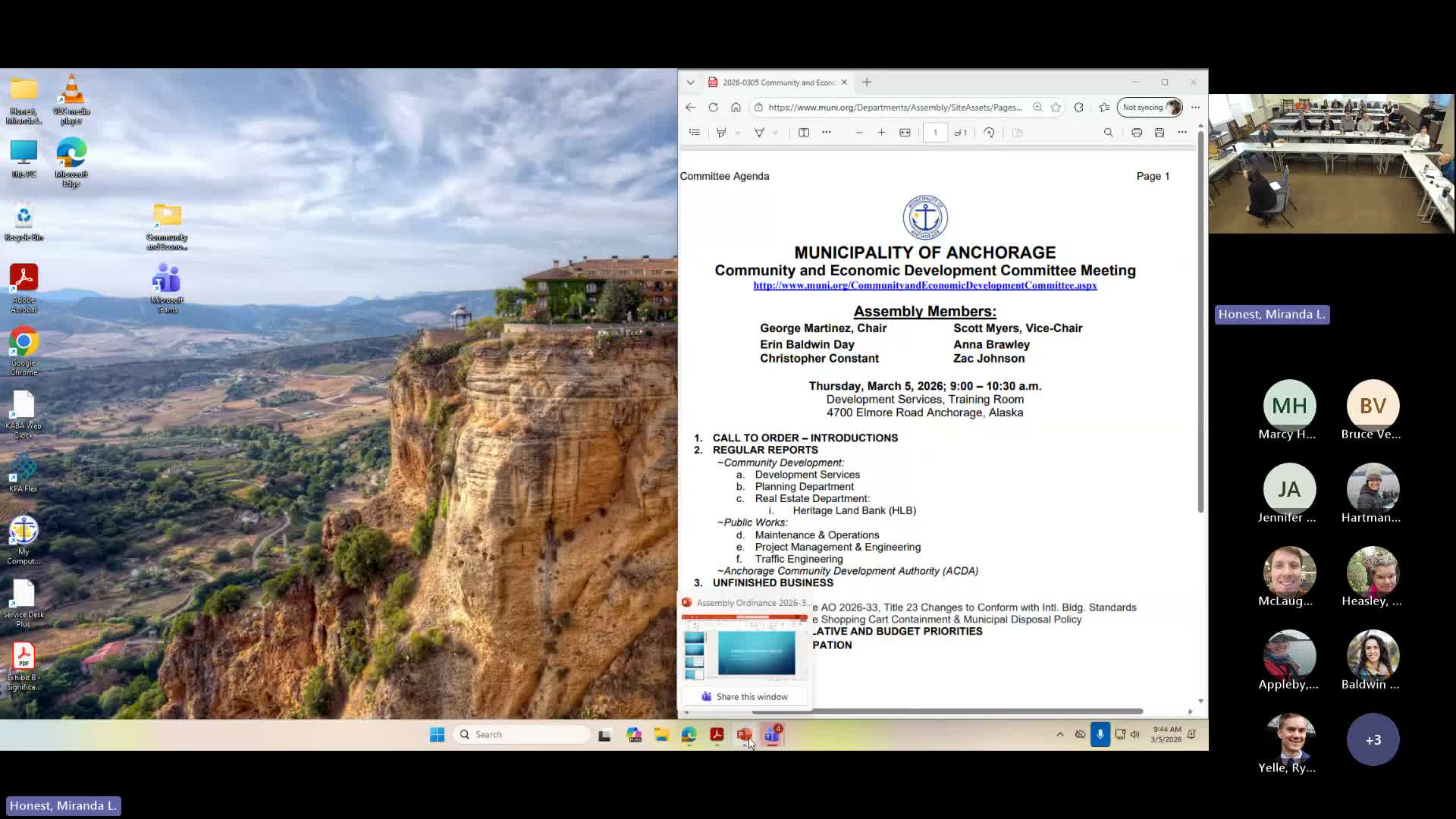
The Community and Economic Development Committee of the Anchorage Assembly heard a detailed briefing March 5 on proposed updates to Title 23 of the municipal code, a package staff said is intended to adopt national building‑code changes and add local amendments for Anchorage conditions.
Daniel King, the staff presenter, said the ordinance (read in the meeting as "Assembly Ordinance 2020 six‑thirty '3") would repeal certain fee provisions, update multiple building‑code chapters and incorporate industry guidance developed in committee meetings with engineers, architects and contractors. "This ordinance is actually going to repeal 10‑75, which is fire inspection fees," King said, and the repeal will be folded into the fire chapter of the building code.
Why it matters: King and staff framed the update as a safety and affordability measure. Adopting the newer codes would let Anchorage seek an improved ISO insurance rating (staff said the jurisdiction is currently at a 5 and previously had been at a 3), and several changes are designed to reduce surprise costs for homeowners and speed residential projects.
Major proposals and staff explanations
• Nonstructural permit threshold: The administration proposes raising the dollar threshold that triggers a building permit for nonstructural home repairs from $5,000 to $10,000. King said the $5,000 figure dates to at least 2003 and that the higher threshold better reflects inflation and common repair costs, so small repairs such as limited shingle or drywall replacements would not always require full building review.
• Mobile food and shelter units: Staff will require a building permit for mobile food or shelter units but would exempt them from full building review and routine inspections except for specified items (electrical and land‑use requirements remain in force). King said that change clears up contradictory language that had confused applicants.
• Inspection and fee adjustments: The update adds limits to the number of inspections included on commercial permits (staff said unlimited included inspections had produced surprise costs at permit closeout) and modifies the residential inspection schedule (a baseline number with additional inspections added based on valuation increments) to reduce end‑of‑project fees.
• Single‑exit buildings and compact housing: One of the most consequential proposals would allow, with conditions, up to four dwelling units per floor and single‑exit buildings up to six stories for constrained ("postage‑stamp") lots. King said the change includes required monitored fire‑alarm integration and stricter staircase standards to preserve life safety. "Not a ton" of structural change is expected, he said, but the measures emphasize alarm monitoring and staircase safety.
• Energy code and retrofit safeguards: Staff recommended raising energy expectations toward Anchorage's colder climate (Climate Zone 7) with an "enhanced" option to encourage higher‑performance construction while keeping a minimum path to approval. King said the code will again require structural checks when insulation is increased on existing roofs to avoid retrofit sagging and snow‑load issues.
Committee reaction and next steps
Members asked for more detail on the single‑exit allowance and whether additional safety measures would make small projects uneconomical. One member noted that other cities sometimes must add many safety requirements that can offset the cost savings of a single staircase; King responded that the committee had focused on fire‑alarm monitoring and staircase restrictions to strike a balance between safety and feasibility.
Greg Sewell (Development Services) and Bob Dole (Community and Economic Development) joined King in answering technical questions about the inspection limits and the historical basis for the current inspection counts.
Staff said the code committee process included more than 100 professionals and multiple meetings this year; King said exhibit material and a more detailed work session were scheduled to follow. The committee indicated it will continue the discussion at a scheduled work session and consider ordinance introduction later in March.
What the article does not assert: The committee did not adopt any ordinance at the meeting; staff described proposals and said a work session and formal introduction will follow. Specific ordinance numbering was read aloud by staff in the presentation as spoken and is reported here as spoken in the meeting.
Daniel King, the staff presenter, said the ordinance (read in the meeting as "Assembly Ordinance 2020 six‑thirty '3") would repeal certain fee provisions, update multiple building‑code chapters and incorporate industry guidance developed in committee meetings with engineers, architects and contractors. "This ordinance is actually going to repeal 10‑75, which is fire inspection fees," King said, and the repeal will be folded into the fire chapter of the building code.
Why it matters: King and staff framed the update as a safety and affordability measure. Adopting the newer codes would let Anchorage seek an improved ISO insurance rating (staff said the jurisdiction is currently at a 5 and previously had been at a 3), and several changes are designed to reduce surprise costs for homeowners and speed residential projects.
Major proposals and staff explanations
• Nonstructural permit threshold: The administration proposes raising the dollar threshold that triggers a building permit for nonstructural home repairs from $5,000 to $10,000. King said the $5,000 figure dates to at least 2003 and that the higher threshold better reflects inflation and common repair costs, so small repairs such as limited shingle or drywall replacements would not always require full building review.
• Mobile food and shelter units: Staff will require a building permit for mobile food or shelter units but would exempt them from full building review and routine inspections except for specified items (electrical and land‑use requirements remain in force). King said that change clears up contradictory language that had confused applicants.
• Inspection and fee adjustments: The update adds limits to the number of inspections included on commercial permits (staff said unlimited included inspections had produced surprise costs at permit closeout) and modifies the residential inspection schedule (a baseline number with additional inspections added based on valuation increments) to reduce end‑of‑project fees.
• Single‑exit buildings and compact housing: One of the most consequential proposals would allow, with conditions, up to four dwelling units per floor and single‑exit buildings up to six stories for constrained ("postage‑stamp") lots. King said the change includes required monitored fire‑alarm integration and stricter staircase standards to preserve life safety. "Not a ton" of structural change is expected, he said, but the measures emphasize alarm monitoring and staircase safety.
• Energy code and retrofit safeguards: Staff recommended raising energy expectations toward Anchorage's colder climate (Climate Zone 7) with an "enhanced" option to encourage higher‑performance construction while keeping a minimum path to approval. King said the code will again require structural checks when insulation is increased on existing roofs to avoid retrofit sagging and snow‑load issues.
Committee reaction and next steps
Members asked for more detail on the single‑exit allowance and whether additional safety measures would make small projects uneconomical. One member noted that other cities sometimes must add many safety requirements that can offset the cost savings of a single staircase; King responded that the committee had focused on fire‑alarm monitoring and staircase restrictions to strike a balance between safety and feasibility.
Greg Sewell (Development Services) and Bob Dole (Community and Economic Development) joined King in answering technical questions about the inspection limits and the historical basis for the current inspection counts.
Staff said the code committee process included more than 100 professionals and multiple meetings this year; King said exhibit material and a more detailed work session were scheduled to follow. The committee indicated it will continue the discussion at a scheduled work session and consider ordinance introduction later in March.
What the article does not assert: The committee did not adopt any ordinance at the meeting; staff described proposals and said a work session and formal introduction will follow. Specific ordinance numbering was read aloud by staff in the presentation as spoken and is reported here as spoken in the meeting.
View the Full Meeting & All Its Details
This article offers just a summary. Unlock complete video, transcripts, and insights as a Founder Member.
✓
Watch full, unedited meeting videos
✓
Search every word spoken in unlimited transcripts
✓
AI summaries & real-time alerts (all government levels)
✓
Permanent access to expanding government content
30-day money-back guarantee
