Waukesha Plan Commission previews zoning code changes that shift routine site‑plan reviews to staff; consent item approved
December 22, 2025 | Waukesha City, Waukesha County, Wisconsin
This article was created by AI summarizing key points discussed. AI makes mistakes, so for full details and context, please refer to the video of the full meeting. Please report any errors so we can fix them. Report an error »
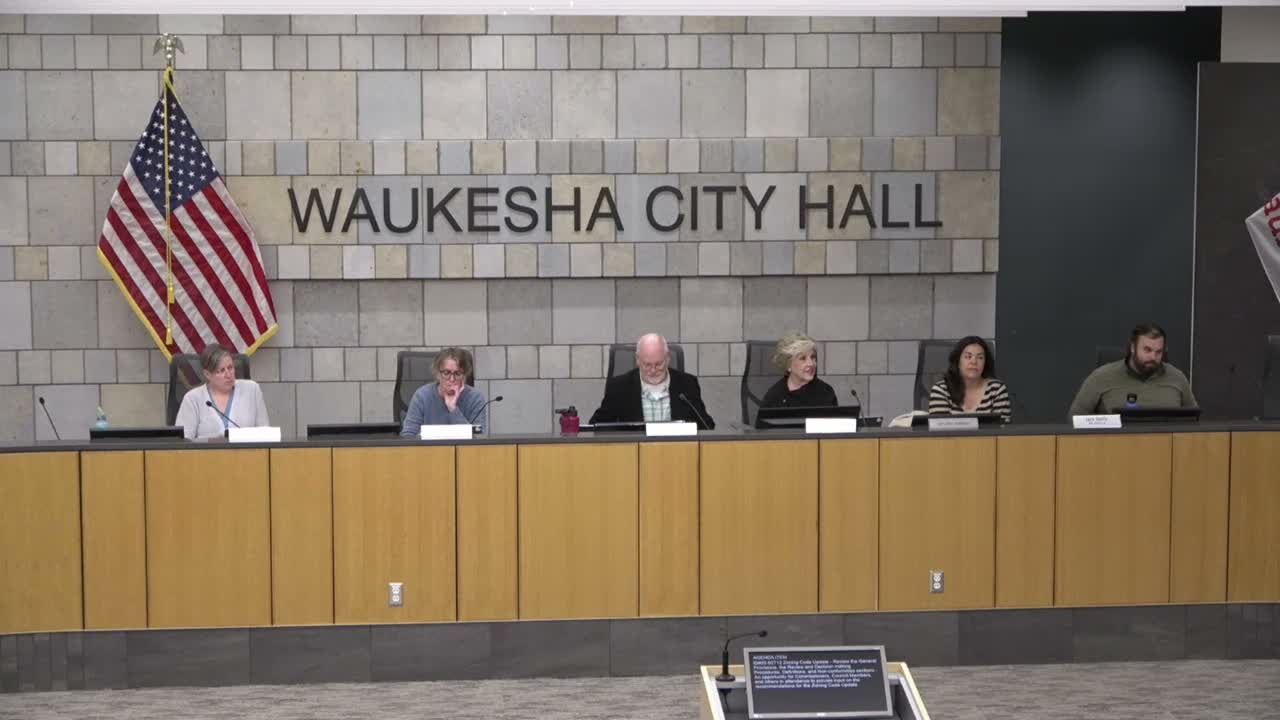
Waukesha City Plan Commission members on Dec. 22 reviewed draft chapters of a proposed zoning code update that staff say will move many routine site‑plan and architectural reviews from the commission to administrative (staff) approval when projects meet clearly defined code standards.
Jennifer, a community development staff member, opened the discussion by framing the change within five project goals and the city’s fiscal limits under state levy rules. She said the city typically sees about a 1% net new construction increase; in 2024 that figure was 1.36 percent—about $129,000,000 in assessed new value—and staff noted achieving the same percentage year over year requires larger dollar increases as the base grows.
Carrie, the presentation lead, said the code draft incorporates design standards that previously were only guidance and not law. “If a developer meets all of these very stringent requirements, which actually are more robust than what the Plan Commission guidelines are right now, then that could be a project that the staff approves, and it doesn't come to the Planning Commission,” she said. Under the proposal, projects that fail any explicit metric in the code—glazing, landscaping, parking, and similar standards—would still be routed to the Plan Commission for review.
Staff reviewed 2025 caseload data showing roughly 100–110 agenda items, of which 54 were site‑plan/architectural reviews (SPAR). About 25 of those were classified as minor SPARs (typical consent items); staff estimated that, under the new language, many minor SPARs and roughly half of the remaining larger SPARs could be handled administratively if they meet the written standards.
Commissioners and attendees asked several questions about the practical effects of the shift. One commissioner asked whether staff approvals would save developers money by shortening the time to an approval; staff did not provide a dollar estimate but said faster administrative approvals could increase yearly project throughput and support the city’s net new construction objectives. Another commissioner urged public transparency, suggesting that formally submitted plans be posted on the city’s website or included as a regular “matters of report” item so the public and elected officials can see what has been submitted and what was administratively approved.
The nonconformity chapter drew detailed discussion. Carrie explained the draft’s approach to nonconforming lots, buildings and site elements, including a 50% threshold rule that would trigger full compliance for altered site elements and a 12‑month discontinuance rule that would remove grandfathered nonconforming status after a year of inactivity. Commissioners noted that the 12‑month rule is supported by long‑standing case law and asked that city legal staff review any proposed changes.
Members also discussed procedures for pre‑application meetings, Board of Zoning Appeals referrals, conditional use permits and PUD (planned unit development) criteria. Staff said subdivisions are being split into major and minor categories and that Act 68—a statutory change effective July 1, 2026—may require additional edits to align the code with state law.
Several public commenters raised project‑specific concerns. A resident of District 5 asked whether extensive glass façades could affect nearby marshland; staff replied that glazing minimums are already in the design standards, that curtain‑wall (all‑glass) façades are not specifically prohibited, and that such proposals would trigger project‑level review and discussion of site impacts.
On routine business, the commission approved by unanimous consent the final site plan and architectural review for 1351 East Main Street after no one asked to pull the item from the consent agenda. The chair recorded the approval as unanimous; no roll‑call vote tally with individual member names was read into the record.
Next steps outlined by staff include incorporating commission feedback into the draft code, finishing PUD criteria and remaining chapters, holding a joint committee working session and hosting public open houses and a communications campaign before adoption is scheduled in February–March (subdivision standards are expected later). Staff also noted a planned upgrade to permitting software in 2026 that could improve public access to submitted plans and administrative decisions.
The Plan Commission adjourned with staff directed to incorporate the comments and return a revised draft for further review and public outreach.
Jennifer, a community development staff member, opened the discussion by framing the change within five project goals and the city’s fiscal limits under state levy rules. She said the city typically sees about a 1% net new construction increase; in 2024 that figure was 1.36 percent—about $129,000,000 in assessed new value—and staff noted achieving the same percentage year over year requires larger dollar increases as the base grows.
Carrie, the presentation lead, said the code draft incorporates design standards that previously were only guidance and not law. “If a developer meets all of these very stringent requirements, which actually are more robust than what the Plan Commission guidelines are right now, then that could be a project that the staff approves, and it doesn't come to the Planning Commission,” she said. Under the proposal, projects that fail any explicit metric in the code—glazing, landscaping, parking, and similar standards—would still be routed to the Plan Commission for review.
Staff reviewed 2025 caseload data showing roughly 100–110 agenda items, of which 54 were site‑plan/architectural reviews (SPAR). About 25 of those were classified as minor SPARs (typical consent items); staff estimated that, under the new language, many minor SPARs and roughly half of the remaining larger SPARs could be handled administratively if they meet the written standards.
Commissioners and attendees asked several questions about the practical effects of the shift. One commissioner asked whether staff approvals would save developers money by shortening the time to an approval; staff did not provide a dollar estimate but said faster administrative approvals could increase yearly project throughput and support the city’s net new construction objectives. Another commissioner urged public transparency, suggesting that formally submitted plans be posted on the city’s website or included as a regular “matters of report” item so the public and elected officials can see what has been submitted and what was administratively approved.
The nonconformity chapter drew detailed discussion. Carrie explained the draft’s approach to nonconforming lots, buildings and site elements, including a 50% threshold rule that would trigger full compliance for altered site elements and a 12‑month discontinuance rule that would remove grandfathered nonconforming status after a year of inactivity. Commissioners noted that the 12‑month rule is supported by long‑standing case law and asked that city legal staff review any proposed changes.
Members also discussed procedures for pre‑application meetings, Board of Zoning Appeals referrals, conditional use permits and PUD (planned unit development) criteria. Staff said subdivisions are being split into major and minor categories and that Act 68—a statutory change effective July 1, 2026—may require additional edits to align the code with state law.
Several public commenters raised project‑specific concerns. A resident of District 5 asked whether extensive glass façades could affect nearby marshland; staff replied that glazing minimums are already in the design standards, that curtain‑wall (all‑glass) façades are not specifically prohibited, and that such proposals would trigger project‑level review and discussion of site impacts.
On routine business, the commission approved by unanimous consent the final site plan and architectural review for 1351 East Main Street after no one asked to pull the item from the consent agenda. The chair recorded the approval as unanimous; no roll‑call vote tally with individual member names was read into the record.
Next steps outlined by staff include incorporating commission feedback into the draft code, finishing PUD criteria and remaining chapters, holding a joint committee working session and hosting public open houses and a communications campaign before adoption is scheduled in February–March (subdivision standards are expected later). Staff also noted a planned upgrade to permitting software in 2026 that could improve public access to submitted plans and administrative decisions.
The Plan Commission adjourned with staff directed to incorporate the comments and return a revised draft for further review and public outreach.
View the Full Meeting & All Its Details
This article offers just a summary. Unlock complete video, transcripts, and insights as a Founder Member.
✓
Watch full, unedited meeting videos
✓
Search every word spoken in unlimited transcripts
✓
AI summaries & real-time alerts (all government levels)
✓
Permanent access to expanding government content
30-day money-back guarantee
