St. Pete Beach adopts ordinance adding 40‑ft setback where feasible, keeps negotiation path for small wireless facilities
March 09, 2026 | St. Pete Beach, Pinellas County, Florida
This article was created by AI summarizing key points discussed. AI makes mistakes, so for full details and context, please refer to the video of the full meeting. Please report any errors so we can fix them. Report an error »
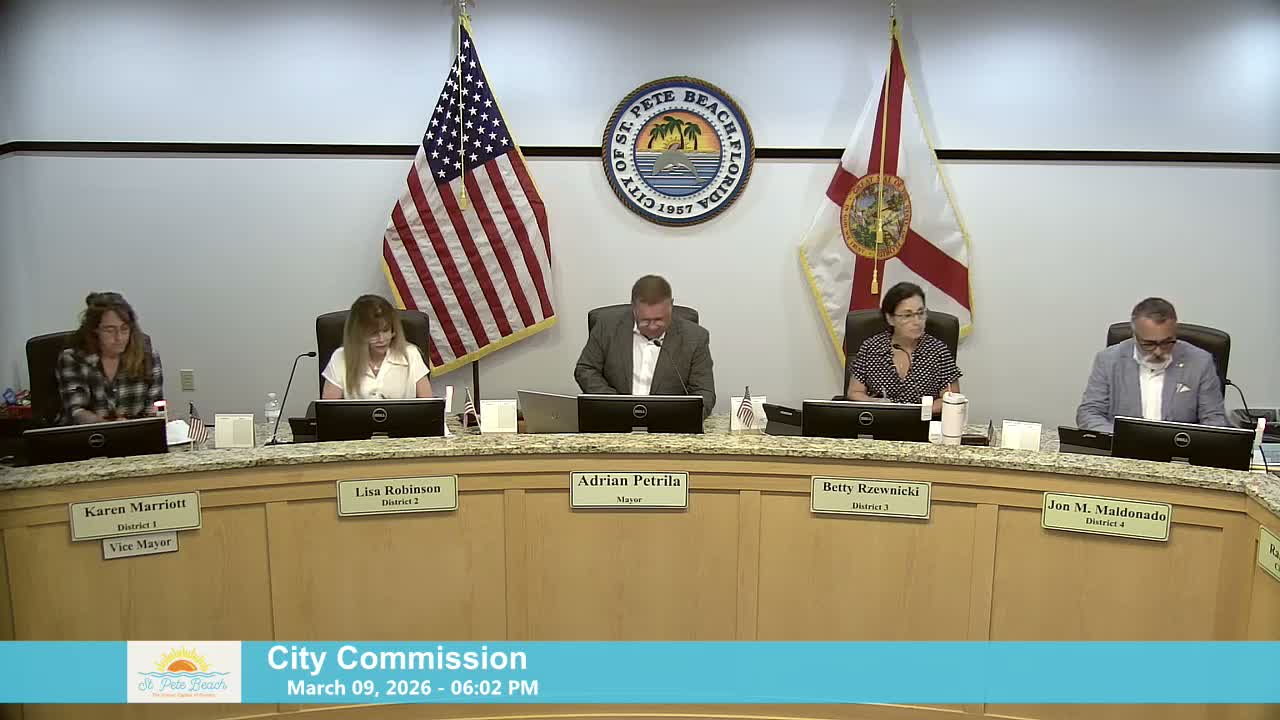
The St. Pete Beach City Commission voted 4‑1 on March 9 to adopt revisions to the city code governing communication facilities in the right of way, replacing a staff‑recommended 30‑foot recommended setback with a 40‑foot recommended setback where technically feasible and keeping a negotiation period for applicants seeking relief.
The ordinance (2026‑03) amends Chapter 132, adopting staff language on driveway and fire‑hydrant clearances and adding the residents’ suggested language as a new subsection. Commissioners also asked staff to include a caveated reference to a 500‑foot separation “where possible and technically feasible without limiting communication services,” language the city attorney said could be severed if struck in litigation.
Why it matters: the change is meant to reduce visual and safety impacts of wireless facilities installed on poles in residential areas while preserving the city’s ability to review applications case‑by‑case. Residents and neighborhood advocates had pushed for stronger separation and setback rules, saying the proliferation of poles and antennas will damage neighborhood character and property values. Telecom companies warned the draft would conflict with Florida rights‑of‑way law.
At the meeting, Scott McCullough, an attorney representing residents, emphasized safety and sightline concerns and urged a larger setback. “30 feet just won't cut it,” he told commissioners, arguing a setback roughly equal to pole height is necessary to protect dwellings if a pole were to fail. AT&T’s representative said the proposed rules risked running afoul of state law, asserting that “what is being suggested will be in direct violation of state statute about what we are allowed to do in right of ways.”
City Attorney analysis: legal staff and the city attorney repeatedly warned that the statute cited by proponents limits a municipality’s ability to adopt minimum separation rules for small wireless facilities. The attorney told the commission a blanket minimum‑distance requirement would be difficult to defend: “the statute says the city may not limit the placement by minimum separation distance of small wireless facilities,” and a broad 500‑foot minimum would likely be subject to a facial challenge and exposure to attorney‑fee claims under Florida law.
What the ordinance does: the final motion (adopted with modification) 1) substitutes a 40‑foot recommended setback from the nearest dwelling where technically feasible, measured from the dwelling unit; 2) retains the staff approach requiring applicants to respect driveway visibility and fire‑hydrant clearances cited in the land‑development code and NFPA requirements; and 3) adds the residents’ proposed language (including their separation concept) as a distinct subsection with the qualifying phrase that the 500‑foot separation applies “where possible and technically feasible without limiting communication services.” The ordinance also preserves a negotiated relief/waiver process rather than making relief purely an administrative variance.
Votes and next steps: the motion passed 4‑1 (Vice Mayor Marriott cast the lone no vote). Staff will codify the exact measuring conventions in the ordinance text and return the finalized ordinance for publication; the city’s attorney also recommended severability language so that, if any part of the new subsection is struck in court, the remainder of the ordinance survives.
The commission asked staff to continue outreach and to coordinate with the city’s lobbyists at the state level on preemption issues. Expect the ordinance language and implementation rules to be posted with the codified code and used in permit reviews going forward.
The ordinance (2026‑03) amends Chapter 132, adopting staff language on driveway and fire‑hydrant clearances and adding the residents’ suggested language as a new subsection. Commissioners also asked staff to include a caveated reference to a 500‑foot separation “where possible and technically feasible without limiting communication services,” language the city attorney said could be severed if struck in litigation.
Why it matters: the change is meant to reduce visual and safety impacts of wireless facilities installed on poles in residential areas while preserving the city’s ability to review applications case‑by‑case. Residents and neighborhood advocates had pushed for stronger separation and setback rules, saying the proliferation of poles and antennas will damage neighborhood character and property values. Telecom companies warned the draft would conflict with Florida rights‑of‑way law.
At the meeting, Scott McCullough, an attorney representing residents, emphasized safety and sightline concerns and urged a larger setback. “30 feet just won't cut it,” he told commissioners, arguing a setback roughly equal to pole height is necessary to protect dwellings if a pole were to fail. AT&T’s representative said the proposed rules risked running afoul of state law, asserting that “what is being suggested will be in direct violation of state statute about what we are allowed to do in right of ways.”
City Attorney analysis: legal staff and the city attorney repeatedly warned that the statute cited by proponents limits a municipality’s ability to adopt minimum separation rules for small wireless facilities. The attorney told the commission a blanket minimum‑distance requirement would be difficult to defend: “the statute says the city may not limit the placement by minimum separation distance of small wireless facilities,” and a broad 500‑foot minimum would likely be subject to a facial challenge and exposure to attorney‑fee claims under Florida law.
What the ordinance does: the final motion (adopted with modification) 1) substitutes a 40‑foot recommended setback from the nearest dwelling where technically feasible, measured from the dwelling unit; 2) retains the staff approach requiring applicants to respect driveway visibility and fire‑hydrant clearances cited in the land‑development code and NFPA requirements; and 3) adds the residents’ proposed language (including their separation concept) as a distinct subsection with the qualifying phrase that the 500‑foot separation applies “where possible and technically feasible without limiting communication services.” The ordinance also preserves a negotiated relief/waiver process rather than making relief purely an administrative variance.
Votes and next steps: the motion passed 4‑1 (Vice Mayor Marriott cast the lone no vote). Staff will codify the exact measuring conventions in the ordinance text and return the finalized ordinance for publication; the city’s attorney also recommended severability language so that, if any part of the new subsection is struck in court, the remainder of the ordinance survives.
The commission asked staff to continue outreach and to coordinate with the city’s lobbyists at the state level on preemption issues. Expect the ordinance language and implementation rules to be posted with the codified code and used in permit reviews going forward.
View the Full Meeting & All Its Details
This article offers just a summary. Unlock complete video, transcripts, and insights as a Founder Member.
✓
Watch full, unedited meeting videos
✓
Search every word spoken in unlimited transcripts
✓
AI summaries & real-time alerts (all government levels)
✓
Permanent access to expanding government content
30-day money-back guarantee
