St. Pete Beach waives seawall permit fees for right‑of‑way properties; staff to study citywide resilience
March 09, 2026 | St. Pete Beach, Pinellas County, Florida
This article was created by AI summarizing key points discussed. AI makes mistakes, so for full details and context, please refer to the video of the full meeting. Please report any errors so we can fix them. Report an error »
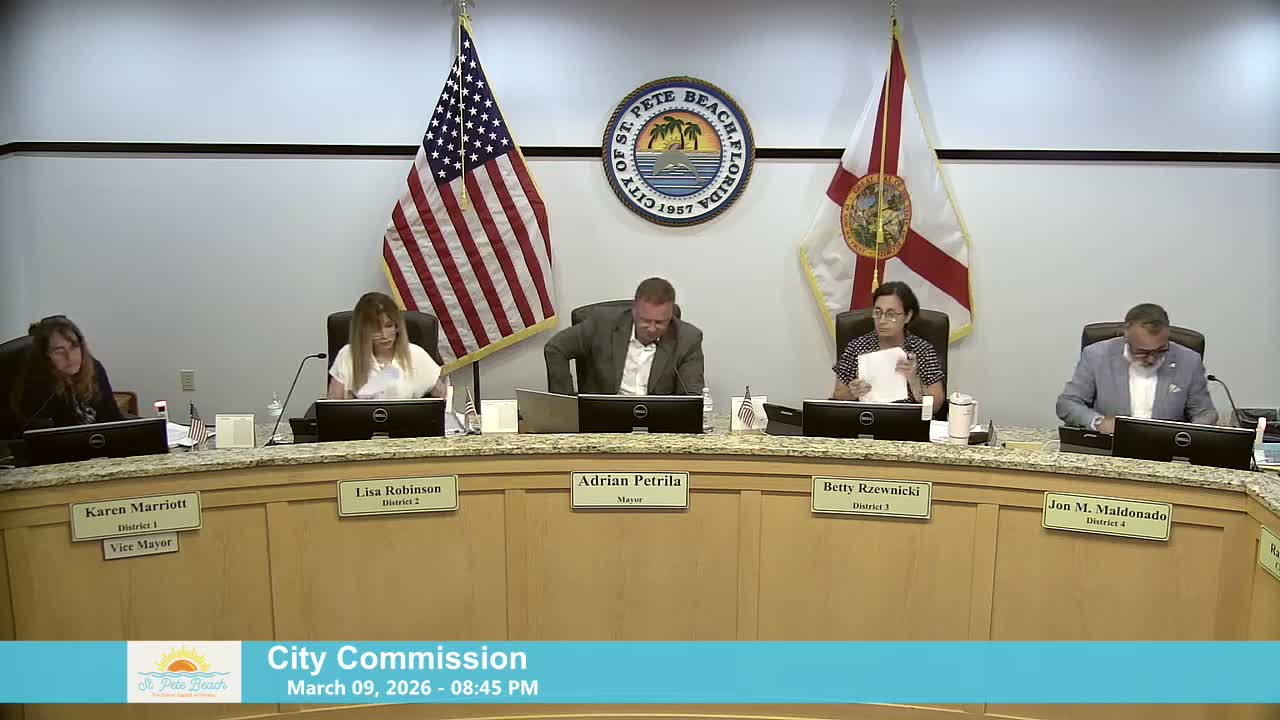
The St. Pete Beach City Commission on March 9 approved a temporary waiver of building permit and plan‑examination fees for private seawall permits that adjoin city rights‑of‑way. The two‑year waiver runs from March 10, 2026 through March 10, 2028; commissioners amended the resolution to make it retroactive to Hurricane Helene to cover recent storm repairs.
Why it matters: staff said the measure aims to accelerate repairs that protect both private property and city assets (roads, sidewalks, drainage and utilities) that abut seawalls. Building official Luke Curtis told the commission the city saw a marked increase in seawall applications after the recent storms and explained the code’s administrative‑variance criteria for reducing required elevations.
Key numbers and staff estimate: staff said there are roughly 4,575 linear feet of seawall adjacent to city rights‑of‑way. Using a sample of post‑storm permits, staff estimated average seawall construction cost at about $1,108 per linear foot, equating to approximately $5 million in work overall and roughly $83,000 in permit fees that would be waived under the two‑year program. Staff also said 83 seawall permits have been filed since 10/01/2024 and that approximately 41 properties meet the adjacency criterion for the right‑of‑way waiver.
Public comment and scope: multiple residents urged the city to consider historic docks, commercial properties and the risk that raising one property’s seawall without coordinated backfill or stormwater mitigation could shift water onto neighbors. John Rondolino, a waterfront property owner, said the city’s seawall rules and their interaction with drainage can be confusing: “Seawalls are designed to keep the sea off the property,” he told commissioners, and urged clarity on which properties will be required to upgrade and how backfill and drains will be handled.
Commission direction and implementation: commissioners emphasized the rationale for limiting the initial waiver to seawalls adjacent to city rights‑of‑way — where the public infrastructure benefit is clearest — while asking staff to prepare a citywide seawall study (expected in 2027) to evaluate broader incentives. Several commissioners said they favored expanding assistance later if data support it; one commissioner stressed the need for equity and outreach to low‑income or long‑tenured homeowners who might struggle with replacement costs.
Votes and next steps: the motion to adopt Resolution 2026‑05 as amended (retroactive to Hurricane Helene) passed unanimously. Staff will return with draft language to implement the waiver and produce the citywide seawall study in 2027; staff also flagged possible future options such as requiring caps engineered for future elevation increases, options for engineered backfill, and tying hardship thresholds to a percentage of building value.
Why it matters: staff said the measure aims to accelerate repairs that protect both private property and city assets (roads, sidewalks, drainage and utilities) that abut seawalls. Building official Luke Curtis told the commission the city saw a marked increase in seawall applications after the recent storms and explained the code’s administrative‑variance criteria for reducing required elevations.
Key numbers and staff estimate: staff said there are roughly 4,575 linear feet of seawall adjacent to city rights‑of‑way. Using a sample of post‑storm permits, staff estimated average seawall construction cost at about $1,108 per linear foot, equating to approximately $5 million in work overall and roughly $83,000 in permit fees that would be waived under the two‑year program. Staff also said 83 seawall permits have been filed since 10/01/2024 and that approximately 41 properties meet the adjacency criterion for the right‑of‑way waiver.
Public comment and scope: multiple residents urged the city to consider historic docks, commercial properties and the risk that raising one property’s seawall without coordinated backfill or stormwater mitigation could shift water onto neighbors. John Rondolino, a waterfront property owner, said the city’s seawall rules and their interaction with drainage can be confusing: “Seawalls are designed to keep the sea off the property,” he told commissioners, and urged clarity on which properties will be required to upgrade and how backfill and drains will be handled.
Commission direction and implementation: commissioners emphasized the rationale for limiting the initial waiver to seawalls adjacent to city rights‑of‑way — where the public infrastructure benefit is clearest — while asking staff to prepare a citywide seawall study (expected in 2027) to evaluate broader incentives. Several commissioners said they favored expanding assistance later if data support it; one commissioner stressed the need for equity and outreach to low‑income or long‑tenured homeowners who might struggle with replacement costs.
Votes and next steps: the motion to adopt Resolution 2026‑05 as amended (retroactive to Hurricane Helene) passed unanimously. Staff will return with draft language to implement the waiver and produce the citywide seawall study in 2027; staff also flagged possible future options such as requiring caps engineered for future elevation increases, options for engineered backfill, and tying hardship thresholds to a percentage of building value.
View the Full Meeting & All Its Details
This article offers just a summary. Unlock complete video, transcripts, and insights as a Founder Member.
✓
Watch full, unedited meeting videos
✓
Search every word spoken in unlimited transcripts
✓
AI summaries & real-time alerts (all government levels)
✓
Permanent access to expanding government content
30-day money-back guarantee
