OIR tells Seattle council final week of state session is a 'rush to the finish' as budget, housing and tax bills move
March 09, 2026 | Seattle, King County, Washington
This article was created by AI summarizing key points discussed. AI makes mistakes, so for full details and context, please refer to the video of the full meeting. Please report any errors so we can fix them. Report an error »
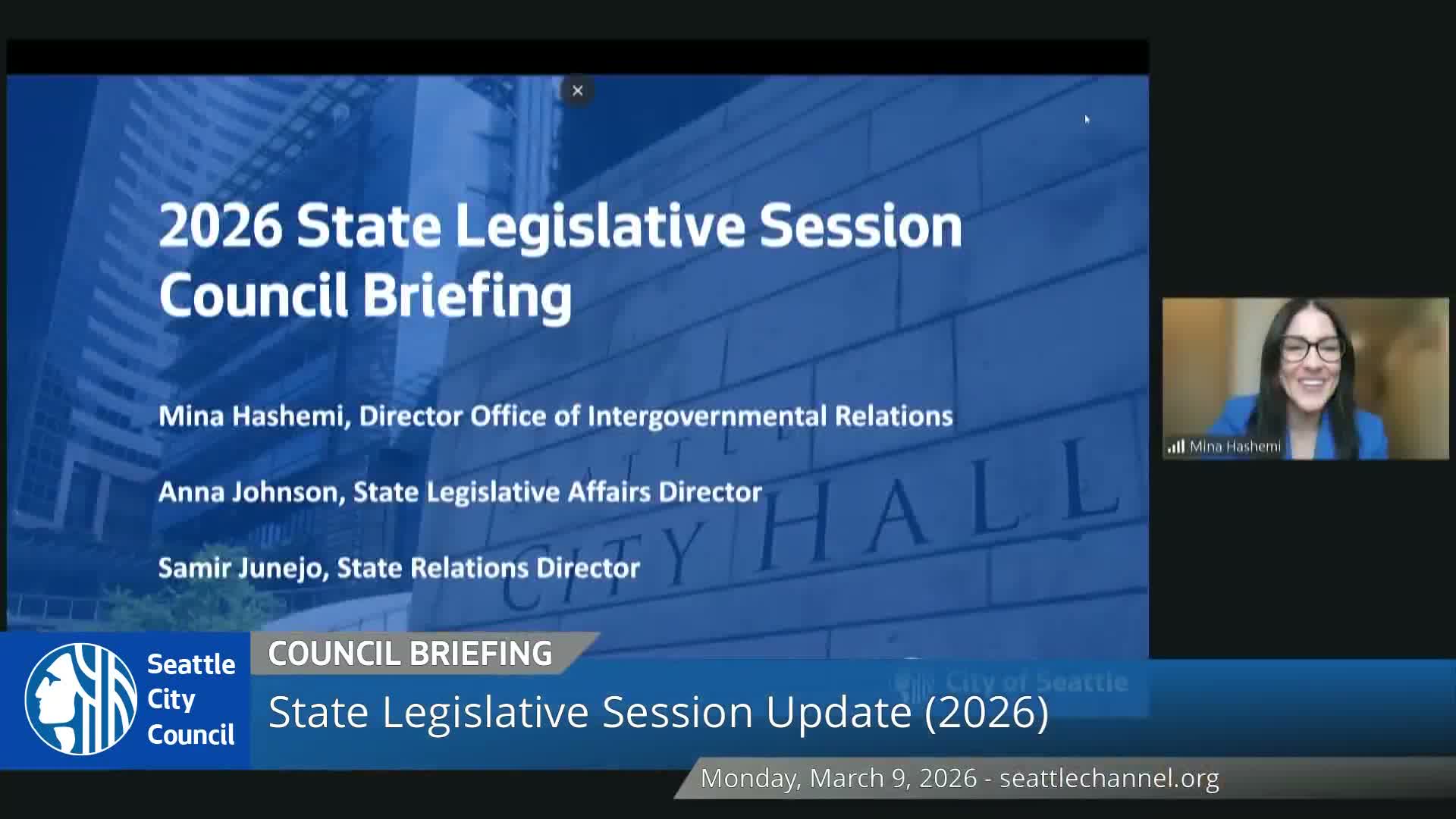
OIR Director Nina Hashemi told the Seattle City Council on March 9 that the state legislature is in its final week and racing toward a sine die deadline on March 12. "We are in the final week of the state legislative session, and there are just 3 full days left," Hashemi said, framing the briefing as a budget-focused sprint.
A state relations presenter summarized legislation of interest to the city. She said House Bill 1687 (social housing) had been signed by the governor and that other measures—such as HB2266 on permanent supportive housing and bills addressing restrictive covenants for grocery stores and streetcar-obstructing vehicles—were moving through the chambers. The presenters repeatedly emphasized that final budget text and numbers would be released this week and that negotiations could change substantive provisions before sine die.
On the budget, OIR staff said both proposed supplemental operating budgets were roughly $1,500,000,000 larger than prior forecasts and that the packages rely in part on the state rainy day fund and agency spending reductions to balance the biennial budget. The presenters called out several local-impact items: approximately $15 million proposed for grants to permanent supportive housing providers for operation and maintenance, $10.5 million for 911 program support and technology, and new capital allocations to housing trust funds (noted in the House and Senate at different levels).
Councilmembers asked pointed questions about two topics in particular. On a bill referred to as the "millionaires tax," Councilmember Foster asked whether cities and counties would receive funding for indigent defense; OIR staff replied that the bill in its present form had removed direct funding for local indigent defense and that some sales-tax exemptions in the package could create local impacts that are acknowledged in intent language but are not yet quantified. Foster pressed for any available estimates for Seattle; OIR said they had not yet seen exact numbers and would share budget releases when available.
On a separate point, a councilmember asked about changes to the Mosquito Fleet Act after a senate striker. OIR staff said the striker made numerous changes—adding new local ferry-district and local-government requirements—and offered to circulate a detailed list of amendments to council offices.
Why it matters: the briefing outlined multiple items that could materially affect Seattle's budget and services if adopted, from housing operations funding to revenue changes that could support statewide K–12 meal programs. Council leadership requested a follow-up summary after the session ends so the council can track which provisions survive final negotiations.
The briefing ended with OIR offering to distribute final budget documents; the council moved on to committee and district updates.
A state relations presenter summarized legislation of interest to the city. She said House Bill 1687 (social housing) had been signed by the governor and that other measures—such as HB2266 on permanent supportive housing and bills addressing restrictive covenants for grocery stores and streetcar-obstructing vehicles—were moving through the chambers. The presenters repeatedly emphasized that final budget text and numbers would be released this week and that negotiations could change substantive provisions before sine die.
On the budget, OIR staff said both proposed supplemental operating budgets were roughly $1,500,000,000 larger than prior forecasts and that the packages rely in part on the state rainy day fund and agency spending reductions to balance the biennial budget. The presenters called out several local-impact items: approximately $15 million proposed for grants to permanent supportive housing providers for operation and maintenance, $10.5 million for 911 program support and technology, and new capital allocations to housing trust funds (noted in the House and Senate at different levels).
Councilmembers asked pointed questions about two topics in particular. On a bill referred to as the "millionaires tax," Councilmember Foster asked whether cities and counties would receive funding for indigent defense; OIR staff replied that the bill in its present form had removed direct funding for local indigent defense and that some sales-tax exemptions in the package could create local impacts that are acknowledged in intent language but are not yet quantified. Foster pressed for any available estimates for Seattle; OIR said they had not yet seen exact numbers and would share budget releases when available.
On a separate point, a councilmember asked about changes to the Mosquito Fleet Act after a senate striker. OIR staff said the striker made numerous changes—adding new local ferry-district and local-government requirements—and offered to circulate a detailed list of amendments to council offices.
Why it matters: the briefing outlined multiple items that could materially affect Seattle's budget and services if adopted, from housing operations funding to revenue changes that could support statewide K–12 meal programs. Council leadership requested a follow-up summary after the session ends so the council can track which provisions survive final negotiations.
The briefing ended with OIR offering to distribute final budget documents; the council moved on to committee and district updates.
View the Full Meeting & All Its Details
This article offers just a summary. Unlock complete video, transcripts, and insights as a Founder Member.
✓
Watch full, unedited meeting videos
✓
Search every word spoken in unlimited transcripts
✓
AI summaries & real-time alerts (all government levels)
✓
Permanent access to expanding government content
30-day money-back guarantee
