Committee narrows enforcement window for old general‑district judgments under HB1426 amid split testimony
March 09, 2026 | 2026 Legislature VA, Virginia
This article was created by AI summarizing key points discussed. AI makes mistakes, so for full details and context, please refer to the video of the full meeting. Please report any errors so we can fix them. Report an error »
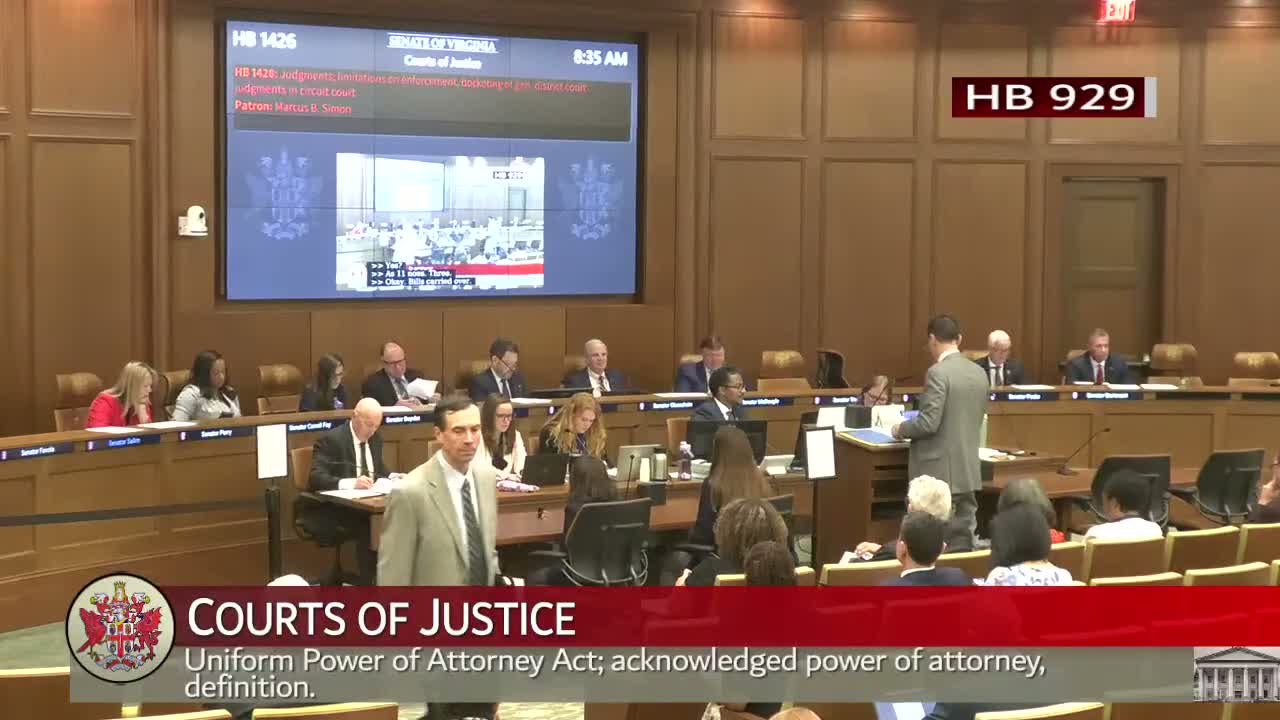
The Senate Courts of Justice Committee considered House Bill 1426, a measure to limit enforcement of general district court judgments to the original 10‑year limitation period following judgment, rather than permitting repeated 10‑year extensions by docketing in circuit court.
Delegate David Simon said the change targets very old judgments that linger indefinitely and can resurface—often bought by debt buyers—long after court records are destroyed, making it difficult for debtors to defend. “It feels to us that fairness and due process require that once the general district court records are destroyed, you should not be able to collect,” Jay Spear of the Virginia Poverty Law Center told the committee, citing cases of very old judgments being enforced against vulnerable people.
Opponents, including Baker McClanahan (private practice) and representatives of creditors’ groups, argued the bill would drive cases into circuit court, reverse gains from prior jurisdictional reforms, and disrupt customary collection practices. McClanahan said the bill could force many litigants and pro se parties to file in circuit court rather than the general district court, increasing cost and complexity for consumers and the courts.
Committee members debated drafting choices and considered an amendment to limit the change to enforcement sought by plaintiffs who acquired judgments from another party; the committee ultimately adopted clarifying language, voted to report the bill, and noted potential need to coordinate with related House measures (for example, the Uniform Default Judgment Act).
Delegate David Simon said the change targets very old judgments that linger indefinitely and can resurface—often bought by debt buyers—long after court records are destroyed, making it difficult for debtors to defend. “It feels to us that fairness and due process require that once the general district court records are destroyed, you should not be able to collect,” Jay Spear of the Virginia Poverty Law Center told the committee, citing cases of very old judgments being enforced against vulnerable people.
Opponents, including Baker McClanahan (private practice) and representatives of creditors’ groups, argued the bill would drive cases into circuit court, reverse gains from prior jurisdictional reforms, and disrupt customary collection practices. McClanahan said the bill could force many litigants and pro se parties to file in circuit court rather than the general district court, increasing cost and complexity for consumers and the courts.
Committee members debated drafting choices and considered an amendment to limit the change to enforcement sought by plaintiffs who acquired judgments from another party; the committee ultimately adopted clarifying language, voted to report the bill, and noted potential need to coordinate with related House measures (for example, the Uniform Default Judgment Act).
View the Full Meeting & All Its Details
This article offers just a summary. Unlock complete video, transcripts, and insights as a Founder Member.
✓
Watch full, unedited meeting videos
✓
Search every word spoken in unlimited transcripts
✓
AI summaries & real-time alerts (all government levels)
✓
Permanent access to expanding government content
30-day money-back guarantee
