Bill would require insurers to explain reduced loss estimates after disasters; committee adopts $3,000 threshold
March 09, 2026 | 2026 Legislature VA, Virginia
This article was created by AI summarizing key points discussed. AI makes mistakes, so for full details and context, please refer to the video of the full meeting. Please report any errors so we can fix them. Report an error »
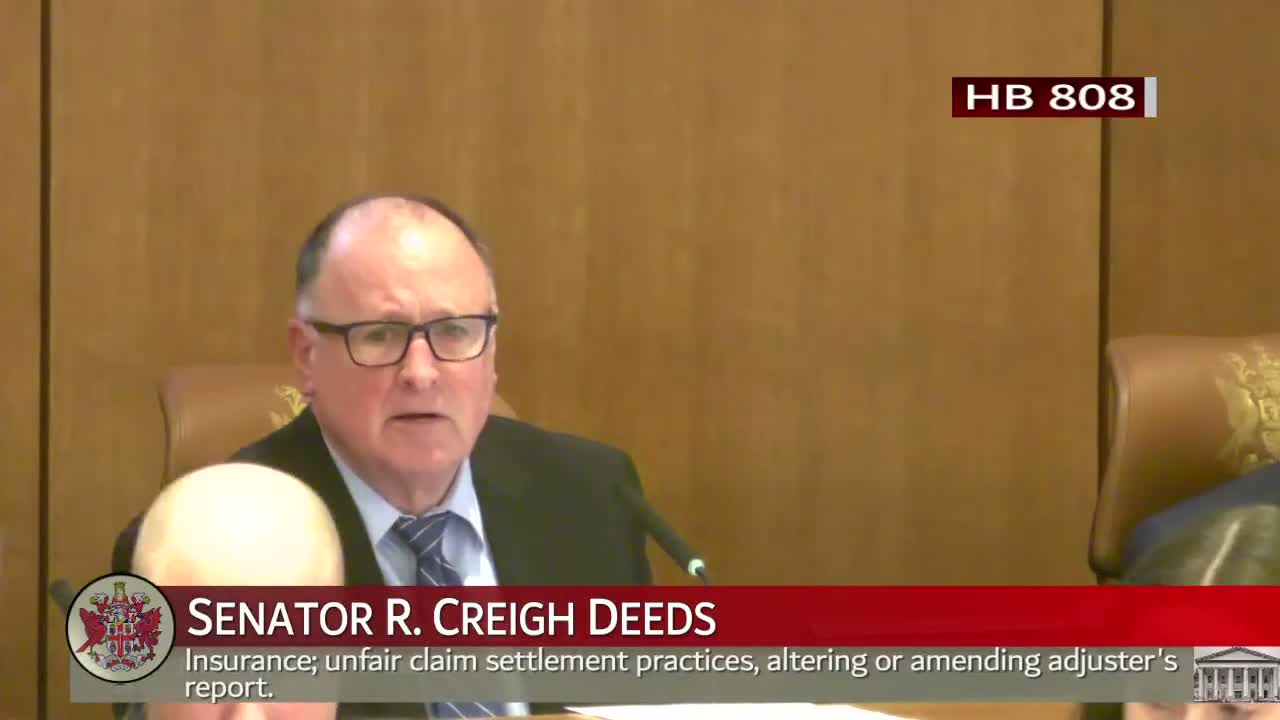
Delegate Helmer told the committee the substitute clarifies when an insurer must disclose why a previously provided written loss estimate was reduced. "What this requires ' is that if you downgrade that estimate... they need to provide an explanation of why that changed," Helmer said, describing the bill as a consumer protection response to cases where initial adjuster estimates are later reduced without explanation.
Committee members discussed whether the measure should apply to all claims or include a monetary threshold. After back-and-forth about small claims and vehicle damage frequency, the committee adopted an amendment setting a $3,000 threshold for reduced loss estimates. Industry witnesses including Elizabeth Parker of the American Property and Casualty Insurance Association said the substitute was trending in the right direction but remained too broad and could be difficult to implement; they suggested limiting application to natural disasters or raising the threshold to $5,000'$10,000 for practicality.
Independent adjusters and collision-repair representatives backed the change as a consumer-protection and affordability measure. Christian Balester, a former independent adjuster, told the committee he has seen repeated examples where damage was reduced in claims handling and said transparent documentation is "what should exist already." Jordan Hendler, executive director of the Washington Metro Auto Body Association, said the measure would protect vehicle owners and called it both a consumer-protection and affordability measure.
The committee adopted the threshold amendment and moved the substitute forward to the next step for fiscal or additional review.
Committee members discussed whether the measure should apply to all claims or include a monetary threshold. After back-and-forth about small claims and vehicle damage frequency, the committee adopted an amendment setting a $3,000 threshold for reduced loss estimates. Industry witnesses including Elizabeth Parker of the American Property and Casualty Insurance Association said the substitute was trending in the right direction but remained too broad and could be difficult to implement; they suggested limiting application to natural disasters or raising the threshold to $5,000'$10,000 for practicality.
Independent adjusters and collision-repair representatives backed the change as a consumer-protection and affordability measure. Christian Balester, a former independent adjuster, told the committee he has seen repeated examples where damage was reduced in claims handling and said transparent documentation is "what should exist already." Jordan Hendler, executive director of the Washington Metro Auto Body Association, said the measure would protect vehicle owners and called it both a consumer-protection and affordability measure.
The committee adopted the threshold amendment and moved the substitute forward to the next step for fiscal or additional review.
Don't Miss a Word: See the Full Meeting!
Go beyond summaries. Unlock every video, transcript, and key insight with a Founder Membership.
✓
Get instant access to full meeting videos
✓
Search and clip any phrase from complete transcripts
✓
Receive AI-powered summaries & custom alerts
✓
Enjoy lifetime, unrestricted access to government data
30-day money-back guarantee
