Senate approves confidentiality measure for immigration‑enforcement participants after sharp floor debate
March 09, 2026 | 2026 Legislature TN, Tennessee
This article was created by AI summarizing key points discussed. AI makes mistakes, so for full details and context, please refer to the video of the full meeting. Please report any errors so we can fix them. Report an error »
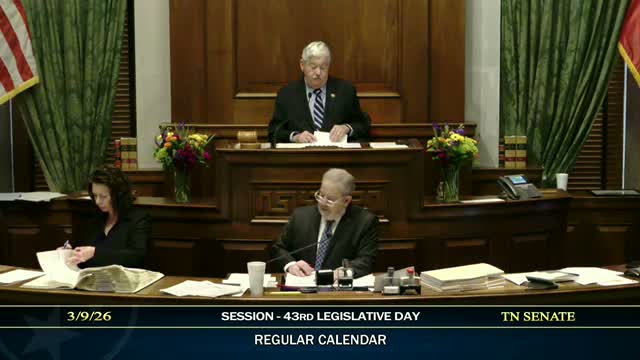
The Tennessee Senate passed Senate Bill 14 64 on March 11, 2026, after a prolonged floor debate over whether narrowly drawn confidentiality protections would unreasonably limit public accountability.
The bill, as explained by Chairman Briggs on the floor, requires state and local government entities to keep certain information about federal, state or local officers participating in immigration-enforcement activities confidential and exempts that information from public inspection. The amendatory language specifies that protected information may include an officer’s name when accompanied by other personal identifying information, information that would endanger the individual, the identity of undercover personnel, or when a documented threat assessment indicates an ongoing risk of harm. It also preserves disclosure when required by federal law or court order and allows information-sharing among law-enforcement agencies "for law‑enforcement purposes." The amendment establishes criminal penalties for unauthorized disclosure.
Senator Yeager urged support on grounds of officer safety, saying the measure is "a very reasonable constitutional approach" to protect officers who face heightened risks. Supporters emphasized that the statute permits disclosure where required by law and does not block internal or external misconduct investigations.
Opposition on the floor was led by Senator Yarbrough, who said the bill "allows law enforcement when engaged in one narrow category of activity to operate in anonymity" and cautioned that creating categorical secrecy "is directly contrary to the American constitutional tradition." Yarbrough warned that exempting broad categories of government activity from standard transparency requirements could become "a blueprint for government abuse." He urged that accountability concerns be weighed against safety claims.
Senators asked whether the bill would prevent officers from providing their names when law required it; floor leaders answered that the bill does not prohibit disclosure where law or procedure requires an officer to present identifying information. The sponsor and a floor leader said the bill was drafted to be narrow and to include safeguards for misconduct investigations.
The bill passed on third and final consideration; the clerk recorded the bill as having received the constitutional majority necessary for passage on the floor.
Next steps: The statutory confidentiality standard will be implemented by state and local records custodians; the bill also creates a criminal reporting rule that will require further guidance from enforcement agencies and counsel concerning the threshold for ‘documented threat assessment’ and the procedures for permitted disclosure.
The bill, as explained by Chairman Briggs on the floor, requires state and local government entities to keep certain information about federal, state or local officers participating in immigration-enforcement activities confidential and exempts that information from public inspection. The amendatory language specifies that protected information may include an officer’s name when accompanied by other personal identifying information, information that would endanger the individual, the identity of undercover personnel, or when a documented threat assessment indicates an ongoing risk of harm. It also preserves disclosure when required by federal law or court order and allows information-sharing among law-enforcement agencies "for law‑enforcement purposes." The amendment establishes criminal penalties for unauthorized disclosure.
Senator Yeager urged support on grounds of officer safety, saying the measure is "a very reasonable constitutional approach" to protect officers who face heightened risks. Supporters emphasized that the statute permits disclosure where required by law and does not block internal or external misconduct investigations.
Opposition on the floor was led by Senator Yarbrough, who said the bill "allows law enforcement when engaged in one narrow category of activity to operate in anonymity" and cautioned that creating categorical secrecy "is directly contrary to the American constitutional tradition." Yarbrough warned that exempting broad categories of government activity from standard transparency requirements could become "a blueprint for government abuse." He urged that accountability concerns be weighed against safety claims.
Senators asked whether the bill would prevent officers from providing their names when law required it; floor leaders answered that the bill does not prohibit disclosure where law or procedure requires an officer to present identifying information. The sponsor and a floor leader said the bill was drafted to be narrow and to include safeguards for misconduct investigations.
The bill passed on third and final consideration; the clerk recorded the bill as having received the constitutional majority necessary for passage on the floor.
Next steps: The statutory confidentiality standard will be implemented by state and local records custodians; the bill also creates a criminal reporting rule that will require further guidance from enforcement agencies and counsel concerning the threshold for ‘documented threat assessment’ and the procedures for permitted disclosure.
Don't Miss a Word: See the Full Meeting!
Go beyond summaries. Unlock every video, transcript, and key insight with a Founder Membership.
✓
Get instant access to full meeting videos
✓
Search and clip any phrase from complete transcripts
✓
Receive AI-powered summaries & custom alerts
✓
Enjoy lifetime, unrestricted access to government data
30-day money-back guarantee
